
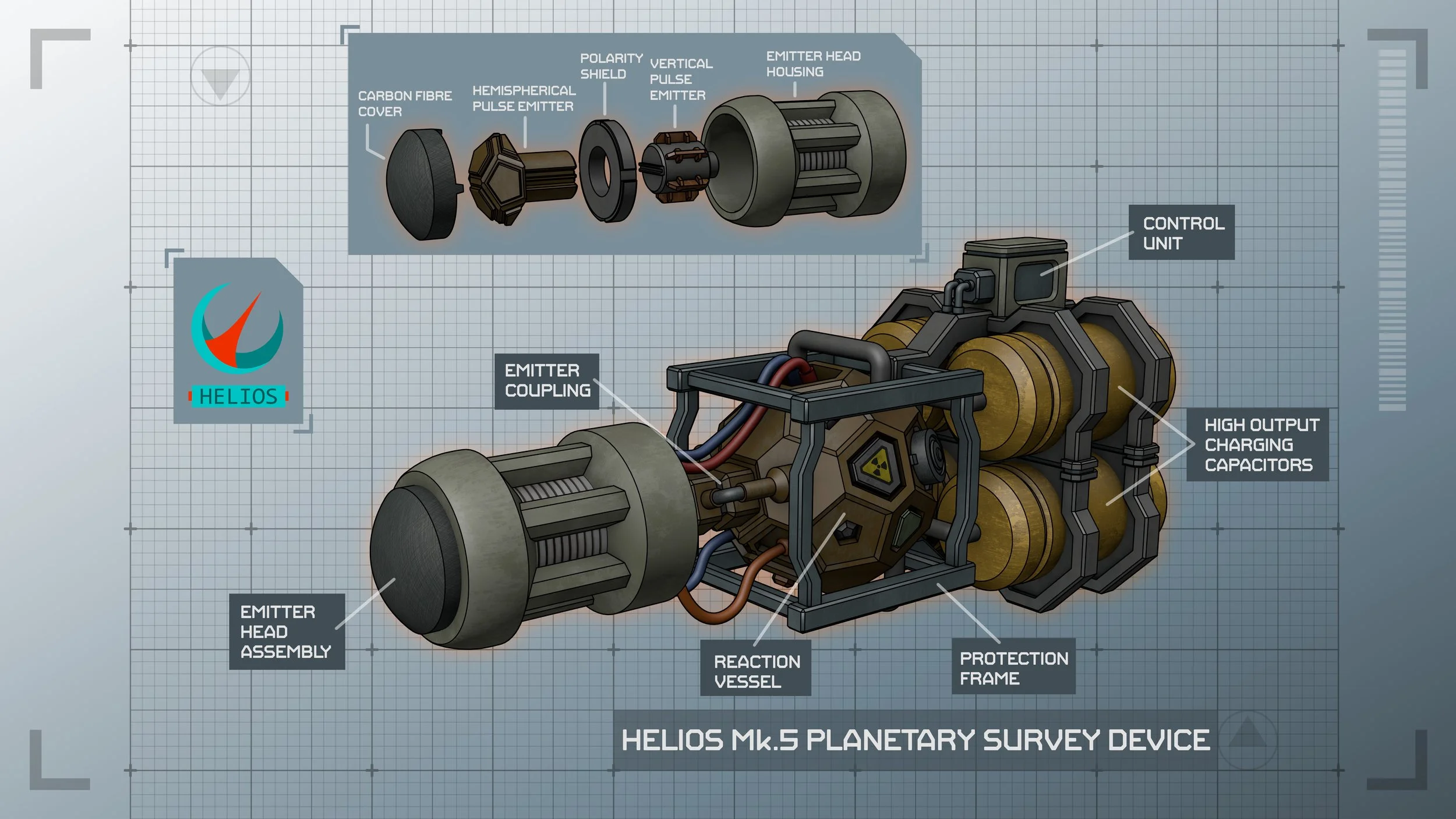
Pulse Salvo
“This improvised device caused immediate and catastrophic damage to the defending HE-V, and widespread damage and system failures throughout the Ellison’s Rise complex.”
Terror at Ellison's Rise! Brazen Attack Leaves Dozens Dead, Site Contaminated
Solare News Network
November 6th, 2385 ESY
Ellison's Rise, Luna
A coordinated terrorist attack on the WegMaCo logistics hub at Ellison's Rise occurred in the early morning (local) hours on November 5th. The result: Dozens dead and many more wounded. The Lunar Security Authority warns that the casualty count is likely to increase in the coming days as this attack marks yet another use of weaponized planetary survey systems by criminal actors.
WegMaCo spokesman Luis Brincombe indicated that the terrorists initiated the attack using a suspected Helios planetary survey device (PSD). The deployment of the device produced devastating effects on the installation, its workers, and its defenders.
Brincombe stated at a press conference earlier today:
"At approximately 0320 hours UTC, our security personnel assigned to exterior patrol of the facility were notified of unauthorized persons and vehicles passing the perimeter near Residential Annex Three. The quick-reaction team moved in to investigate with an HE-V in support, and that is when the attackers deployed an improvised radiological weapon. This improvised device caused immediate and catastrophic damage to the defending HE-V, and widespread damage and system failures throughout the Ellison’s Rise complex.”
Commercial PSDs produce “pulse salvos” of intense electromagnetic, gamma, x-ray and exotic particle radiation. Though highly effective for remote analysis of targeted terrain in quest of lucrative ores, these emissions can damage hardened electronics, corrupt AI memory architecture, destroy HE-V motive systems and cause severe bodily injury upon exposure.
Eyewitness accounts describe a blinding blue flash immediately prior to the onset of the attack. The security team HE-V pilot, contractor Stephan Strauss, was extracted from his crippled HE-V, a Recluse, later by rescue personnel some four hours after the initial attack but later succumbed to acute radiation sickness during emergency LAS transport to Tranquility Medical Center. Independent testing conducted by the Lunar Workers Safety Commission after the incident later confirmed that dangerous radiation levels remain across a two-hundred-meter radius from ground zero at the device’s detonation.
After neutralizing the exterior security team almost entirely, the terrorists, numbering between twenty and thirty on-foot combatants in vac-suits and accompanied by two HE-Vs, stormed the installation. Employees and remaining security personnel fought back for three hours, enduring mayhem and death before reinforcements drove the terrorists from the complex and away to a waiting ship.
The administrator of the Ellison’s Rise complex, WegMaCo’s Carrie Glover, alleges that entire sections have been rendered unusable and uninhabitable from damage, radiological contamination or both in the aftermath.
Speaking to a Solare News Network affiliate on condition of anonymity, a doctor at Tranquility Medical Center has verified the treatment of nineteen WegMaCo employees among the wounded for severe radiation-related injuries, with several in critical condition.
The latest in a series of similar attacks occurring over the past decade, this incident has sparked real concern among corporate citizens and government officials over the continued proliferation of repurposed survey devices in an increasingly turbulent post-Rift Solar System. PSDs, originally intended solely as commercial tools for prospecting and geological analysis, were long ago flagged by security consultants as considerable threats should they fall into the hands of bad actors.
That insurgents have once more managed to weaponize a PSD is not surprising. Such actions have only increased since the intentional development and subsequent military adoption of functionally equivalent devices as missile warheads following the Hughes Station Incident. That costly accident was the catalyst that inadvertently demonstrated the war potential of PSD mechanisms. Considering the tight arms controls and expense of military-grade pulse salvo weapons, the only question for black marketeers is where they will procure commercial devices for conversion into lanterns or glowflies; colorful nicknames for improvised pulse salvo munitions used by both insurgents and security professionals.
A source in WegMaCo’s asset protection division, also on condition of anonymity, disclosed to SNN journalists that the terrorists’ weapon likely originated from a lot of old Helios devices reportedly stored at Prosperity, and implied that Dairo Mining Group collectivists may have sold one or more such devices to the terrorists, or may even themselves be responsible.
Brincombe deferred any other commentary regarding this part of the ongoing investigation, but he did confirm that several of the terrorists were slain during the course of the attack and promised that their origins and affiliation would soon be determined.
For the traumatized survivors of the attack on Ellison's Rise, though, these assurances are cold comfort as this incident is proof that the conflicts raging elsewhere in the Solar System have arrived at Earth’s doorstep. In these conflicts, terrible weapons are increasingly chosen as the tools of choice for fighters with nothing left to lose.
Updated 1101 UTC 11|07|2385: The Lunar Security Authority has placed all settlements within the Mare Crisium administrative zone on elevated alert and is implementing immediate, mandatory audits of commercial survey equipment inventories across Luna.
Contributing reporting courtesy of Jay J. Ashley.
Illustration by Florian Mellies
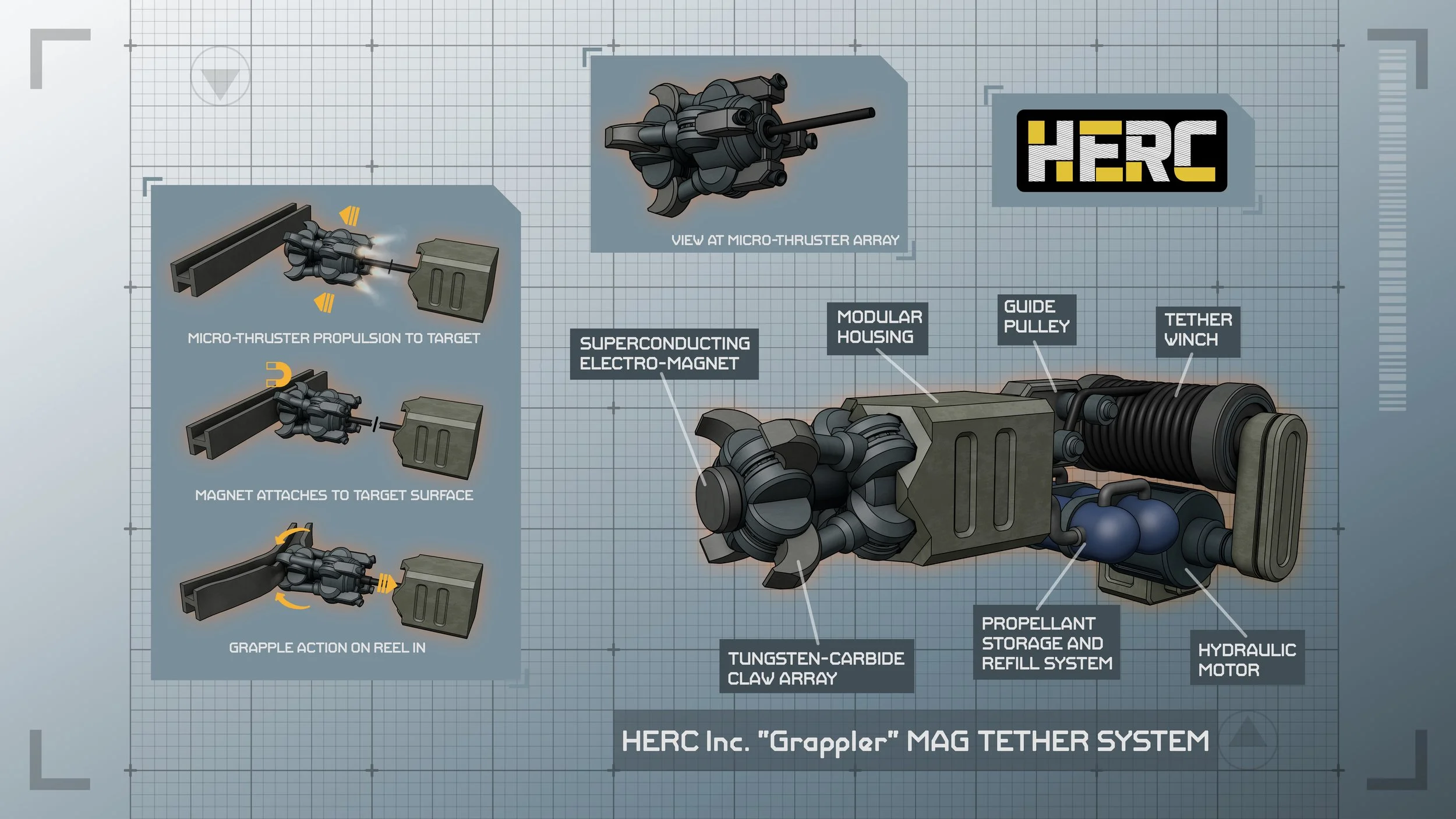
Mag Tether
That’s why I thought of trying the magnet. Strong enough for an ugly tug-o-war. Thought to hold him still and kneecap him, me and Mel working together.
PRIORITY: IMMEDIATE
CLASSIFICATION: SENSITIVE
CBRS Report Cat: DOCEX
CBRS File No: K-3
Subject: Gert Schenk [Deceased]
Subject Affiliation: Dairo Mining Group
Items of Interest: (1) Pamphlet, (1) Transcript
Analyst Notes: Attached material found among subject’s personal effects in lodging. Subject KIA during Prosperity (Jovian planetary system) interdiction contract 13AUG2386ESY. Material collected by CBRS personnel during follow-on site exploitation sweep. Sanitized versions were forwarded to principal (VisalCorp) per contract provisions.
DOCUMENT 1: Pamphlet - HERC Inc. Magnetic Tether System
Stop Wrestling With Lost Productivity!
When you need the very best in HE-V mounted material-handling technology for terrestrial and orbital operations, take hold of the job with Grappler™!
HERC’s latest magnetic tether system provides superior, safe and dependable performance in all operational domains. From temperatures as low as -270°C to as high as 470°C, in vacuum or in crushing atmosphere, and in any gravitational environment, only Grappler allows truly foolproof operation.
Grappler’s magnetic head generates a focused 11-Tesla field to secure ferrous loads weighing up to 50 tons*. Grappler is perfect for positioning structural and spaceframe components, heavy salvage operations, cargo handling, zero-gravity station-keeping, vehicle recovery, and much more! The head assembly is attached to an ICT (integrated conductor-threaded) quad-bonded nanocarbon fiber tether that provides reassuring structural integrity and power transmission from an HE-V's reactor directly to the superconducting magnet assembly.
*dependent on host vehicle capability.
HERC Reminds Users to Follow All Standard Magnetic Tether System Safety Guidelines
NEVER use magnetic tether system for transport of fragile goods, people, or pets. CONSULT a medtech before operating if you have any metallic implants, artificial organ(s), dental pins, or any other ferrous material* in your body, and to make sure you are healthy enough to safely** operate the equipment.
*including iron in hemoglobin.
**Exposure to magnetic fields rated at or above 3 Tesla may cause temporary effects in humans. These effects include but are not limited to: nausea, motion sickness, vertigo, dizziness, spatial disorientation, visual hallucination, involuntary eye movement, a metallic taste, nerve tingling, muscle spasms and altered blood circulation. Altered blood circulation may cause death. These effects may become permanent.
[Handwritten note on reverse face: "Tether OK after shock load test, length @ 50m. Need to double check coupling, fasteners and mount."]
DOCUMENT 2: Transcript of Recovery Agent’s Account
Analyst Comment: Speaker is confirmed to be Jake Caban, freelance ‘recovery agent’ often employed by corporations and various independent organizations. See supplementary report K-3-A.
Mag tethers? Can’t your boss help you with that? Oh, for bounty work? Ha! Hey, sure, sure. Thanks for the drink. Sure. They work better than you might think, if you’ve got a plan. Had a live-catch contract pop up on my desk from Empyrean Reach, ah, what was it. About nine months ago. Get this, mark was a former Cerberus shooter on the lam. Out there and alone, stag. Empyrean wasn’t forthcoming with the backstory. Anyway, last known loc had him doing freelance work out past the Belt under a fake name. No time to parse, in or out, and need to know, right now. Suits, eh? Apparently ol’ Beltin’s fixers wanted to chat with this wayward boyo real bad. So I’m in, I tell him, and I call my bro. No time to put a team together.
Skipping the trace work part, we tracked him to one of the big, old deep space cylinder habitats, pulling security duty for a crew of independents. Drifters, really, one or two notches above thieves if you ask me. Like I mentioned, contract specified live capture only, no excuses. Me and Mel, we hatched a quick plan to sell ourselves as fellow itinerant entrepreneurs. Will work for parts, we said. We were both in modded workrigs - my Breaker, him in the Mason - and on a tramp ship that remora’d out on one of WegMa’s bulkers. Good cover, believable.
They were all working scrap and parts from the exterior of the cylinder and the nearby debris field. Little bit of back and forth, minding our manners, and they told us to come on down. The mark was still in one of those Cerberus models, the kind you don’t see too often. The big eyeball, you know? I wonder how he got away in it? Anywho, he’d tried a fair bit to vis-mod the thing, make it look a little like a Corp rig, but I could tell. We touch down on an exterior pad, and it was time to party.
There’s a trick when it comes to nabbing someone, alive, out of an HE-V. The trick is it's damn impossible. You shoot to disable, it’s still real easy to kill the pilot. You can try to just bum rush, but the fast guys will bolt, not to mention any close fight can go against you. Lots of vets have some damn trick up their sleeve that will punch your ticket at arm’s length. All this, ten times harder in vacuum, natch. Sure couldn’t ask him nicely, hey, turn yourself in! That’s why I thought of trying the magnet. Strong enough for an ugly tug-o-war. Thought to hold him still and kneecap him, me and Mel working together.
Guy was canny, and good. Ready to rock at the first sign of trouble. We announced and rushed him, he was at the edge of the landing grid. The drifter crew bugged out, didn’t want any part. That was good for us. He lit me up with a laser and particle cannon, and a machine gun I think. Nerve-wracking when you’re EVA, believe it. Mel was getting into his side through some antenna mast scaffolds. I think we both had a lot more zero-g time in our HE-Vs than he had.
Yeah. So, I closed in a bit while he and Mel traded, popped him with a four-rack of subs - just to shake him up - and then hit him with the magnet. Fired up the mains and there was no getting that thing off. He tried to run, then! Actually jumped away, drifting, and that cable snapped taut. I was anchored good and had a free hand on a girder. Ol’ girl weren’t budging. He was tumbling all over, a real comedy show. He tried the laser. It was invisible, but there was no missing these glowing furrows it left in the deck. Happily, he didn’t slice the cable. Mel was laughing at the guy - laughing! - as I started talking him down.
Then maybe he realized he couldn't fight back or get away. He ejected. Right there, bap. Bolts blew, the cowl and head flew off and out he came in a little gust of frost. No suit on. Maniac didn’t even have a vac-mask on... He squirmed a bit, then went still. Man, awful. Yeah, my face looked a lot like yours, pal. Mel jumped for him. Risky. Sixty seconds of exposure leeway, maybe we could save him on the ship. Mel reached him, scooped him up. But by the time I reeled them both in it was way too late.
Ended up putting him on ice for the ride home and hauled in his HE-V. Contract paid an advance with liability to cover expenses and repairs, win, lose or draw. Come collect and we’ll stroke you a check! Feh, I’ll pass, thank you. Ol’ Empyrean ain’t so understanding of failure with little people like us. I sent the body and the HE-V onward, care of, and jumped ship halfway to Mars.
[Handwritten note in margin: "T, I told you. This can work!"]
Illustration by Florian Mellies

Claim Rights
The broad, beveled, monolithic strikeface of the hammer was scarred and pitted from the abuses of countless strikes delivered during countless shifts. It was already an old tool long before it came into Orin’s possession, and he had put on plenty of his own work over the years.
September 4th, 2381 ESY
Manchester, England
Orin watched the rolling aurora dim as the inky sky sluiced away, turning first indigo then orange and finally blue then bluest. A rare clear morning, but the cobwebbed scratches on his HE-V’s canopy fuzzed all the colors pastel. Cool dampness reached him through the cracked hatch, either evaporating dew or the promise of rain. The damp-fresh smell was tainted with the tang of biodiesel exhaust from the eight-wheeled truck’s creaking engine, parked nearby.
Inside the cavernous assembly building to his right, four friends hustled around in their protective suits. Davis, Sarah, Farhan and Geoff. The satin fabric of each suit was patched with reflective, metallic tape and plenty of prayers. All were busy gathering supplies and pulling the fiber optic cable runs they’d been sent to collect.
Davis radioed as he walked out with a bundle over one shoulder and rifle slung over the other. “Anything from home yet?” Tinny squeals and crackling static intruded over Orin’s headset speaker. The solar flares were intense. Without their suits, those same flares would in time boil his friends’ exposed skin. The radiant warmth would feel pleasant, at first, on such a cool day.
Orin keyed the headset mic. “No, air is bad. I’ve tried them twice. No joy.”
“Okay, then. Just as well. We’ll be ready to head back in a couple hours.” Davis tossed the bundle into the truck’s bed and turned toward the building.
Orin threw him a wave with his left arm inside one of the chunky, articulated master sleeves that translated his movements to the HE-V’s arms. The ramshackle machine waved one blocky arm at Davis in kind. Orin’s “Rooster” was a racecar-red Pitman body, checkered with rust, on a pair of tan, refurbed military legs leftover from one old war or another. Ungainly and desperately maintained, the old bird still got the job done.
Orin loosened the curled fingers of his right hand slightly. The Rooster’s hand relaxed also, and the pommel of the impact hammer slid to the cracked asphalt with a metallic bang. The broad, beveled, monolithic strikeface of the hammer was scarred and pitted from the abuses of countless strikes delivered during countless shifts. It was already an old tool long before it came into Orin’s possession, and he had put on plenty of his own work over the years; breaking down and breaking in, and occasionally breaking skulls when fellow scavengers didn’t mind their manners.
Orin pressed and held left index finger to base of thumb inside the control gauntlet to desync and then reached for his tea. The Rooster’s reactor hummed, healthy and steady, and he was relieved that most of the caution and status lights on his boards stayed dark. He sipped and scanned, alert for any signs of movement among the buildings cloaked with creepers and ivy on either side of the highway fronting the complex.
If anyone happened upon them and if words failed to dissuade he’d rely on the hammer and his other weapons: the stubby howitzer pulled from a broken-down tank with six fat shells in its autoloader, and the shabby eight-tube rocket launcher of dubious trustworthiness perched on the Rooster’s shoulder. Four of the launcher’s tubes were empty. Of the four loaded ivory-colored rockets, two leaked an acrid yellowish oil from creases in their casing. Farhan was a military man, and assured Orin months back that they may not launch but were safe enough to carry. Orin privately doubted this assertion.
Just then he spotted a cloudy haze to the southwest, and watched as it turned onto the vast asphalt apron from the highway. Orin squinted. Two vehicles, a military truck, and a flatbed tractor. Men rode the latter. Some carried rifles. Behind them at a jog came another HE-V, smaller than his own monster and almost as janky. Faded black and yellow hazard stripes lined its limbs. All were coming their way.
Orin hurriedly dropped his insulated cup into the holder, half stood to fully dog the hatch and hastily resynced before keying his radio. "Hey! Hey, hey, we got people!" He stammered.
“Folks from Blackburn?” Davis asked back, his tone desperate, hoping it was friends or at least decent neighbors.
“No, I think not,” Orin replied and squared up to the onrushing strangers. He lifted and took a two-handed grip on the hammer’s haft, one mechanical hand high, one low. Feedback from the sleeves rendered its prodigious weight still hefty in his flesh-and-bone hands.
The vehicles stopped some hundred yards away. Men piled out and scattered, taking up positions in what cover they could find. Among them were many rifle barrels. The other HE-V advanced to the fore, and now Orin could see a multi-barreled gatling gun rigged to its right arm. The left arm was an enormous, articulated jackhammer.
The other machine issued a long horn blast and its pilot radioed on an open channel. "This is our patch. You thieves are trespassing, mate. Shut down and surrender, or we shoot." A woman’s voice. Surly. Serious.
"It's nobody's patch, now, friend. We’re just trying to go on living, same as you. It doesn’t need to be like this," Orin replied coldly.
"Have it your way."
The other HE-V raised its gun and fired. A track of exploding concrete raced toward Orin, and he triggered his howitzer reflexively. The Rooster was shoved back in a billowing cloud of smoke and Orin could not tell if he had been hit or not. The howitzer shell dropped long, a little behind the other HE-V, but the blast was close enough to send it tumbling forward and explode the smaller truck in a fireball. Rifle bullets pinged all over the Rooster’s inches-thick steel hide.
Orin switched firing circuits and tried the rockets, going for the knockout. Only two leapt away and exploded on target. One drunkenly spiraled off to impact somewhere across the highway. The fourth was a dud. His friends were shouting over the radio, but adrenaline turned their words to babel. The hostile HE-V was regaining its feet shakily, leaning on the jackhammer.
Orin pushed forward, sending fifty tons into a brazen charge as the howitzer’s autoloader clanged through its lengthy reload sequence. Reaching his foe he slipped right, planting his feet, rotating, and bringing the impact hammer way, way back just as his enemy’s gun rose again to meet him. The Rooster swung together with its pilot.
The massive head of the hammer smashed through the opposing HE-V’s left arm assembly at the elbow joint and crumpled its left flank like balsa wood. A dazzling sheet of sparks bloomed as the terrible cacophony assailed Orin’s ears. He felt the transmitted jolt of the hammer’s kinetic assist module and flinched at the destruction unfolding mere feet beyond the Rooster’s crystalloy canopy.
His enemy was hurled away from the colossal impact as if an archangel had descended to smite her. Sparks and fluids trailed. The striped machine landed hard and skidded, hull shrieking, over a low concrete barrier, grinding it and the men sheltering behind it to slurry. The wrecked HE-V smoked and smoldered but did not move again.
Orin spun in place, confronted by a trio of men with rifles raised. Brave or desperate, and too close for comfort. Orin raised the hammer high. The head’s shadow fell over the three like an eclipse and they quailed, eyes wide with primal terror, before quickly throwing down their rifles and shrinking away from the Rooster like the ants they were.
Illustration by Florian Mellies
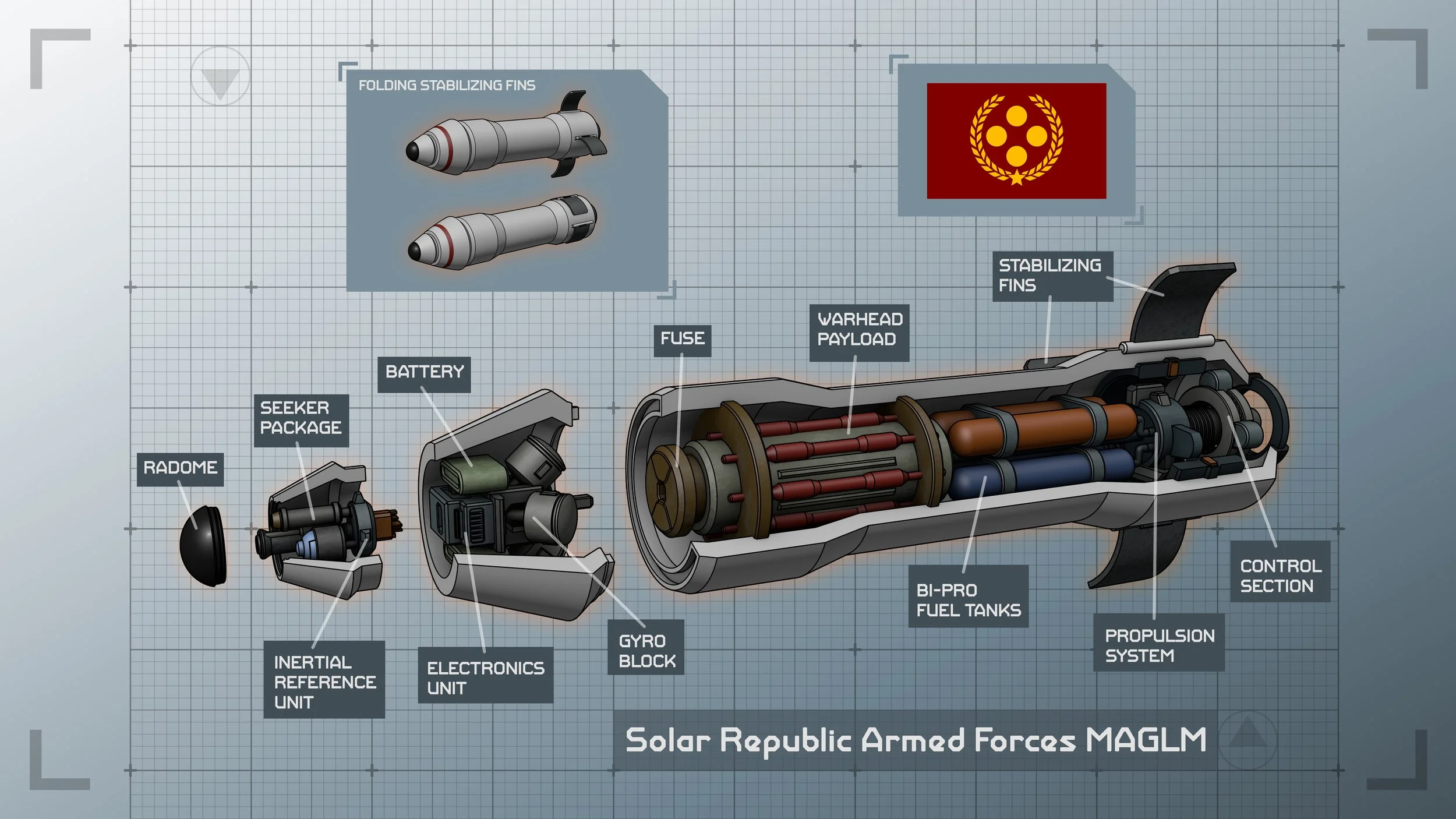
MAGLM Missile
The MAGLM’s warhead is optimized for armored vehicles and structures, but will auto-select for soft targets or limited area saturation as needed. Direct, top, offset or loitering attack decisions are likewise made by the missile’s brain.
Solar Republic Armed Forces Archives
Armor Corps Training and Testing Center - ACTTEC
Munster, Germany
Lecture Segment: Advanced HE-V Weapon Systems - Missile Employment
Instructor: Commander Mike “Kicker” Hoxie
Date: <REDACTED>
Good afternoon, pilots. Resuming where we left off from yesterday. Decisioning. In the field, you’ll have aboard your HE-V you’ll have every resource needed to accomplish the mission at your disposal. Expending these resources wisely will win you the day. Squandering them will put the mission, and the Republic, in jeopardy. Choosing when and how to employ your weapons is chief among your responsibilities, and among all the weapon systems you can carry, the most versatile, powerful and expensive are your missiles.
You’re on the hook for every launch authorization. So pay attention. Let’s begin with a historical overview of guided missiles. They’ve been a staple of warfare for three centuries now, with the first combat-effective models emerging in the mid-20th century. Damned crude by our standards. Simple rocket motors, basic radar or infrared seekers, uni-charge warheads. Real fire-and-forget capability was the goal in the early years. For decades, high accuracy demanded constant input and correction from the launching platform; fighters, ships, so on.
Nearing the end of the 21st century, guidance and maneuverability was much improved. Hybridized navigation systems. AEG-fueled motors, fulltime datalinks. High resolution seekers that could differentiate subtle nuances in target profiles. We see here, too, the first multi-mode attack profiles. In the mid 22nd century, the state of play changed again. Composite fire control systems paved the way to superior pre-launch routing, and most state-of-the-art missiles around here first employed multiple coprocessors for true onboard intelligence.
Still pretty dim compared to the ones you’ve got, but they were the first decision-maker missiles that would proactively counter evasive maneuvers or other target defenses. This capability was enhanced further by the use of improved bi-pro fuels and pulse-detonation motors; throttlable, restartable, and programmed to burn or conserve as needed to ensure a kill. These birds were sophisticated enough to select their own attack vectors and coordinate with other, compatible missiles in flight.
The end of that era marked the beginning of the brilliant missile age, our time. Modern missiles, the ones you'll be launching and defending against, are vastly superior by an order of magnitude to anything any army has deployed prior. The current model MAGLM you’ll field uses a seeker package combining radar, laser imaging, infrared, and visual profile recognition, with all modes capable of crosscheck across a friendly battlenet. That means that if one, or even all, scan and track modes are nullified, the missile will still figure out how to reacquire the target as long as it can communicate with another node on its network, be that a friendly missile, the launch vehicle, a forward observer… You get the idea.
The MAGLM’s warhead is optimized for armored vehicles and structures, but will auto-select for soft targets or limited area saturation as needed. No man-in-the-loop needed, but you can override as required. Direct, top, offset or loitering attack decisions are likewise made by the missile’s brain. When you receive the launch auth request, all you have to do is pull the trigger and so long. Right? Isn’t that nice..?
Wrong! Big time. These munitions are, without question, the most sophisticated guided weapon system ever devised but they pale next to the ultimate weapon: you. Working together, your HE-V, the missile, and the battlenet will solve for all aspects of the tactical equation: where is the missile going, what is it targeting, when does it need to get there and how to deconflict or coordinate. But it is up to you to assess whether the launch is prudent. Only you can factor in the intangibles: the tempo of the fight, the strategic situation, the cost-benefit.
Oh yeah, you heard me. Listen very carefully. Missiles are expensive. Every single missile matters, and you are accountable for every one. War is, has always been, about logistics. Remind yourself of that. Your commanding officer isn't going to pin a medal on you when you waste three brilliant missiles on a convoy of trucks you could've smoked with your guns for a fraction of the cost. Your company quartermaster may well strangle you.
Your HE-V’s AI combat controller will always look for ways to do the most damage as quickly and as surely as possible. You’ll get lots of launch requests, just like a needy girlfriend. Can we go here? Here? How about here? Here sounds good! Rookie pilots will always try to make her happy, authorizing every launch request the second it pops up on the HUD. Launch, launch, launch, treating missiles like common bullets. Tsk. Don’t laugh, I know who you are; I’ve seen your simulator logs. You won’t last if you don’t break that habit. You’ll be relieved for negligence or wind up dead.
Your missiles must be shepherded, saved for when precision, standoff, or overwhelming firepower is required to crack a hard or dangerous target. Usually that’s another HE-V. From a tonnage-to-versatility perspective, missiles are unmatched. Use them to do the things your other weapons cannot achieve. Use them as personal fire support. Or team fire support. By all means, loose a bird to save a friend in need. It’s far simpler to launch on an immediate request and maintain focus on your own engagement, rather than attempt a breakaway to reach a teammate.
Now, they are not foolproof. We, and the few militaries that can rival the Solar Republic’s, fit HE-Vs and many vehicles with defenses designed to defeat them. You must endeavor to understand these systems to both employ missiles effectively and protect yourself from them.
First and most common: submunitions. Typically shoulder- or turret-mounted, they fire airbursting bomblets that make clouds of fragments or flechettes. You ever hunted birds, or shot clays? Same thing. Think of it as a shotgun blast in three dimensions. Targeted missiles are damaged, or more rarely, destroyed. Usually seekers get blinded, or propulsion or steering ends up compromised. The missile then goes off-track or is forced to detonate prematurely.
The other major countermeasure is proper anti-missile systems. Point defenses, PDWS, CIWS. These are automated turrets, usually superposed volley guns or small pulsed lasers, that engage incoming ordnance when it reaches the terminal phase. Invariably they are set to full automatic operation and are commanded by an HE-Vs combat controller. That’s the only way they can engage quickly enough. Acquisition and tracking happens in fractions of a second, and a good PD suite can intercept multiple threats, but only high-angle ones.
You must factor all of this and more when deciding to engage. Here’s the takeaway, gentlemen: Out there, in the field, you won't have me and your other instructors watching when the request pops up. You'll have to make the call, launch or abstain, and there’s always more to consider than just destroying any given target. Think carefully, but quickly.
That’s enough for today. You are dismissed.
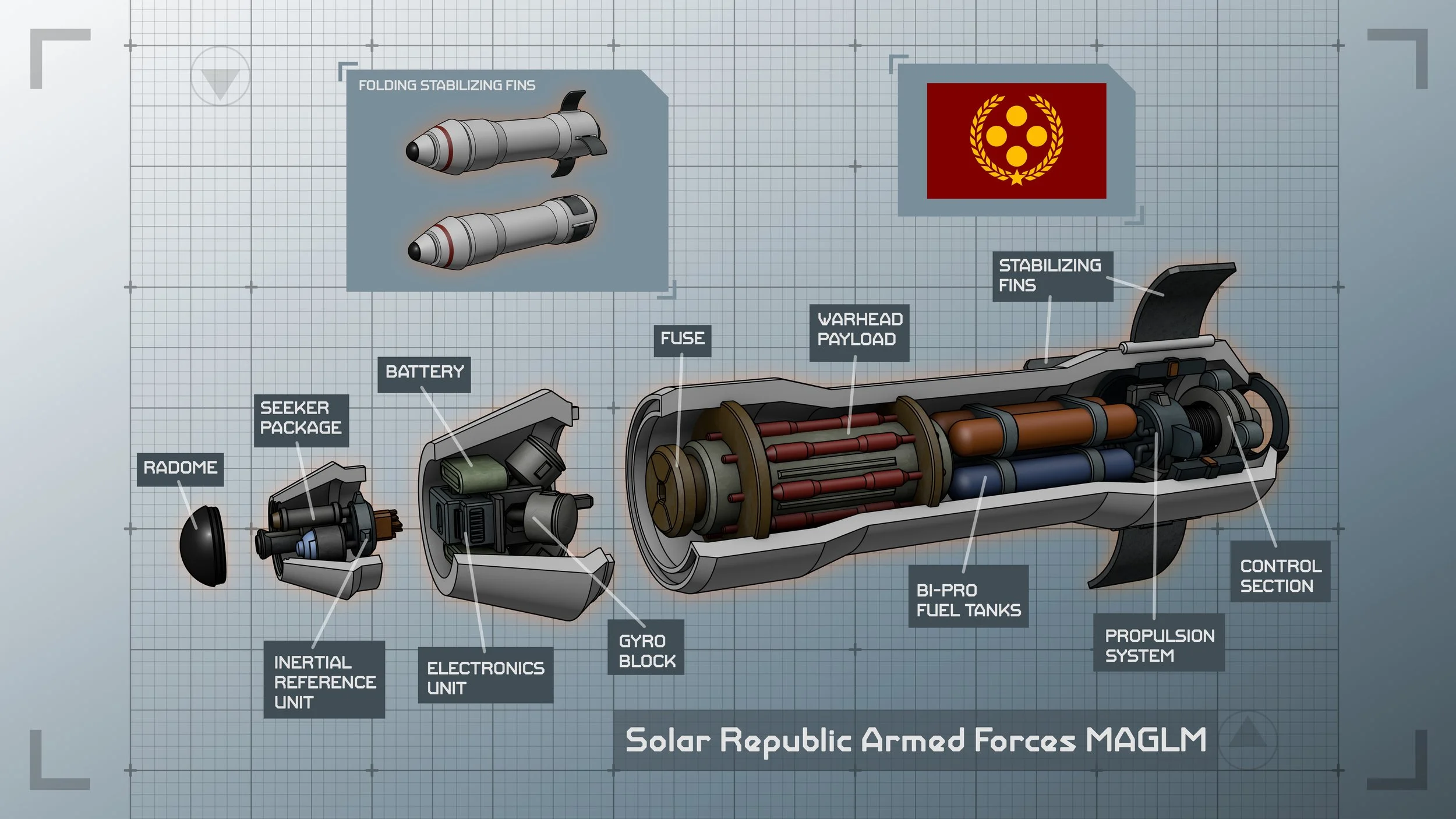
Illustration by Florian Mellies
By The Numbers
Clark’s team was outside again, Espinosa with him. His HE-V’s telemetry showed a potential failure at fifteen forty-four and sixteen seconds. One monitoring employee had flagged it and opened a channel before the caution alert blinked on at twenty seconds.
Yusef woke, sat up and listened. He listened for any alarms, near or distant. For the groaning of fatigued metal pushed to failure. For the bang-crash of a blown lock. He listened to his own heartbeat, reassuringly steady. Every morning, this secular ritual. He slipped on his boots, left his quarters and padded to the scrubber systems bay to check the board. The same as he did every morning.
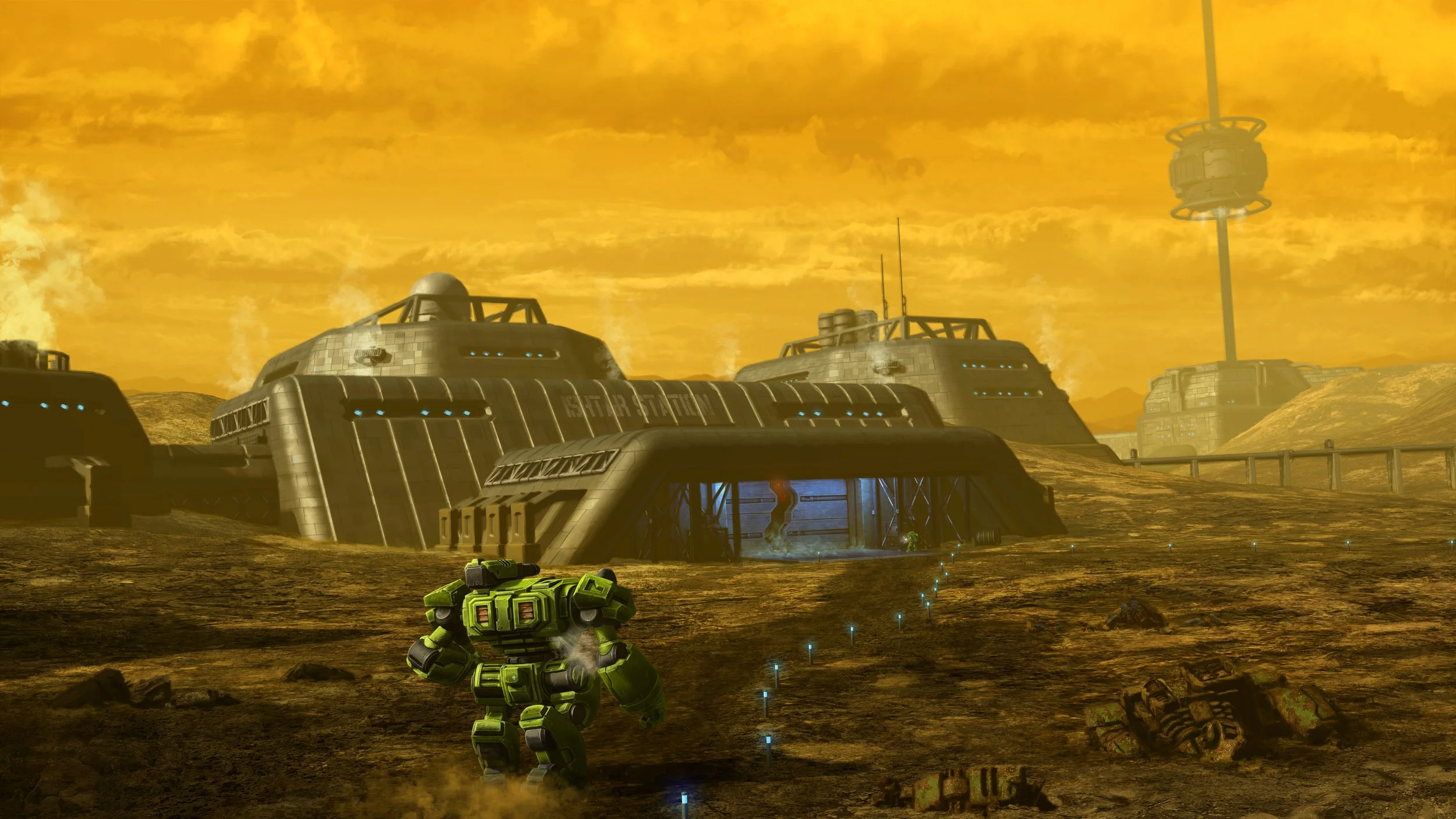
The scrubber board showed the status of thirty living-membrane panels. Each panel, securely nestled in a filtration manifold near the installation’s core, was a slab of engineered biological material supported by a sterile metal frame, roughly four times the size of a big mattress. These panels scrubbed CO2 and other contaminants from the air inside Ishtar Station. The status light glowed the only acceptable color: green. Green, the color of reassurance. Yellow was the color of irritability and headaches. Red the color of sickness and probable death. In the nine years Yusef had been living dirtside on Venus, the light had only ever turned red once. But people still died even when it wasn’t.
With this most important task complete, he returned to his room and terminal to check atmospheric pressure outside the installation’s hull. Then he checked the clock, and then the temperature in his hab block. The same order, the same way, every time. The hab temperature was troubling: still two degrees warmer than was set, as it had been for the past two weeks. No one had figured out or could explain why. That had some on edge. Yusef knew it had kept one of his subordinate enviro technicians lying awake and working through possibilities long since exhausted.
But a green board this morning. No alarms. No death. A good day so far. He exhaled deeply, turned on his hot water pot that was one of his few in-room luxuries, and fished a packet of instant coffee out of the small cabinet over his desk. Yusef stirred bitter powder into scalding water, sipped, and let the ambient noise of the installation work through him in the darkened room. He would allow himself these fifteen private minutes before he washed and dressed for his shift.
—
The canteen was as busy as ever. As busy as always. Third shift coming off, first shift going on. The ceaseless, endless churn of fifty-odd people among the two-hundred souls who called Ishtar Station home. The same faces, the same times. The same long tables and dim serving counter. The counterfeit aromas of ultra-processed food, and the tinny reek of too-often recycled cooking grease. Day in and day out. Reassuring. Mind-numbing. Sometimes the seating arrangements changed. That wasn’t often.
Yusef found his usual seat beside Clark, one of Ishtar’s senior exterior maintenance personnel. The man ate his usual beige “oatmeal” porridge with mechanical enthusiasm, not quite looking at it. Clark was thirty something, but his face was so lined and weathered from latent stress it resembled the acid-etched slopes of the basalt hills beyond the murk outside. The clatter of Yusef’s tray and silverware on the table was greeting enough for both men.
"Scrubbers okay?" Clark asked without looking up.
"Yup. Ninety-six percent."
"That’s good. What happened with that culture dieback the other week?"
"Don’t rightly know. It healed though, clean bill of health," Yusef sat down. "Upper is, I mean we’re, checking them all today. The substrates and mothers. It's been two years since the substrates were checked."
“Hm,” Clark made his sound that meant noted.
Behind the table where breakfasts and dinners were finished was a reinforced porthole of transparent laminated crystalloy, six inches thick. A clear disc holding Venusian pressure, corrosion and temperatures at bay. Ishtar Station’s interior was a pleasant seventy-one degrees; the surface outside an endless, nearly nine-hundred degree inferno that looked nothing like the brimstone Hell of Christian tradition.
The ever-present fog seemed lit from within, somehow, a sickly yellow-orange that pressed on the rim of the porthole, held back only by the meager, bluish lightstrips of the canteen. The oppressive haze of Venus' surface permitted no real sunlight, and no horizon. At ninety-three bars of pressure, the atmosphere near the ground behaved more like a liquid than a gas. Any failure of suit or seal or lock, the briefest exposure, for even a microsecond, meant certain, gruesome, mercifully instant death by crushing. A man wouldn’t even know he had perished at all.
Beyond the gloom, the plains of Ishtar Terra stretched away, broken by the distant, fanged shapes of primordial basalt formations. Ishtar Station had been here for a hair over a century but you couldn’t tell from its appearance. The exterior pressure-wall coating was laboriously refreshed every eighteen months with new biopoly sealant; another of the many products gleaned from the secretions of the extremophile chemoautotroph microbes living thirty-seven miles above them. Microbes that were harvested by the aerostatic arcologies held aloft by their vast balloons of breathing air, where the sky was open and the temperatures comparatively mild.
Yusef had been up to the nearest arcology a few times. Twice for medical evaluations, once to consult the scientists regarding irregularities with one of their crops. Each visit, he’d stood at the luxuriously wide observation windows for a long time, looking out at the roiling clouds below and the open, clear sky above; sky was something he’d started to forget existed, conceptually.
A bland, computerized voice announced the time. Yusef hurriedly finished his breakfast and bid farewell to Clark. A bell from the arcology was due to arrive at ten-thirty hours standard and he had errands in the meantime before the arrival of a visitor. Descending the miles-long, specially treated graphene-composite tether from the cloud deck like a huge elevator, the pressurized capsules delivered vital cargo and personnel down through and up out of the thick, hot, crushing atmosphere. The maintenance and monitoring of the bells and their cables was attended to, above and below, with religiosity.
—
The nearby receiving dock, connected to Ishtar Station by way of underground tunnel, was one of four such facilities serving Ishtar Terra’s installations. People, consumables and replacement components, the latter often needed, were either manufactured in the few remaining orbital facilities or shipped in from elsewhere, usually Mars. Yusef was at the dock when the bell arrived to greet Dr. Nikki LaRue, one of Selegin Corporation’s newly attached xenobiologists. She was here for a scheduled inspection of the station’s bioreactor cultures.
Inside the cavernous subterranean space the bell vented a halo of gas as it pressurized, equalized, and finally slid open its massive hatch. LaRue emerged, self-consciously tailing the clutch of rawboned, veteran surface dwellers returning planetside. Yusef recognized her manner, common to first-time and infrequent visitors: taut glances at the walls and ceilings, anxiously holding her breath. Understanding the risks of the surface, and actually being on it, were two different things.
Yusef strolled out of the now-open vestibule to the foot traffic ramp and tried to greet the doctor with a warm smile.
"Ah, Chief Yusef. Hello. I’m Dr. Larue." She extended a hand.
"Doctor," Yusef shook it. "Welcome to the surface. First time?"
"Only my second. The last was years ago. First time to Ishtar Station, though." She found Yusef’s smile wan, almost uncanny. It struck her as ill-fitting, like the man rarely used or needed it.
"Very well. Come on, then. I’m sorry, but safety orientation will be mandatory in that case. I'll take you through it back at the complex. Won’t take long, I promise."
Dr. LaRue masked her annoyance and discomfort with a shrug and forced laugh. Extensive safety briefings for surface visitors had been mandatory everywhere, as far as Yusef knew, since forever. Long ago, before his time, a logistics consultant sent down to one installation had assumed that the sounding of an emergency integrity alarm was only a drill, and had remained in a vulnerable corridor when the subsequent breach occurred. The aftermath of the incident, and exhibits of the doomed consultant’s pulped, burned remains, had been integrated into every orientation package since.
The two boarded a small, motorized cart for the short trip back to the complex. Once there, in a cramped classroom, Yusef watched the safety video with LaRue, demonstrated how various standard emergency systems worked, and instructed her on marshalling procedures in case of various incidents. The xenobiologist's composed expression didn't waver.
"Last thing, exterior travel. It shouldn’t come to that on this trip, I hope!"
“Please, no!” LaRue said with false cheer.
"HE-Vs or hardsuits are the only options for anything outside. If you aren’t in one, you die. Inside the hull, at the perimeter compartments, hardsuits mandatory for work in any area not rated triple-redundant. We don't let anyone walk or work outside the hull without a certified rating and a sign-off. Do you by chance have-”
“No, no need up there. I work in a lab,” She flicked her eyes up toward the ceiling. “And I don’t suppose there’d even be time to put on one of the suits, would there? I’ve read about the other accidents."
"Eh, well. One never knows, it’s best to be prepared for all eventualities here. But if you aren’t certified they won’t be any good, anyway. Best to sit tight and wait for help," Yusef said, pleasantly.
LaRue looked at him blankly for a moment and then smiled, briefly. With the safety brief complete, they headed deeper into the complex.
—
Despite the bigness of the term, Ishtar Station’s bioreactor bay was a small room, smaller even than the spartan, workmanlike lab Dr. LarRue typically haunted aboard Selegin’s Aerostat-Seven. The space hummed with the low, continuous sound of ventilation fans and computers. Glass and composite tanks lined one long bench, and a larger, shiny, solid tank sat at the end of the room.
These tanks each contained an environment suitable for cultivating, sustaining or otherwise developing Venusae sulfurokytos. The cloud-dwelling microorganism that now motivated, and made possible, continued human endeavor on Venus. Most groundside inhabitants called it the germ.
LaRue moved along the tanks, tablet in hand, with sharp, professional attention. She’d already spent some time pulling readouts, and carefully extracting and cataloguing samples in vials. Yusef waited out of her way, answering what questions he could.
"If the temperature drift continues on number three, you'll see a drop in yield. Slightly. The culture is still compensating. See the metabolic dip, here?” Yusef made a show of looking at and failing to understand the complex chart on LaRue’s tablet, brow furrowed. “The organisms are working harder than they should be."
"Oh."
She continued her checks, made more notes. It was some minutes before she spoke again. "The arcologies are shipping cultures at full capacity now, yields have been excellent for the past six years."
"We know." Yusef kept his voice even.
"HQ wants more, and we need all hands on deck for the increased production. I understand there have been setbacks here, but every scientist that has to make a trip down for basic troubleshooting is one we won’t have topside for a few shifts," LaRue seemed pained, almost sheepish. “These issues should not be insurmountable with the resources at your disposal. You understand, don’t you?”
“I see. Well, doctor, no one here has the expertise to tend to the germs should the vats fail or deviate. We watch them, we record the data. We can resurface the scrubber membranes with a completed batch of film ourselves. That’s all. If taking someone away from their duties above is too great a burden, I might request the administrator to ask HQ to post a scientist here, fulltime. I understand the duty usually goes to the junior personnel...”
A chilly silence solidified between them.
—
Clark's crew was heading out at thirteen hundred hours. Yusef, other duties tended to, watched them depart the yawning bay doors from the operations center’s exterior camera feeds: three HE-Vs moving out, slowly, in a line across the cracked terrain. Rotating marker lights glinted off their hulls, each coated in long-wearing, hi-vis fluorescent green. The lead rig was Clark's Breaker, a heavy industrial machine that had been on Venus for twenty-two years, and survived much. The most memorable incident was a harrowing fall into an underground lava tube that had collapsed beneath it. Clark had lived, self-recovered, and refused to elaborate about the experience.
Looking over the shoulder of the seated dispatcher, the exterior temperature displayed in the corner of the monitor read 871°F. Pressure 89.2 bar. Wind, negligible by Earth’s standards, hardly a breeze. On Venus, at this pressure, a few miles per hour meant substantial force, enough that it forced the HE-V pilots to compensate and carefully plan each step, lest they tip.
Yusef scanned the neighboring monitor, showing the HE-Vs' telemetry. Pilot vitals, reactor status, hull integrity, more, all updating continuously. The employees at the monitors watched intently for subtle deviations that might give advanced warning of any developing problems. Catching them early often saved lives, and hardware.
Clark's crew would be out for roughly four hours. About normal. Their job was to replace exterior stanchions nearing the end of their service lives along the complex’s southern pressure hull. Work parties were planned around getting the job done quickly and efficiently: time outside accumulated stress on the minds of workers in ways that weren't immediately apparent.
Yusef stretched as various personnel spoke quietly into their headsets. He glanced at an old photograph on the wall of the operations center, framed behind scratched plastic. It showed, from orbit, Venus against the black of space, and in the foreground, between the camera and the planet, the vast, skeletal span of one of the old Helios Corporation orbital construction yards.
Those sprawling orbital docks and shipyards were once the beating, industrial heart of the Dyson Swarm program way back when. Venus' location, convenient to Earth but closer to the sun, made it the obvious staging point for constructing and then slingshotting modules and cargo towards the array site. The yards, in total, were the largest artificial structures in the solar system until the array itself was completed: all girders, spacebays and pressurized work modules, each thousands of meters long and tall.
After the Rift, most of them came to ruin. Some were parted out, salvaged. Many more were left to decay in orbit or were shredded after falling into Venus's atmosphere, accidentally knocked or, some said, deliberately pushed. Some of their parts lay even now on the surface, twisted, melted, partly-ablated sculptures of steel and ceramic, scattered across the planet like whalefall bones. Yusef heard, on good authority, that squatters, criminals and other people of dubious character inhabited or hid among the remaining yards.
His mind wandered next to the old HE-V wrecks dotting the landscape near most of the surface installations, and he could not stop himself from fruitlessly looking out of the ops center’s panoramic window into the murk. There were about forty such wrecks, most from the initial surface colonization phase, abandoned where they and their brave pilots fell. Expensive machines, cutting-edge by the standards of their time. Half-buried in dust, hulls long since corroded to husks, their cockpits open to the opaque clouds. Surface work teams that had cause to go by them always gave them a wide berth, treating them with some combination of superstitious dread and reverence; reminders that other men had worked and died here, that even HE-Vs were better suited to hard vacuum than this inhospitable Gehenna.
Clark had told Yusef once, early in his time at the Station, that the old wrecks were monuments, reminders of the blood price that must always be paid in purchase of mankind's mastery. The same payment was made when he first roamed the savannah in animal hide, spear in hand. The same payment for the raising of the first skyscraper. The same as when he’d first sought the stars.
Yusef thought Clark was probably not okay back then. But since his own long stay on the surface, he’d come to see, and admire, Clark’s essential wisdom and thought about it a lot. He blinked out of his reverie and left the operations center.
—
Yusef tried to visit the sunlight spa every day, as was technically mandatory.
Each compartment of the spa was three smaller rooms: an antechamber for dressing and undressing; the main chamber with its simu-spectrum lights, immersive screens and controls, big enough for a few friends; a washing room at the far end. The lights were very good, expensive, calibrated to perfectly replicate the solar spectrum as received on Earth's surface on a clear, bright day. Temperature and humidity in the main chamber were both adjustable, capable of simulating the cold of winter in the northern climes or the blazing but still pleasant heat of summer at the equator.
Twenty minutes per session. Most crew went twice a week as they could. Yusef and others went every day, treating it the same as any other critical systems maintenance task. Just like the maintenance of scrubber membranes or other life support systems.
Yusef had only a short wait today, and spent the time chatting with Espinosa, one of Clark's pilots. Just twenty-six and only two years groundside, Espinosa was on Venus to work off the substantial private debt he’d incurred from commercial HE-V pilot school on Luna. The young man was still in the phase of adaptation Yusef thought of as enlightenment. Some grim lifers among the crew called it the yips.
Always destructive, it was the phase when the novelty of being on Venus, not above it, wore off and the daily reality of permanent surface residence took hold. Sometimes it got pretty bad: A glassy stare, dangerous levels of distraction, forgetfulness, irritability, a precipitous drop in personal hygiene indicative of declining will to live. Sufferers were kept under constant watch by fellow employees, and especially security personnel. Rotating out, for any reason, was rarely possible.
"My sister asked me, when I shipped out, when I’d be coming back," Espinosa said.
"What’d you tell her?" Yusef asked in response.
"I told her four, five years. Maybe.”
"That true?”
The young man didn't say anything for a moment. "No. I didn’t get top marks. No sponsor, nothing like that. I have to pay it all back, and this is the only billet I could get. Gonna take a decade. But it’s worth it, you know? For a better future. HE-V pilots are needed everywhere. This is just the first chapter. Paying my dues." He looked sharply at Yusef, and though he smiled Espinosa's eyes were brimming with despair. He looked close to tears.
"After a while it gets easier. Focus on the day. One day at a time."
Yusef had not lied, exactly. The sharp dislocation did eventually dull. The ache for blue sky and open horizon, a profound longing not even known by spacers, faded to something more tolerable. For most. Smart ones lived by and worshipped their routines. They built relationships with the two-hundred some souls to form an emotional horizon to orient against. They found meaning in their work, and if they couldn’t they Stockholm’d themselves good and hard until they loved it. Smart ones reminded themselves of the stakes. Every job at Ishtar manned the perimeter, the boundary, between life and lethal.
Espinosa’s despair seemed to retract all at once as he looked down to the deck between his feet and exhaled. Concealed or abated, the older man couldn’t tell. He looked up at Yusef again, and asked earnestly. "Maxwell Base. Clark says that crew doesn’t like us. Old static. You know about it?"
"They like us fine. They don’t hate us."
"Which is it?"
Yusef considered how to frame this bit of Venusian lore. "It’s irrational. Like a rivalry. During the bad years, the Rift's worst decades, the aughts, supply runs to Venus had dropped to near nothing. Even the arcologies had sustained only with some difficulty, and they tried to help where they could, but the groundside facilities all suffered pretty terrible. Hell, Ishtar had to go a stint operating twenty-three months on half scrubbers. Seventeen people died of respiratory failure.”
“The Max fared worse,” Yusef continued. “The corporate operator, a smaller firm back then, closed now, had just written it off. The employees were terrified and desperate, left alone too long. They lost over two hundred people. Lack of basics, and environmental problems. Supplies didn't reach them in time, that on top of some critical failures. Ishtar, then, we were luckier. Maxwell begged us for aid, and the administrator, ours, Ishtar’s, turned them down. There were threats, a raiding party came out, but it didn’t work. More died. It made for some bad blood, lasted awhile.”
Espinosa was quiet. He looked troubled. A door in the sunlight spa opened and the previous occupant came out, blinking and flushed.
"Yeah. Yeah, that would last. Damn, Yusef."
"The surface installations have their own histories. All the people from back then, they’re gone now. The stories still have a way of riling some people up. No different than anywhere else in the system. Same thing happened everywhere. ‘Cause of the Rift."
“See ya later.” Espinosa got up from the bench and walked toward the open spa. Yusef soon enough entered his own. A long soak, dinner, more checks, then to bed.
—
The next day came and the morning was uneventful. Later on Yusef was back in ops, watching. Clark’s team was outside again, Espinosa with him. His HE-V’s telemetry showed a potential failure at fifteen forty-four and sixteen seconds. One monitoring employee had flagged it and opened a channel before the caution alert blinked on at twenty seconds. The ops center supervisor came over, expression serious. Yusef stepped back.
"Ops to Rigger party. Clark, we’re seeing a caution on number three’s ventral seal. Please verify and confirm."
“Roger, Ops. Wait one,” A twelve second pause. "Confirmed, ops. We’ve got it.”
"Espinosa, what's your reading on internal atmospherics comp out?"
"Eh, uh, just under nominal, Ops. Seal still reading intact on my board. Micro-fracture, maybe.”
The seated employee looked back and up at her supervisor, still staring at the screen. He shook his head once and said “abort.”
The tech adjusted her headset, turning back to the screen. “Espinosa, it’s been called for rain. Come on back in, nice and easy.”
“Okay. I'm heading back. Turning for home," Espinosa said, his voice noticeably tightening with anxiety.
"Understood. Clark, continue on shift or RTB at your discretion."
"Roger, Ops. Continuing on. We're ten minutes from the tunnel vent. Careful heading back, Espinosa."
Yusef watched Espinosa’s telemetry as his Pitman turned on the screen and began the return walk. Yusef did not take his eyes off the readings for the thirty long minutes it took him to cross the plain and reach the hangar bay. He made it in. Only then did the people gathered around the displays in the operations room relax. Yusef left.
After the spa, after dinner, it was time for the evening check of the scrubber board. Green, as they had been this morning. Yusef wanted to know what happened to Espinosa’s rig. He walked through the east block to the HE-V bay. The tech’s inspection revealed the seal was defective. A flaw. It was many operating hours from its scheduled replacement, but had it failed the cockpit would have imploded and Espinosa would have joined the other monuments. The young pilot didn’t take the revelation well. The gasket was replaced and the Pitman was returned to service before second shift ended.
Yusef left the noisy bay and went home to his tiny, private quarters. He turned off the lights, save for the small lightstrip over the desk, and sat in silence. It was, all told, another good day on Venus.
Good days were exactly like bad days, most times. The same checks, the same crap food, the same line for the spa, the same couple hundred other people, the same near-death experiences, the same burnt-orange nothing pressing this nervous clutch of humanity into their glorified can. The only difference was whether the numbers stayed the same. Numbers on meters and numbers on rosters.
Yusef's earliest memory was, long ago, him asking his mother why some people lived in boxes in space or in caves underground when there were nicer places to live with animals and oceans. Because someone has to, she answered, said sweetly in the way that mothers do to placate a precocious child’s mind until it latches onto another mystery of life.
Someone has to. Yusef pulled a thin notebook from the shelf and picked up his pen. He began to write. On any other planet, the incident with Espinosa’s HE-V would have been written up as a near-miss. There would be inquests, investigations, litigation even. On Venus, it was just a standard workplace happening. A near-catastrophe caught and addressed, carry on. Yusef made a note on a single line of the ruled paper, the way he always did. The date, the time, a brief description. Almost a haiku.
Espinosa, outside. Bad seal on Pitman, caught it in time. He made it back okay.
Yusef closed the notebook and replaced it, next to twelve others on the shelf already filled from cover to cover. He crawled into his narrow bed, and pulled up the blanket. Far above him, right then, in the acid clouds that separated the surface from the sky, Aerostat-Seven pushed back against two-hundred mile-per-hour winds. LaRue was back aboard, having taken the bell up that morning, her review of the chemoautotroph records and housing conditions complete. She had, before departing, informed Yusef that her report to Selegin HQ would feature top marks for he and his staff.
Yusef slept. In the morning, he rose and listened. Then he pulled on his boots and went to check the scrubber board. Green. He returned to his room, looking forward to the coffee.
Illustration by Florian Mellies
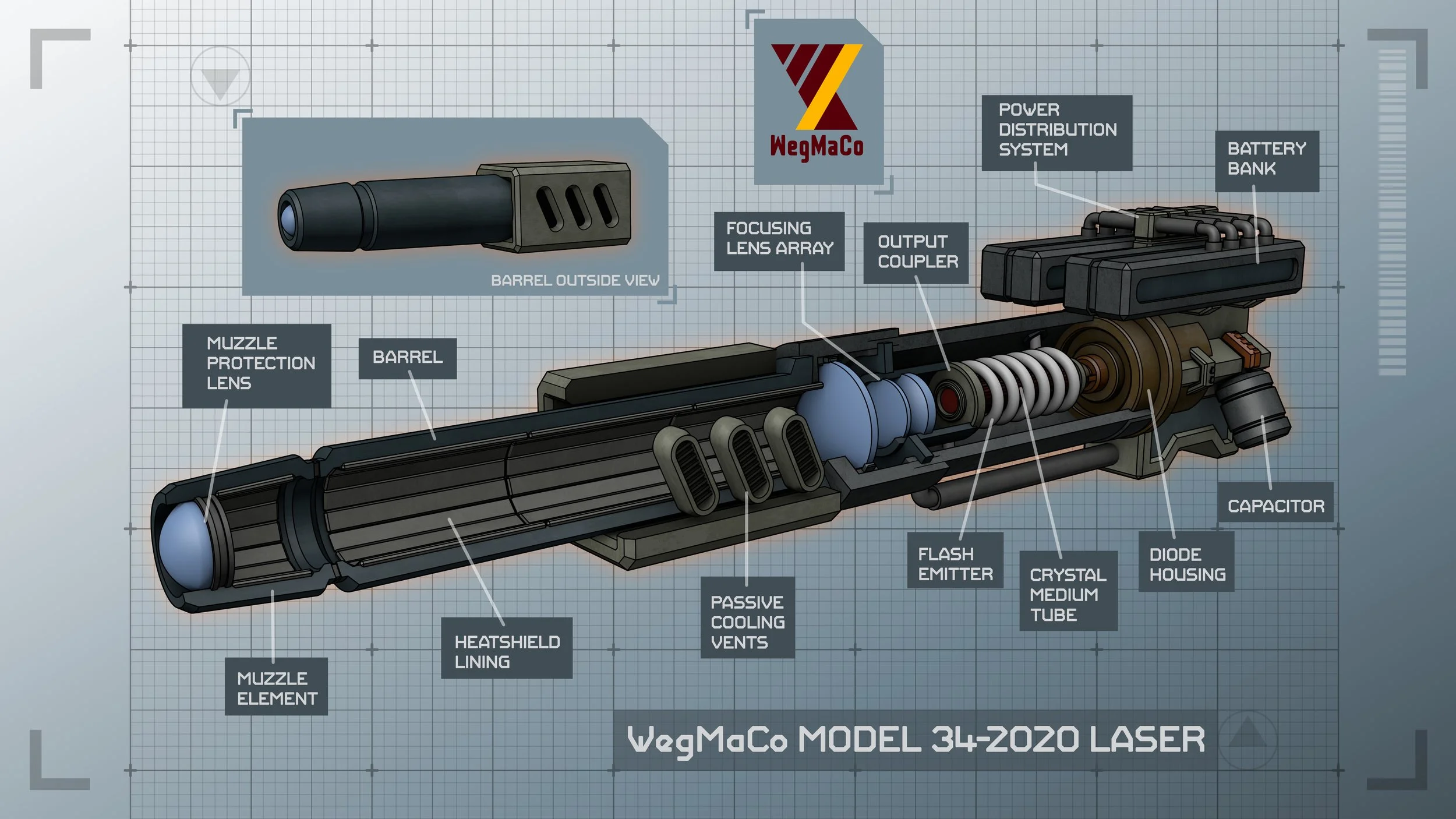
Laser: WegMaCo Model 34-2020
Engagement was now achievable at, quite literally, the speed of light. Early laser adopters enjoyed a period of near-total battlespace domination across all spectrums.
Load Transcript
Archive: Firepower Through the Ages - A WegMaCo Historical Series
Episode: 19 - "CUTTING EDGE: The Rise of Laser Weaponry"
In the pantheon of humanity's directed energy weapons, none have captured the imagination like the laser. For generations, truly powerful lasers were relegated to the realm of science fiction, or else industrial curiosities. The notion of bringing lasers to the battlefield, always so tantalizing, proved frustratingly impractical for actual, head-to-head combat. However, the status quo changed in a millisecond upon the perfection of portable fusion power systems circa <REDACTED>. In a flash, offensive lasers became a deadly reality.
Far from an enthusiastic milestone, initial testing proved the allure of laser weaponry as nothing short of intoxicating to generals and soldiers alike: unrivaled precision, impressive range, and functionally instantaneous time-of-flight to target. If the target could be seen, it could be struck and often before they could even register a threat was present. A laser beam, unlike missiles and even shells, left zero time to react.
Engagement was now achievable at, quite literally, the speed of light. Early laser adopters enjoyed a period of near-total battlespace domination across all spectrums. This paradigm shift, and the resulting arms race, consumed the defense and R&D budgets of every major Earth military and corporate power for decades. Lasers were used in every role, from direct engagement of ground, sea, air and space targets, to employment as persistent and efficient counter-missile arrays.
The focused beam of a laser instantly melts then vaporizes metallic armor in microseconds, with the resulting thermal shockfront creating a jet of superheated material that bores into and through the target, causing further damage. Traditional reactive armor systems offer no protection whatsoever against a laser attack. Lasers are also especially effective against optical sensors and other sophisticated electronic equipment. Delicate optics and electronics can be rendered blind or hopelessly ruined by even the most passing contact.
These effects are impressive enough, but the worst is still in store for the unlucky target. Once the beam breaches the target’s hull, unarmored structural members and other components are rapidly degraded or destroyed: Hydraulic systems rupture and fluids ignite, ammunition cooks off, and delicate electronic components slag under intense heat. For crew members, the consequences of a laser strike are brutal. Should the beam pierce an occupied space, or penetrate a non-compartmented vehicle, the typical result is near-instant death as superheated metal vapor floods the interior. It goes without saying that should a laser directly hit a human being, such as a foot soldier, the outcome is nightmarish.
The effectiveness of lasers was, and is, undeniable but the early, frenzied adoption and proliferation of the technology soon revealed intractable operational hurdles. Potent lasers capable of defeating armor had always demanded extraordinary amounts of power; that problem was handily solved by sophisticated microfusion powerplants, but they were still strained to their limits, effectively imposing a governor on maximum beam duration and rate of fire. Furthermore, the waste heat generated by even the most efficient battlefield lasers was and remains immense. The necessity of intricate thermal management systems increased weight and complexity, and greatly increased fragility.
Ultimately, the sum of these drawbacks meant that sustained fire proved impossible for all laser classes intended for HE-V, tank or aerial installation. To sidestep the issues, engineers configured “portable” class laser weapons to fire in short, intense activations or strobe their beams via rapidly charged and discharged capacitors. This solution allowed a modest rate of fire, but the end result was that, for all their penetrating power, lasers simply could not match the raw destructive force of more traditional options like autocannons and missiles.
The great Golden Age laser arms race chilled substantially once all interested parties determined that these limitations were simply part and parcel of the weapon system, categorically. Further drawdown on lasers occurred as countermeasures evolved: Ablative armor coatings, specialty ceramic plating, and foamed carbon-titanium internal baffling all proved effective at degrading laser performance and improving survivability.
Lasers still remained a primary HE-V weapon for over a century, but eventually the technology settled into a particular role, just one battlefield tool among many. It wasn’t until the aftermath of the Rift that lasers faced an existential crisis. The expertise needed to craft such weapons along with their intricate construction, demanding maintenance regimes, and overall fragility made them too difficult a proposition for many belligerents. Many vintage lasers, each a marvel of artifice, were abandoned outright or else cannibalized for parts.
Lately, the sudden resurgence of laser weaponry comes from an altogether likely source: corporations! Considering that ammunition shortages and logistical concerns are just as likely to sway conflict outcomes as any tactical failure, weapons that can ease such burdens once more command a premium. Some corporations, like Tri-Tac SpA, quickly leveraged their intact manufacturing infrastructure and institutional expertise to craft new laser weapons optimized for modern combined arms warfare, like their acclaimed and deadly Sapphire Series.
Other companies took an innovative approach with their laser products; WegMaCo’s Energetic Products Division broke new ground with their two-time award-winning Model 34-2020 by exchanging raw power for dramatically improved ease of maintenance, user-friendliness and reliability. WegMaCo’s very own employee, Security Guard David Thomlin, has voluntarily equipped the 34-2020 on his HE-V for years:
Oh, yeah, the Tri-Tac one? I've run one of those beamers. Heh. It’s an absolute monster- uh, when it works! But let me tell ya, this WegMaCo model, it’s reliable. You fire, you hit, you just keep on firing. It won’t core out an ultraheavy at a klick in one shot, sure, but you won’t spend half a week in the bay waiting on a tune-up, either. That's a good trade, I'll take that deal! WegMaCo allll the way for me.
What an endorsement! But despite how advanced the lasers of today are, their true value is largely unchanged: their ability to effortlessly engage targets at extreme range with pinpoint accuracy and zero time to impact. Lasers are still the weapon of choice for surgical strikes against high-value targets or against foes that lack access to specialized laser defenses even if they are not, and likely never will be, the universal battlefield solution that the early dreamers imagined.
Nonetheless, the king of directed energy weapons endures as the exemplar of human ingenuity in mankind’s endless quest for the perfect implement of war.
This historical presentation has been brought to you by WegMaCo Media Studios; a division of WegMaCo, a family company.
Illustration by Florian Mellies
Dedication
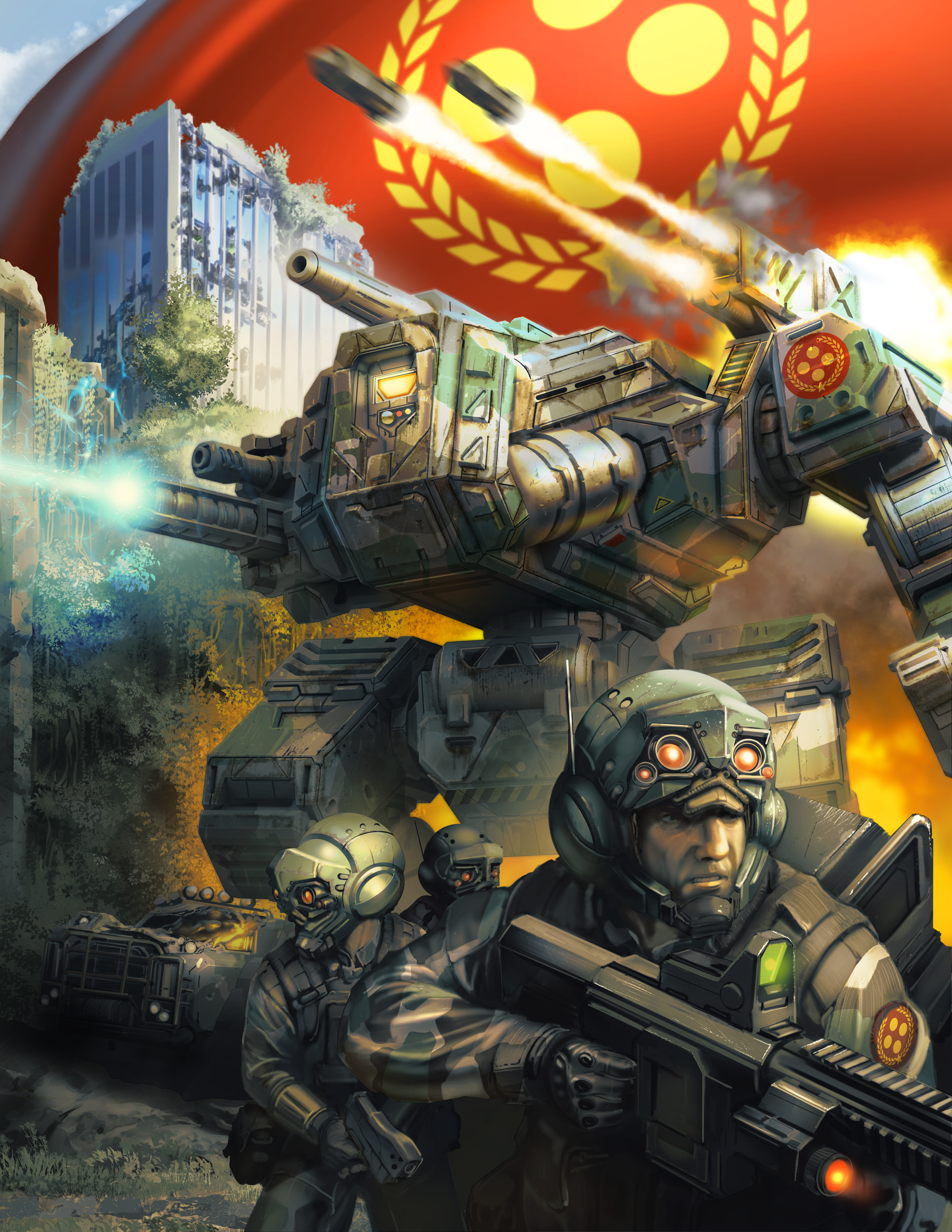
Johnson leaned on the trigger, a stream of case heads like giant tacks tumbling from the gun to the pavement behind him, and the deadly autocannon gnawed all the way through the Falke’s torso section, which collapsed in flames and thick, black smoke.
May 24th, 2383
Solar Republic Armed Forces Base “Honor”
Lima, Peru
The amphitheater-style briefing room, originally designed to seat hundreds, was currently occupied by only fourteen in the front rows. Thomas “Nacht” Johnson, listened to the struggling air handlers while his compatriots chatted quietly. One unit rattled quietly somewhere above, the stale air it pushed a bit too humid.
Even the little things were subject to corner cutting. Johnson sipped at his foul instant coffee, winced, and tried to project calm patience. His immediate superior was eleven minutes late to the briefing. Johnson was thirty-eight, a Solar Republic captain and HE-V pilot in the armor corps. He was a believer in the Republic’s ideals, in their long-standing vision of a united, prosperous mankind spreading in an orderly fashion throughout the solar system. He had enlisted at twenty-three and served with distinction ever since.
Next to him sat First Sergeant Justin Keller, callsign Relic. He had come by his handle honestly: at fifty-eight, he was the oldest member of the team, by far, and one of the oldest still serving fighting men in the Solar Republic Armed Forces. By rights, he should have been drummed out to non-combat duty, or even retired, but the state of things on Earth along with Johnson's constant lobbying kept him behind the sticks. Johnson increasingly questioned himself over allowing, much less encouraging, the old timer to keep plugging away.
Keller was something of a unit mascot, now, but still sharp and a living link to the before times. Not before the Rift, of course, but rather the time when the Solar Republic still waxed powerful and potent. Back then more organizations, especially the corporations, respected their singular authority. Privately Johnson regarded Keller as a mentor and something of a father figure. His actual father had been dead for more than a decade.
Keller was talking softly but animatedly, gesturing with his hands, explaining some intricacy of maneuver to Dixon and LaPlace, the two junior HEV pilots in the team. Junior was a relative term; both men were seasoned veterans but had been transferred to Johnson's command as replacements. One for a resignation, the other a death in combat. The pair listened to Keller with rapt attention, but Dixon's cocked eyebrow made him out as less sure of the lesson.
Johnson finished the dregs of the cheap, nasty coffee, immediately regretted it and heard the rapid clicking of boot heels in the long hallway outside the briefing room. They reached the door and it swung open forcefully. Major Eder entered and snapped as you were before half the butts in the room lifted from their seats. The formerly crisp and composed military man was a sorry sight in Johnson's estimation. He wore a near-permanent five o’clock shadow to complement the heavy, dark circles under his eyes. As bad as Johnson's schedule and duty tempo had been for the past twelve months, apparently the Major’s was far worse.
“Good morning, men.” The room responded with a chorus, likewise, echoing through the nearly vacant space. “I apologize for the delay. To business. We've got another interdiction op on deck.” He approached the podium with its built-in workstation, and the clicking of keys also echoed. A theater sized wall display lit up as the lights dimmed sympathetically. High resolution satellite and aerial photography appeared, a familiar tableau to the men in the room.
“As of 0430 Zulu yesterday, an independent, unregistered ship evaded the Republic picket measures, made planetfall and landed here. In Panama.” The Major’s voice was dog tired. Worse than tired, Johnson thought. Ragged. Worn out. A new picture appeared along with a topographical map, a red bullet glowing a little ways inland from the Pacific coast. The recon image showed a rough but functional light-duty spaceflight complex and accompanying airstrip. A modest blue and yellow civilian cargo lander sat in the middle of the tarmac’s expanse.
Eder continued. “Usual suspects, usual activity: Free traders from the outer system, and intel shows the outbound cargo is the typical black market buffet. Arms, medical supplies, a smattering of luxury goods and materials. We aren't sure right now what the ship delivered, but satellite imagery and flyovers indicate heavy cargo being unloaded.”
He continued, leaning on the podium as if delivering a eulogy. “You all know the drill. Go in, bust ‘em up, shut it down. Impound the ship and cargo, and detain everybody. If they resist, lethal force is authorized. Questions?”
Johnson led here, like always. “Enemy forces, and any fixed defenses, sir?”
Eder appeared exasperated even at this. He clicked over to another set of photographs with an accompanying chart. “Three HE-Vs. Two old tracked warhorses, one armed workrig, all variously equipped. There may be four, total. A second work rig that is as of now unaccounted for. Plenty of footsloggers, too, with small arms and light anti armor weapons. No visible anti-air, no emplacements. The local strongman has been doing well for himself, but we’ve tackled his sort before.”
The hell they hadn’t. Not this lean, Johnson thought to himself. He turned to glance at Keller who was already giving him a sharp, knowing look from beneath his snowy eyebrows. This was way too close to an even fight already, far from the three-to-one odds the Republic favored for gaining compliance with a minimum of loss or bloodshed. That didn’t even account for handling detainees.
“What's our force allocation for this op, sir?” Keller asked with false optimism.
“Just what you see, Top.” Murmuring from the men at that. Someone let out a low whistle. “One armor team, three infantry squads for the roundup and to secure the ship. Two Makos running escort for the transports.” A few rows back, by themselves, were Rob Lee and Eliar Hernandez, flyboys jockeying the swift attack craft. The other flight officers who were present flew the Orca infantry transport or the massive HE-V lander. Also present were a few senior technical personnel, and an infantry officer and noncoms.
Johnson and Keller shared another pointed look. This was, without question, the thinnest interdiction mission that either man had run. An infantry lieutenant asked, “Sir, what are the atmospherics looking like for the projected duration of the mission?”
“Emissions forecast is severe. Expect long range sensor interference, and short range comms may even be affected. Suits mandatory for dismounted operations. The good news is we can use this to our advantage, it will mask our approach to the AO.”
“Bring your sunblock, girls,” the infantryman quipped.
“This is going to be some kinda party,” Keller whispered, ruefully.
“Tactical plan, strategic considerations and maps should be on your pads now. I want departure no later than 1100 local. Element leaders, brief your subordinates accordingly. Prep your rigs, check your gear. If there are no other questions, you are dismissed. Good luck and godspeed, gentlemen.”
Major Eder wasn't waiting for questions regardless. He closed the briefing on the terminal, returning the wall screen to a giant Solar Republic Armed Forces emblem before turning, grabbing his briefcase and leaving in a rush.
—
The tall, cavernous hangar space was also mostly empty, like the rest of Honor Base, and its interior was half in shadows. The base complex once supported five task force elements of fifteen HE-Vs each; each element was three teams of four, one team of three, plus attached supporting forces, ground and air, per standard doctrine. Johnson presently commanded just five HE-Vs total, and his air assets were shared between his unit and another understrength element. The arc lights above the empty gantries were shut off.
Johnson took the noisy, metal stairs two at a time up the scaffolding surrounding his Mars, musing on the sorry state of the Solar Republic. The twilight years had already begun when he joined up, but he didn't know it at the time. Keller had said as much back then, but Johnson had brushed it off with the bravado and certainty inherent to youth.
Despite the shabby pageantry of permanence and dominance they still vainly projected, the Republic launched fewer and fewer interdictions in space or the skies over Earth. When they did, the results of such missions were no longer beyond question. More ships snuck through, more escaped, and more went unchallenged after runners increasingly pushed back. And no wonder: the warchest was empty. Personnel were jumping ship to private or national concerns. Signatories, friends and foes alike no longer respected Republic decrees.
The Solar Republic yet lived only because of tremendous inertia. A mountain inverted, and poised to fall.
Johnson reached the mid-deck, level with the machine’s cockpit and low-slug arm-mounted weapons pods. A technician was there carefully wiping down the domed transparent cover over the target designator in the top socket, situated just above the long barrel of the 90mm Rockwell autocannon that served as his primary weapon.
Johnson slipped past the man to complete his own visual pre-mission inspection, and quickly walked around the backside looking for leaks, signs of sabotage and the like. The same way he had hundreds of times before. He moved to the left arm and its railgun, leaning out to take hold of the ventilated shroud around the rails. He tugged several times forcefully; not even a wobble, all secure.
Another technician approached with a large, padded helmet bag in hand. The bulky helmet, its interior studded with non-invasive EEG sensors, would together with the physical controls help Johnson control and orient his HE-V. The visor would project a reactive HUD and other data, also. Johnson gave him an encouraging word, and he followed down the narrow catwalk stretching to the Mars’ cockpit, the transparent armored canopy already yawning open.
Captain Johnson stepped out onto the rim of the cockpit, gingerly avoiding the hazard-striped flat marked no step; a warning against the procession of explosive bolts. He gripped the overhead handhold on the canopy frame and stepped down and into the recessed space. He turned and took his helmet from the tech’s outstretched arms. Thomas settled into the heavy, padded seat behind the layered, raised instrument panels. He removed the helmet, socketed in the leads, and stowed the bag. The tech finished checking the seals lining the cockpit, stepped back and gave a crisp salute that Johnson returned. With that the tech turned and walked away.
Compared to other, more modern HE-Vs, the Mars was not top of the line. The 80-ton behemoth was comparatively simple and slow, but it boasted ruggedness and reliability in spades. He missed his Shepherd, but Johnson had grown to appreciate how secure the cockpit environment was while still affording a wide field of view. It was deeply set and low on the torso, near the machine’s chest, and recessed under a monumental cowl that afforded tremendous protection from overhead threats. Together with the chunky digitigrade legs, it lent the deadly heavy a stooped, awkward appearance, but it more than lived up to its god-of-war namesake.
Johnson donned his helmet, and ran through the remaining elements of his stand-up sequence. The techs had already lit the Mars' reactor. He clicked one switch and then held a short lever down to lower and secure the canopy, the servos a baritone whine. Before it could close, a klaxon in the hangar sounded three times, followed by loud, reverberating clangs. Dixon was stepping out slowly and carefully in his Scarab, heading for the staging area. The Mars' canopy shut with a clunk and a hiss of pressurization and the noise outside turned dull and thin, muted.
Sealed against the hot outside air, the cockpit smelled of metal, lubricant, ozone and old sweat. It was distinctly unpleasant and to Johnson strangely comforting; the aroma of familiarity. Johnson went on with the sequence. Hydraulic master standby light on, fluid level check okay. Backup battery and auxiliary power unit, okay. Boot fire control system, weapon system diagnostics - autocannon, railgun, submunition launcher, rocket rack - all in the green, rocket fusing system okay. Optics and sensor test done, good to go.
He reached forward with his left hand and flipped a succession of switches: spin up gyroscope, balancer activation, actuator tensioning system, reactor demand synchro and PTO. A succession of clangs, whirrs and a deep, rumbly hum sounded deep within the Mars; a titan, wakeful, one dreadful eye opening. Johnson buckled his five point harness and cinched the straps down tightly.
Another bank of switches and buttons: load compensation, surface interpretation, locomotion master controller, locomotion assistance - the last two would rouse the HE-Vs computer brain and subbrains that handled keeping the monstrous machine upright and going where Johnson intended. Four more; radar to standby, combat AI to standby, friendly datastream acceptance and protection.
Several displays lit up and blinked through a torrent of information as the Mars networked and completed handshaking with the other HE-Vs and assets in the unit, ready to share and respond to vital targeting data and telemetry in combat, and do so far faster than any human being could relay and act upon.
The last step. Johnson settled his feet on the pedals, took a firm grip on the left control stick and flipped a cover up to throw one more switch with his right hand, releasing the mechanical interlocks that allowed the HE-V to settle into a stable posture. There was a loud clang, a brief sensation of falling as the Mars sagged momentarily under its own immense weight before catching and standing up to its full height.
He thumbed a knob on the right stick and spoke into the helmet mic. “Gauntlet Team, this is Gauntlet Leader. Comms check and confirm datastream crosslink, over.” Keller was striding out of the hanger now in his Daiko.
“Reading you, Geist. Gauntlet-Two copies, datastream is okay,” Keller replied.
“Gauntlet-Four copies you, loud and clear, Lead. Crosslink is good to go, warheads ready for requests.” LaPlace in the missile-laden Corso, not out of his bay yet.
“Gauntlet-Three copies, data integrity is green, all systems okay. No problems.” Dixon.
“This is Archer, Gator-1, reading you five by five. Network looks good here, we’ll double-check underway before we put cleats on the ground.” That was Lee, the Mako’s LAS engines audible as a tinny howl over the airwaves.
“Comms check and crosslink confirmed. Let’s head ‘em out, Gauntlet,” Johnson replied. He pushed the left stick forward and nosed the Mars out into the hangar lane, watching his main display’s “chin” camera to follow the instructions of the spotter crew. In a few steps he was under the radiant Peruvian sun, and striding toward the waiting lander that would carry him and his unit on their mission.
—
Things had gone dicey fast. The flight to the area of operations was uneventful, but that ended when the colossal lander touched down in a pasture by the town, disgorging Gauntlet as the Makos circled overhead, ready to pounce on any threat. People fled from their work, others watched from rooftops beneath shady pergolas, radios in hand. Several pickup trucks had already sped away, dust flying, toward the illicit shipping terminal.
The Republic HE-Vs were only covered by a single Mako on station, Lee, Gator-One. Gator-Two had tailed the larger craft up protectively as it withdrew to join the Orca carrying their infantry in a holding pattern. Hostile HE-V signatures soon appeared on scopes, and the aircraft quickly confirmed four moving around the grounded runner ship and heading to block their approach. Dense vapor rolled from the belly of the ship; a sure sign of intention to take off and boost for orbit. Repeated hails announcing the Solar Republic’s presence, and demanding immediate compliance and surrender had been ignored.
A low earth-container wall surrounded the complex, but was no obstacle at all even to the lightest HE-V in Gauntlet. Johnson’s Mars, paced by Keller’s Daiko, plowed straight through it and the flimsy tilt-gate guardhouses barring the road, LaPlace and Dixon just behind. The runway stretched across the northern edge of a wide, reinforced landing grid. The southern and western edges of the landing grid were flanked by irregular stacks of deep space shipping containers, conex boxes and other cargo-moving paraphernalia. To the east a clutch of long, low warehouses, taller hangers and other structures. Surrounding the cleared space, verdant jungle greenery; trees, shrubs, tall grasses.
“Watch those stacks, Relic. Movement, watch it..!” Johnson snapped into the mic as his combat computer buzzed urgently about a possible threat.
“I’ve got it, Tom. Something, trying to lock it up,” Keller replied hastily, proper protocol slipping into familiarity.
“Gator-One, do you have visual on possible bully in the crate stacks to the west?” Johnson asked. Bully was code for a hostile contact on the ground.
“Negative, Lead. No vis.”
Across the runway, a tracked Falke dashed into Johnson’s view from behind an intervening building, stopping on a dime between the oncoming Mars and the grounded ship. It opened fire with paired rocket salvos and a long burst from a rotary cannon before he could react. Johnson winced as his view, and his HE-V, disappeared in a fireball. He pressed forward, emerging charred but mostly unscathed; the Mars’ reactive armor packages had triggered and blunted the worst of the rocket salvo, and the smaller gun’s armor piercing rounds had little hope against the thick hide of the heavy.
“Gauntlet Leader is engaged! Return fire, weapons free!” Insolent bastard, Johnson thought, blood running hot and payback on his mind. The sound of heavy ordnance erupted across the complex, friendly and otherwise, as Johnson twitched the right stick to drop his twin aiming reticles on the glowing target indicator bracketing the Falke’s center of mass. The compact machine surged forward toward cover a split-second too late, just as the automatic smoothbore gun on the Mars’ right arm fired.
Rockwell’s infamous auto-ninety enjoyed its reputation for a reason: A stream of armor-piercing high-explosive 90mm shells, three per second, bit great hunks from the Falke, mangling it beyond repair. They smashed through and blew away the left weapon pod, then split the left track bogey into a ruined mess. The pilot desperately tried to rotate in place and bring intact armor into the line of fire, but only managed a jerking start and stop that spat what remained of the left-side track sections through the building behind it.
Johnson leaned on the trigger, a stream of case heads like giant tacks tumbling from the gun to the pavement behind him, and the deadly autocannon gnawed all the way through the Falke’s torso section, which collapsed in flames and thick, black smoke. A few of his rounds went wide and punched through the flank of the grounded ship behind it. He advanced, toward the wreck, and saw, worryingly, smoke starting to pour from the fresh holes in the ship.
BREEP-BREEP. Missile alarm. Too late to react or evade. Johnson barely caught the missile as it swooped down, then felt the terrible, shuddering impact through his HE-V. Too close: it struck just above the cockpit, under the cowl. Damage indicators popped up on the panels. A bad hit; his cockpit seal was damaged.
The radio was alive with chatter now, the Solar Republic pilots calling out targets and instructions. “Ultralight! UL, UL, Husky in the containers, west side, Gator-One setting up for a strike!”
Undeterred, Johnson kicked the flaming ruins of the Falke aside to make way and halted. He turned, watching the nimble Mako up high bank hard, nose over and dive. A barrage of rockets, tight lances of fire, streaked down followed by a bright, jagged stream of tracers before he heard the ripping report of either.
“Kill is negative, might have splashed him. Evading!” Lee flew past overhead and sideslipped before banking away north, fast and low.
Johnson knew they had to get a handle on the situation and finish the fight. He assessed his tactical map and traversed left to the other side of the complex. “LaPlace, hold position. Dixon, you need to peel off east, come up and get a lock-”
Just then, Johnson saw a wide stack of cargo containers open. Unfolded, rather, on the long side. Not fall, they didn’t tumble; one whole side of a stack fell flat, like sheet metal. He didn’t quite understand what he was seeing at first. Inside the cleverly camouflaged position, standing two abreast, a pair of squat, chunky Huskies. Both hoisted and leveled dangerous handheld autocannons like oversized rifles, easily powerful enough to threaten larger HE-Vs. And the Mars was halted, flat-footed, an easy target.
Elephant guns! Terror seized Johnson, liquid nitrogen freezing his blood. A heartbeat later the Huskies opened up on full auto, advancing, launching two short range missiles each from shoulder racks. Rounds impacted all over and around the cockpit, the fat warheads accelerating on columns of smoke-
An explosion. Captain Thomas Johnson’s world shrank, compressed into a nucleus of incandescent agony. The searing heat of boiling oil and savage cold, the pain that erased language and thought and self. The kind that etched its name into the marrow of DNA. He bellowed, eyes bulging wide. Stinging, acrid smoke filled the cockpit. Blood was splashed everywhere, his blood. Over broken screens and rows of switches. Up his nose, the taste on his tongue. Instinctively he reacted, trying also to turn away from the danger. Left turn left stick left stick turn turn turn no - but his HE-V wouldn’t respond.
Through the shock, some horrified fragment of his lucid mind whispered a secret: His left arm was gone, reduced to so much pulped meat and bone. The hot, hot, shard of metal, steaming, still pinned him to the seat. Going quiet now, and lighter, somehow. Had to do something. Voices buzzed in his ear. Flies, shouting at him. The ugliness in front of him mercifully dropped away. Beyond the tarmac green treetops receded into pure, blue skies. Leaning back now, his weight lessening. Better. A rest.
The Mars lurched, off-balance, before it fell backwards out of control. It slammed into the pavement with sickening force, the impact sending cracks radiating out in all directions. Darkness rushed up to envelop Johnson, sweeping him away into oblivion.
Keller raced to protect his fallen commander and friend, urgently sending up a call for immediate reinforcements as the Huskies retreated, bounding away from their kill to join their companion in the maze of container stacks. Blood dripped and ran, pooling on the rear bulkhead of the cockpit. As Johnson’s life ebbed, the sun blazed mosaic patterns across his fluttering eyelids through the shattered canopy.
Illustration by Eldon Cowgur
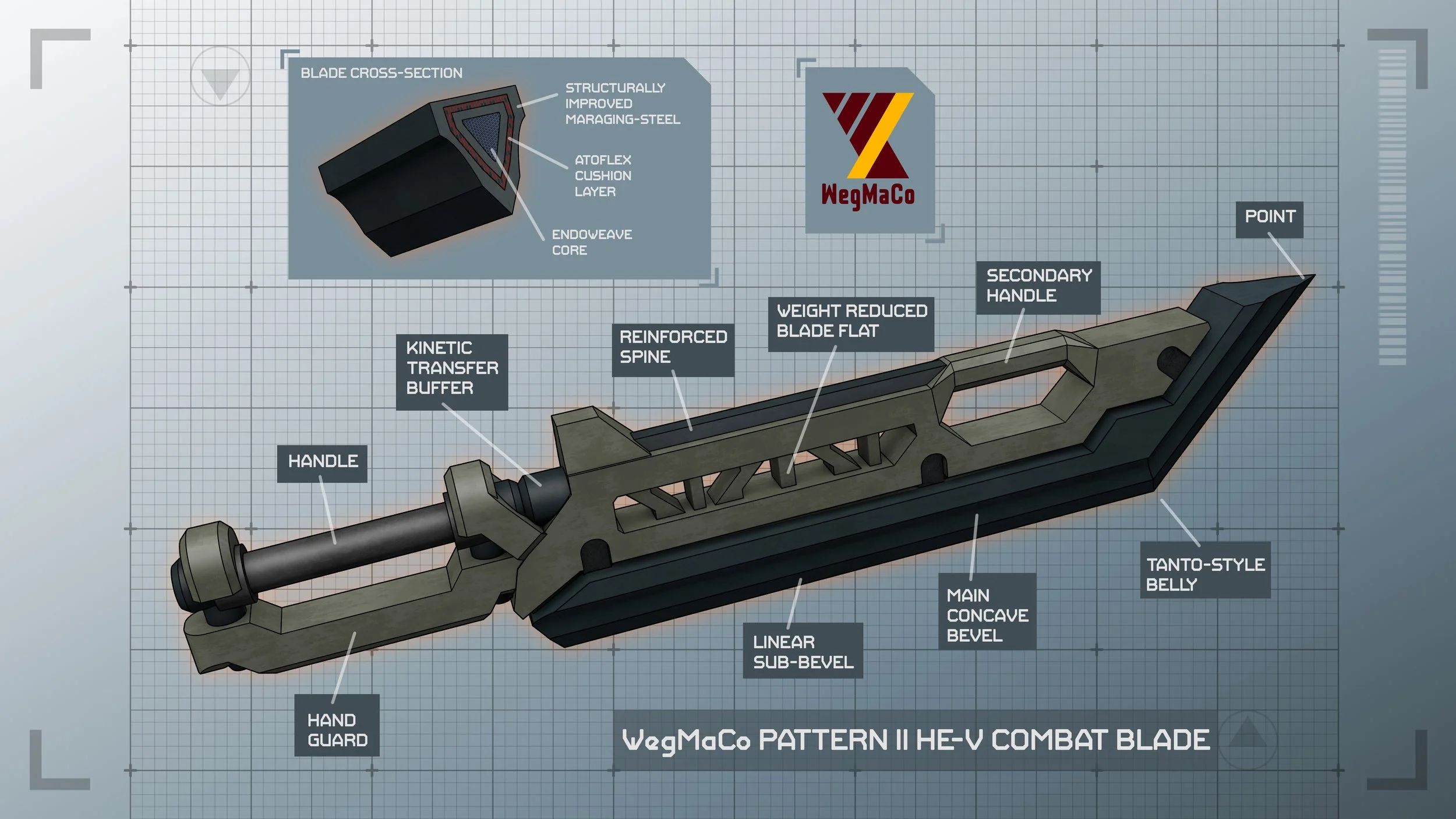
HE-V Combat Blade
The decisive results of these early physical clashes made an immediate impression on pilots and generals: a few quick strikes from a sturdy implement wielded by a powerful war machine could disable opponents just as quickly as ranged weaponry.
Load Transcript
Archive: Firepower Through the Ages - A WegMaCo Historical Series
Episode: 8 - "CLOSE QUARTERS: Combat Blades in the Mechanized Age"
Since the advent of gunpowder, mankind has strived to create weapons offering ever greater range. After the musket came the rifle, then the cannon. Missiles followed, then KKVs and lasers. The ability to destroy your enemies from a distance and prevent them from striking back has always been a fundamental tenet of warfare. And so the HE-Vs of today bristle with guns, missiles, and directed energy weapons more than capable of destroying any target at extreme range.
Why, then, would so many armored combatants revert to carrying giant blades? Why go close quarters, at arm’s length, with a similarly deadly foe? The answer may surprise you, and it is found in the ever-widening gap between the theory and the practice of modern combat.
Throughout the history of HE-V combat, battles have raged through the ruins of Earth's cities and cramped industrial installations, and descended into teeming jungles or maze-like tunnel networks. In these places, engagement distances between opposing HE-Vs may, incredibly, be measured in single-digit meters, even when armed with weapons that can reach out for kilometers.
Naturally, once warfare settled into these tight confines, it was only a matter of time until the fighting turned hand-to-mechanical hand. The decisive results of these early physical clashes made an immediate impression on pilots and generals: a few quick strikes from a sturdy implement wielded by a powerful war machine could disable opponents just as quickly as ranged weaponry. The idea spread quickly throughout military war colleges and corporate thinktanks, and what was originally desperate improvisation soon turned into established doctrine.
The genesis of combat blades as go-to weapons for HE-V pilots first began as a purely mundane tool and not, as is often asserted, any misplaced notion of martial honor or chivalry. Early adopters of military-grade HE-Vs quickly found that the powerful, versatile machines still needed more than their own manipulators to handle the full spectrum of field operations. A simple but strong cutting tool would serve to sever tangled power lines and cables, clear battlefield obstacles, hastily construct fortifications, and perform light demolition work. A correspondingly huge, reinforced blade was the obvious solution, and they proved far more intuitive, affordable and practical than any kind of specialized attachment.
The combat blades of today, though, look very different compared to their utilitarian predecessors. Most are manufactured as composite assemblies of molecularly-reinforced carbide alloys and other materials, optimized for incredible durability. Gone are the basic, almost crude rectangular and notched shapes of the historic utility tools; modern models are singularly designed for the rapid disassembly of tough, armored targets. Categorically they take many forms, from point-driven, tanto-style blades to stout, thick swords and broad wedges more akin to a cleaver or axe head. No matter their shape, all are heavy and sharp enough to cause significant damage with repeated blows, and durable enough to withstand deformation from the terrible stresses of the same.
Despite the brute simplicity of these HE-V weapons, proper design remains a critical consideration. Weight distribution is especially important, as poor balance impacts ease of handling, speed and power in a brawl. Similarly the configuration of the cutting edge will determine the method of employment and may better serve an individual pilot’s preferences or the physical configuration of their machine.
Beyond their obvious situational advantages, combat blades have always conferred other benefits to combatants and their host forces. They require no ammunition, a major boon in times of scarcity when every munition, every bullet and bomb, must be used judiciously. They also have simple maintenance requirements compared to the intricate machinery of all ranged weapons. Consider, too, that sophisticated countermeasures, effective point-defense systems, and specialized armor types have also rendered many ranged weapons less effective or even unreliable. And, most importantly to those right behind the sharp end, they work every time. There is no mechanism to jam, magazine to deplete or power cell to drain.
For insurgents, freedom fighters, militias, and cash-strapped contractors, combat blades have remained relevant by easing logistics concerns, a wise investment of often limited resources. For national militaries and corporate security forces, blades are still the best tool in the toolbox for specific close-quarters problems, and enabling effective asymmetric warfare tactics.
From the most desperate to the best equipped, combat blades have proven themselves a fundamental necessity for fighters through the ages, and in either case they are as useful today in the hands of HE-Vs as they were in the hands of our ancestors millennia ago.
This historical presentation has been brought to you by WegMaCo Media Studios; a division of WegMaCo, a family company.
Illustration by Florian Mellies
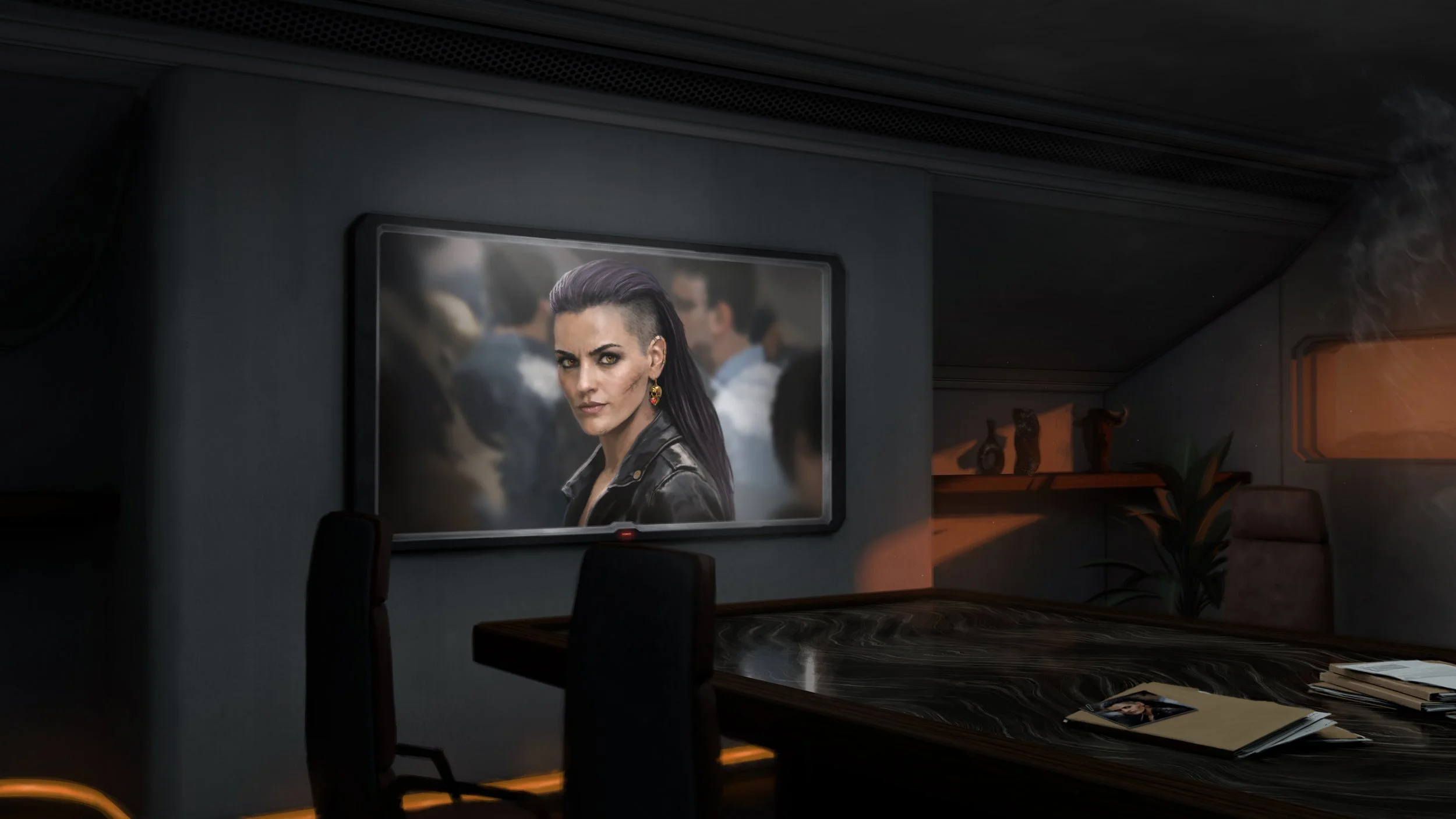
Amber and Ashes
The huge vessels neared the ground, and black HE-Vs with bone white trim jumped out, directly into combat. The assembled clips of surveillance and gun camera footage, and expository animations, paid testament to a brutal assault.
The conference room was far smaller than Shimada had anticipated from the summons. Then again, he perhaps should have suspected as much. Booking him hu-car on a tramp freighter was beneath Empyrean, even when footing the bill for little people like himself. Lowest of low profile, it must have been for some reason. Despite the lack of square footage, the room was still richly appointed, comparatively. A volcanic glass table, trimmed in synthetic wood stained the color of coffee, ringed by nice highback synthleather chairs. Lesser employees in the corporate hierarchy likely organized their glamor-less work here, the countless unseen functions that kept business running and money flowing.
Shimada Masahiko, a senior investigator for the Lunar Security Authority and retired Solar Republic Inspector, sat across from another man at the end of the narrow table. Unusual for this kind of meeting, Shimada had been whisked through the main tower’s side entrance, immediately up a small service elevator and directly to this room. No check-in, no visitor tag, no scanner imprint. Unusual for his counterpart, there was no train of attendants, no underlings, and no interns in the room with them. Not even an assistant taking notes and manning the datapad.
These details underscored the gravity of the meeting to Shimada, growing heavier by the minute. He still felt a kind of relief nonetheless; when the corp enforcer escorting him had driven straight past the opulent main entrance of the tower, he felt a momentary jolt of certainty that it would never be his birthday again, and he wondered what corporate daimyo he must have crossed at some earlier point in his career.
Ernest Crowley, Chief Risk Officer for Empyrean Reach, moved a finger across the ghostly glow of a holographic keypad just beneath the table’s surface. The overhead lights dimmed to nothing, and the baseboards warmed a soft amber in response. Crowley was forty-three, though he appeared to be a decade younger. A streak of silver threaded his black hair, an affectation to be sure. The youth ended at his eyes; much older, flinty, and brimming with death-sentence secrets.
Outside the rectangular, reinforced window the Martian day was bright and mostly clear, and beyond the geometric bubble of the habitat dome a surface of red and orange iron stretched toward a horizon broken by low, jagged hills. A sleek attack craft in Empyrean livery whizzed by in the distance. No sound at all from its engines reached the tower’s insulated interior. Another press and the window slowly opaqued to near solid. Two pinpoint lights winked on above them, spotlighting the stack of folders, files and other paraphernalia between the two men.
The executive flipped open a metal case and withdrew two cigars, producing a slender cutter from his jacket that removed the end of each with a shivery hiss. He passed one to Shimada - a Beltin Estate Private Selection - and the old inspector’s head swam with the cost of the thing. The cutter clinked on the glass tabletop and Crowley leaned over to offer a light. Tiny lasers played silently over the end of Shimada’s cigar, and then again on his own. The executive settled back in his chair, cushions creaking, as he puffed the cigar.
The flavorful smoke was transcendent, and Shimada slipped blissfully across time for a moment. Crowley regarded him from the chiaroscuro gloom, his cigar’s coal reflected in his eyes. Shimada was older by twelve years, taller, slender but broad shouldered. His jaw and nose sat slightly crooked on his face. Despite his lanky appearance, he carried himself with the unmistakable dignity of a man who had sold his life dearly in one service or another. The men smoked in silence for perhaps a minute, then Shimada exhaled and spoke.
“This is immaculate. Thank you, sir.”
“You’re most welcome. Thank you for coming, Mr. Shimada, and for enduring such unpleasant travel. The particulars of the situation we will discuss necessitated precautions, I assure you.”
“I understand. And please, call me Mas.”
"Very well, Mas. To the point. Empyrean wishes to commission your skills to aid with an intractable problem."
Shimada was under no illusions at all that the request was anything of the sort, whatever it involved. Declining would be a career-limiting move, maybe a fatal one. “I am honored, sir. I’ll help in any way that I can.”
Crowley pressed the glowing outline of a key and a wall panel came to life at the other end of the table. On the screen, a candid photo of a woman in some crowded place, looking right into the camera. She was shockingly beautiful, and savage: caramel-skin, left cheek transited here and there with thin, white scars. Athletic, a graceful neck, sharp cheekbones and jaw. Her head was shaved close on either side, the remaining tresses the color of glossy, purple ink and swept back. From one ear dangled a golden skull, a ruby in its fanged mouth. The photo showed her blazing amber eyes alight with predatory recognition. Shimada recognized the woman, and fought down a momentary urge to shift in his chair.
Beneath the photo: DIMITRA GUILLORY.
Crowley set his cigar in an ashtray and smoothly opened a file folder. “Dimitra Guillory. We suspect it’s an alias.” He muttered, annoyed. "Leader of the Void Burners cartel, acting governor of the Maw, and public enemy number one in the solar system."
Shimada flicked a look at the file and back to Dimitra’s gaze. "I know who she is.”
“The reigning bitch to be found in this, or any, galaxy,” Crowley amplified. He split the screen and scrolling text appeared next to the photo. “Wanted for piracy, hijacking, wanton destruction of spacecraft, murder, conspiracy to commit murder, weapons trafficking, kidnapping, and destruction of corporate property. She is charged with thirty-seven counts of terrorism under the Planetary Settlement Security Act, SR1804. That number is academic, in the end. The Republic lacks the will and the means to deal with her. But Empyrean does not, Mas. This was on Europa, two years ago."
The screen changed to a montage of recorded footage, interspersed with blank screens of text.
—
The corporate site had seemed secure enough. The haulers carrying the refined deuterium up to waiting bulkers were protected by long-range sensor nets in orbit and on the surface. Three full HE-V teams, all commanded by skilled pilots, along with a wing of LAS attack craft and two platoons of exoplanet environment-trained troops guarded the facility.
The Void Burners hit them halfway through the filling window, at their most vulnerable. Precious little time was left to react. They had drifted in the dark, ship reactors nearly cold, on fast ballistic trajectories. By the time the site’s active sensors registered the incoming contacts, the first communications satellite was shattered before it could launch a distress call. Soon after the pirate landers were burning down to the frozen surface, too fast to intercept.
The security force was well-drilled and had scrambled, and other employees sheltered wherever practical. But some unknown mishap had prevented surface defenses from engaging the descending landers. The huge vessels neared the ground, and black HE-Vs with bone white trim jumped out, directly into combat. The assembled clips of surveillance and gun camera footage, and expository animations, paid testament to a brutal assault. No mere rabble of criminals, the attackers moved with the efficiency of veteran fighters. The odds were two-to-one against the security team. A handful of the pirate HE-Vs were destroyed during the melee, but the outcome was never in doubt.
With the fighting finished, the Void Burners’ landers returned and the haulers were commandeered, their crews pressed to work under threat of death. Any who resisted were killed. The pirates completed filling the vast deuterium tanks of both. Cooperative employees and contractors were rounded up into the largest habitat module. The director in charge of the facility and most of his staff were summarily executed. The haulers boosted for orbit, while the remaining HE-Vs razed the complex nearly in its entirety before departing.
Dimitra never appeared on camera, but one heavy HE-V with twin particle cannons and a vicious cleaver-style combat blade, was freeze-framed.
—
"Fifty-two dead, hundreds of millions in material losses. Not counting the stolen ships," Crowley pulled on his cigar and exhaled a cloud of smoke. The haze softened Shimada’s view of Dimitra’s looming HE-V on the screen. “That hit was the result of some meticulous planning, indeed. We are certain she had help from among the staff owing to the timing, the inexplicable failure of the anti-ship defenses." He tapped another button and the screen changed to text again.
Shimada nodded slowly. "Business as usual for her."
"Mm hm." The text on the screen described another infamous incident. Another input from Crowley and it split again with a new picture; a massive, tumbling wreckage field drifting among the cold stars. Shimada winced, coughing over his own cigar. He knew what the wreckage once was: a Solar Republic space station.
"The Republic’s Jovian interdiction station," Crowley continued. "This one is familiar to you, I’m sure." He stared at Shimada. Looking for what?
"It is. The Republic was intent on strengthening the blockade of Earth by inspecting and tracking vessels moving through the Belt, and from or to outsystem. A monitoring post, of a sort. Guillory destroyed the station outright. Unprovoked, no theft, no negotiation. No obvious goal but mayhem. A total loss, one-hundred-three dead. Eight survivors in lifeboats or small craft." Shimada studied the blase text detailing the station’s destruction. "Oddly, she immediately claimed responsibility far and wide.”
Crowley pulled another file from the stack, opened and scanned the top page, and set it down in the pool of light on the table. “Did you know that Empyrean Reach purchased the rights to the station not long after the Republic built it?”
"I… Did not. Sir." That bombshell was news to Shimada. He had been under the impression that the Solar Republic stood up and operated the station completely free of all corporate influence. With cause; the megacorporations were constantly attempting to undermine the blockade of Earth for their own ends, and the operational cutout was deemed necessary for security.
"What was the Republic’s determination regarding the destruction of the station?"
"I was not assigned to the case. A colleague was at the time, and he told me that it followed Dimitra’s usual MO. A lightning assault to take total control. An on-site investigation was impossible, of course, but it was apparent that the fusion reactor was sabotaged with catastrophic results."
"Well. Are you familiar with the hijacking of the Bull Rush?"
Shimada shook his head.
"Good. We can still keep a lid on some things. The Bull Rush was a ship, an independent freighter. An old, dreary D-class. We commissioned it to move sensitive medical cargo owing to increased theft from WegMaCo’s, and our own, fleets at the time. This was kept hush-hush, NDAs all around. Total sequestration of the crew. Despite our caution, Guillory still found out somehow and hit the ship in transit. She took the cargo, killed or kidnapped the crew, and commandeered the ship."
"And then?" Shimada had inferred enough already.
"And then, tragedy. We recovered the black boxes from your station - our station - and the ship." Crowley resignedly tapped another key.
—
The Void Burners had intercepted the Bull Rush while it was decelerating toward its destination. A nimble boarding skiff had latched onto the ship’s hull near the lock, and it didn’t take long for the pirates to cut their way inside. Criminal boarding actions like this were not entirely unheard of after the Rift. Standard protocol for a corporate-chartered vessel with a reputable crew was to cooperate with the pirates in order to preserve as much valuable cargo as possible, the ship, and the crew’s lives, in that order. The crew or the ship’s owners would later file an indemnity claim against the client, the corporation would easily absorb the loss, and everyone would move on.
The Bull Rush’s small crew was not reputable. A firefight broke out immediately, with the vac-armored pirates gaining the upperhand and taking the bridge after eight minutes of frantic close-quarters fighting. An internal camera in the bridge compartment had recorded three captured crew held at gunpoint, the ship’s captain among them, kneeling against a bulkhead with hands on heads. The remaining crew members were killed or quickly flushed out after the Void Burners vented the ship.
Viewed from behind, one pirate approached and stood before the captives. Reaching up with both hands, they slowly removed their helmet, revealing a high, braided ponytail of inky dark hair. Shimada again recognized her at once, and judging by the terrified reaction of the captain, so did he. Even through the grainy camera, his gawking, wide-eyed fear was apparent. He cowed, visibly trembling, silent words tumbling from his lips.
Dimtra stood over the helpless man, in judgment or gloating, before drawing a long, silver dagger from a scabbard on her suit’s left shoulder. She slowly, lithely moved closer to the frantic captain as her bodyguards menaced the other two with their submachine guns. The man was hysterical, in shambles, obviously pleading for his life. The pirate queen reached out, almost tenderly, with her free hand to take hold of his hair and-
The screen blinked back to the debris field.
—
"Good God." Shimada’s heart drummed hard in his chest, ears thrumming with faint tinnitus. He reached for his cigar urgently, suffocating. Crowley’d had a long pull on his own, mouth now set in a thin line, eyes grim.
"We’ll skip that part. It takes a while. The unfortunate captain of the Bull Rush, one Tyson F. Connelly, had previous dealings with Dimitra. He traded information on her to us for the opportunity to contract. We thought it a win-win at the time. Ultimately, the Void Burners set the captured ship to full-burn on a collision course with the station. Emergency maneuvering thrusters proved inadequate to prevent the collision. This is from the station’s black box."
Another few taps on the table, and audio played over the room’s hidden speakers. Crackling static, someone vainly hailing the Bull Rush to avert its deadly course. Other desperate voices in the background, wailing, echoing alarms. Then loud, pure noise. The grinding peal of metal being ripped apart. Screaming, screaming. Rushing air, then silence.
Shimada recalled what he had learned of the incident back when: debris scattered across a thousand kilometer volume, a few frozen corpses found tumbling through the void. He shut his eyes and tried to find refuge in the precious cigar’s fragrance.
"The following text data was transmitted on repeat from the Bull Rush as it closed on the station."
Empyrean. Treachery repaid in full, with interest. We stay free. Stay on Mars. It will be worse next time. See you soon. Regards. DG.
"There is no doubt she has been pulling strings since then, but as best we’ve been able to tell she’s personally been aboard the Maw since." Crowley said. He passed Shimada a paper intelligence file, and right after a graphic appeared on the screen: an immense O'Neill cylinder station, half massive construction, half black asteroid. The latter’s surface was cracked and vaguely geometric, like the scales of some immense reptile. Shimada was familiar with the Maw as most law enforcers were: a notorious freeport and nexus of licentiousness, spinning slowly in the void beyond Saturn.
Shimada had no need to read the file. "A former Helios mining station, built before the Rift. Abandoned when the company’s fortunes sank in the aftermath. Occupied and slowly restored by various independent interests. A haven for criminals."
"Our lady Guillory took control approximately six years ago. Functions as a true freeport. No laws, no regulations, save her own. And no questions asked concerning goods or services." The sworn corpo sounded almost like he admired it.
"I understand it is economically important to various independents and freelancers living outsystem."
Crowley shot a sideways glance at the old inspector. "More than that, Mas," he said. "It's a veritable fortress. Defensive systems stolen or salvaged from ships, intelligent voidmine fields, and an ad-hoc flotilla of freelance vessels in dock, arriving or departing," Empyrean’s CRO went on. "Mercs, fellow criminals, smugglers, all more or less loyal to her. The Void Burners pay well and provide the goods. We know the interior is a death trap. A maze surrounding the numerous drydocks. You'd need an army to storm it, and you'd lose most of them. We’ve run the numbers."
Shimada leaned forward and asked the question he had asked himself and his superiors so many times in the past. "So why hasn't anyone just blown it up? One good bombardment, or a massive kinetic strike?"
Crowley huffed bitterly. "Many have considered it. Problems. First, the extrajudicial killing of tens of thousands of people. A PR nightmare even we can’t conceal. And, the board has said ‘no’. Even if we got her, a decapitation strike, they fear Guillory's network will retaliate directly or otherwise. As much as it pains me to admit, she's proven she has kompromat on just about everyone. Including the board members. If she goes down, she says, if she even suspects as much, she's taking the lot of Empyrean with her."
"But, she could be lying to forestall consequences. A bluff. She probably is."
"Eh, the board is convinced otherwise. She has informants in many more institutions than we are comfortable with. Paranoia is taking hold in some quarters."
The full picture started to resolve in Shimada’s mind as he studied the Maw. He puffed thoughtfully and the men sat in silence again. “Why is Empyrean so concerned with her? Hasn’t she struck at other corporations, other authorities?"
"Yes, on both counts. However, she's got a personal grudge against the Beltin family, and is bloody intent on using their collective necks as a knife block."
That was another surprise. "Is anything known of her true identity?"
Crowley shrugged. "That's the billion-credit question. I’ve got theories. Facial recognition is iffy, but she might be a former corporate pilot. Based on some circumstantial evidence, she graduated from Echelon's CY-REM school. So one of theirs, or maybe even our own. That would explain her tactical ability and skill in the cockpit. But it's not concrete. She could be anyone."
Shimada leaned back, rubbing one temple. "That should make crosschecking against employee rosters easy, no?"
"I checked our own, and tried the soft pass. Echelon was not forthcoming. And her appearance might have been altered since then."
"How many people does she have working for her?" The scope of the woman’s operations was staggering.
"We estimate the Void Burners number two hundred core, committed members. Lifers. But there’s no telling how many she might call on through her network. Mercenaries. Smugglers. Freelancers of every stripe. She pays well, in favors, goods or credits, and she is fair. By the standards of criminals," Another puff. "And, most troubling, she wins. Wins against us. The little people like that." The admission gave Crowley’s voice an edge that was absent before.
Time for the turn. "Mr. Crowley. Why have you brought me here? Surely an institution as powerful as Empyrean Reach has any and all means needed to deal with her? How can I possibly help?"
Crowley dropped his cigar into the ashtray, gazing intently at the thin, older man. "Mas. It is because I, myself, need a specialist with the know-how and the experience to run the wires and find her weaknesses. She’s a wasp nest; the slightest disturbance means considerable pain. Her network must be rolled up, or isolated, with the lightest touch in order to expose her, make her vulnerable. The lightest touch. That is why you are here. I know what you’ve accomplished in service to the Republic. The impossible. And what you still do for the LSA. I cannot call on the rest of my considerable resources at the risk of operational security. You will report only to me, or to my personally appointed staff. No one else."
Shimada dropped his hands to his lap, and his gaze followed. Pondering, troubled.
Before the quiet stretched on too long, Crowley spoke again. "You will, of course, be handsomely compensated for your skills, time and travel. And you will enjoy the personal gratitude of John Beltin the Third, the Beltin family and myself. Furthermore, it is not my intention to put you in any danger, Mas. Some field work might be needed, though. We have to keep everything close to the chest."
Another outcome that was never in doubt. Back in the game, back on the hunt. No more chasing stolen parts and survey device smugglers across the moon’s barren expanse. When Shimada looked up to meet the executive’s gaze, his own expression was crafty. "She's careful about collateral casualties during some attacks, only sometimes. When it suits her," he stated, picking up a sheaf of papers.
Crowley nodded, smiling. "It’s not random. I don’t think so. Everything she does is calculated. Every action serves some greater plan. I believe you can spot that pattern that must exist. That you can anticipate her."
"Premeditation means any criminal can be predicted, in time."
"Be warned. She has lulled us before,” Crowley pulled another file. "Here. We sent a grab team after her. Our elite pilots, top-of-the-line equipment. Tracked her to a supposed safehouse on Earth. Australia."
The screen changed again to show the aftermath of another terrible battle: a crater where a warehouse once stood, HE-V wreckage smoldering.
"She knew we would go in, and she was never even there," Crowley continued. "An ambush with hired guns and a massive IED. Killed half the team."
"The family fears her." Shimada wasn’t asking.
"Respect and fear aren't the same, Mr. Shimada."
"Neither are they mutually exclusive, sir," Shimada replied politely. He flipped through several of the voluminous files. "My instincts say she is more than a woman bent on simple revenge. She's building," he said slowly.
"To what end?"
"Beyond the consolidation of power, presently, I could not yet say."
Crowley was pressing now, eager for new insights on Empyrean’s hated enemy. “Do you believe she has hopes of going legitimate, somehow? Independent territory? An extortion ring? Establishing a dynasty? Historically, many began as criminal enterprises. A tale old as time."
"Hmm. I don’t think so. If she were to do that, her existence would become inherently political. That is not her way. No." Shimada pulled Empyrean’s in-house psychological profile of Guillory from her dossier. He skimmed a section.
Subject demonstrates high intellect, excellent strategic planning and tactical skill. Traits consistent with psychopathy, pronounced lack of empathy. Expert manipulator. Extremely charming when required. Subject is not impulsive or disorganized despite actions, evidenced by all strikes against Company calculated for maximum effect.
"They really think she's a psychopath?" Shimada asked incredulously.
"The shrinks are doing the best they can, but she is wholly beyond them. She's playing the role, and using that reputation as a tool. She’s ruthless, amoral, driven, yes. But not psychotic."
"Reputation is the only universal currency of the criminal underworld, aye.” Shimada replaced the profile and closed the folder. Dimitra’s picture appeared again on the wall screen. The cigars were mostly smoked, and the conference room suddenly seemed too small by half. Shimada all at once felt very tired, shrunken, somehow.
"So. What's our first move?" he asked.
Crowley stood, and Shimada followed, stretching his back. "I want you to compile a new threat assessment, identify potential vulnerabilities, find completely deniable lines of attack. Recommend a course of action,” Crowley pointed a finger. "The way you would do it. Everything, everything, is for my eyes and ears only. Everything. Got it?"
"Yessir."
"Very good. I will arrange accommodations for you here on Mars. I’ve already taken care of your employment back on the moon. You will be considerably more comfortable than you were getting here. However, our meetings must stay discreet. The walls have eyes, perhaps." He extended his hand and the men shook.
"I pray we can bring her to justice, for all our sakes."
"I have all confidence you can, Mas. Thank you. Please wait here, I will send Dunham for you. In the absence of contact or orders, you can trust him as you would me. No one else. The files here are yours. I will be in touch." With that, Crowley shut down the wall screen, banishing Dimitra’s face, and raised the lights before leaving the small meeting room.
The door clicked closed as the window blinked back to full transparency. Shimada sat alone, slightly woozy as if coming out of a trance. He opened one folder to a printed photo of the pirate queen, her lingering presence compelling him. The picture was the same candid one, and her bright eyes stared straight into him, shrewd and patient. She was out there somewhere, bending her will and resources against Empyrean and every soul counted among their ranks.
That included himself, now. Shimada understood that there was no going back. The universe had conspired to move him onto this grandest of stages, and retreat was no option. He could only hope to stay hidden for as long as he could, beneath the notice of those humorless amber eyes, as he searched and plotted. In the great game of cat and mouse, the mouse had to win and win every day, or die. He closed the folder, considered the ashes of the fine cigars, and waited for his escort.
Illustration by Florian Mellies
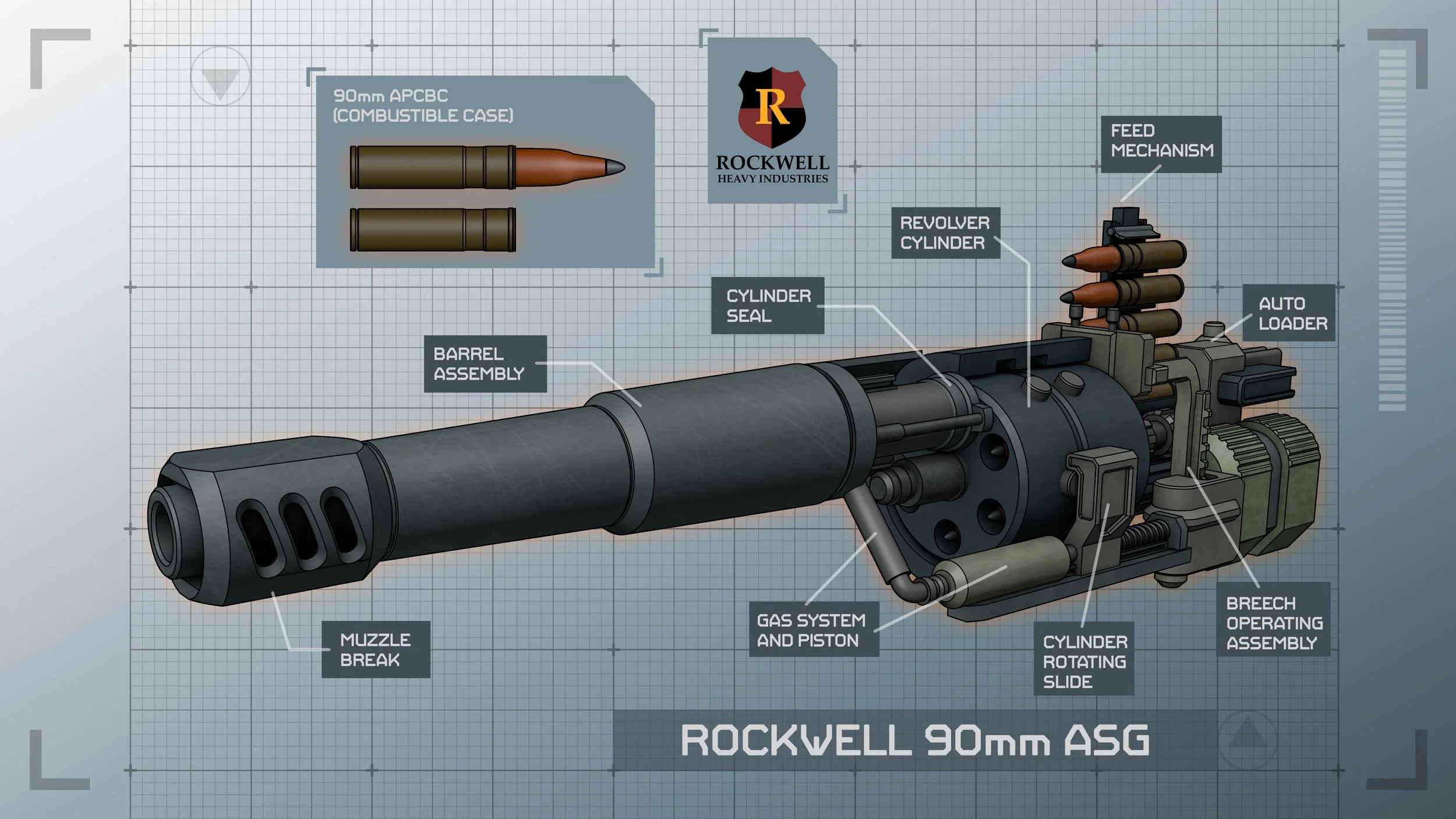
90mm Autocannon
Simply put, the gun proved marvelously reliable and durable, and surprisingly easy to service and overhaul. Rockwell’s gun would not stop shooting due to anything short of critical damage or faulty ammunition, and it filled graveyards and scrapyards alike with dreadful consistency.
Load Transcript
Archive: Firepower Through the Ages - A WegMaCo Historical Series
Episode: 12 - “AUTO-NINETY! The Rockwell 90mm Automatic Smoothbore Gun”
Among humanity's weapons of war, few have demonstrated the remarkable longevity of the autocannon. A design so effective and so versatile that even the most advanced energy weapons have failed to render them obsolete. Autocannons have served as mainstays of mobile warfare for more than four centuries, and perhaps none shine brighter in their long history of conflict than the Rockwell 90mm Automatic Smoothbore Gun.
Known colloquially as the crusher or auto-ninety by seasoned fighters, Rockwell’s flagship 90mm gun system was conceived pre-Rift during the early storm tank era. Though originally intended for installation on those early two-man armored vehicles that dominated the terrestrial battlefields of their time, the ASG proved flexible enough for use as a fixed defensive emplacement and field gun, and soon enough, for installation on HE-Vs. Reliable, robust, accurate and highly destructive, the weapon found immediate acceptance with national and corporate militaries alike, and quickly achieved ubiquity. The distinctive report of the gun would be heard in nearly every conflict zone through the following decades.
Rockwell’s design philosophy for the ASG project was simple: guarantee overmatch through delivery of accurate fire at a rate far exceeding all prior autoloading cannons of similar size, and do so with total reliability. For this task, Rockwell commissioned luminary weapons designer Dr. Martin Marcus to lead the project and oversee every facet of the gun’s creation. Dr. Marcus, in his genius, had determined that the sophisticated defenses armies relied on to counter increasingly advanced weapons were vulnerable to comparatively primitive attack in the form of overwhelming, sustained, direct firepower.
Fortunately for Rockwell’s shareholders, and unfortunately for those downrange, Dr. Marcus' prediction was correct and the ASG project succeeded: Delivering ammunition to the breech from a drum magazine via a linkless, helical conveyor system, the auto-ninety is capable of firing up to 180 90mm combustible case cartridges per minute. That benchmark, prior to its introduction, would have been regarded by tacticians and experts as not only impossible but completely ridiculous.
The auto-ninety soon proved itself much more than a madman’s brainchild: When married to the composite fire direction system of a storm tank, a single gun could easily outmatch a company of yesteryear’s main battle tanks. When fitted to an HE-V hardpoint, the corresponding increase in stability and recoil management allowed operators to demolish entire formations of traditional fighting vehicles. Opposing machines, no matter how heavy and how armored, could not hope to weather an auto-ninety’s punishment for long.
However, this tremendous firepower would count for nothing if the crusher couldn’t work in all climates and all conditions, and work every, single time. Dr. Marcus bestowed the auto-ninety with its legendary reliability by eschewing nearly every ordnance design principle common to his era: unlike energy weaponry, there was no need for an exotic power supply or delicate focusing lenses; the ammunition did not rely on then-fussy hypergolic propellant technology; there was no need to harden a guidance suite against electronic countermeasures. There was little to go wrong.
Even the cutting of weight was relegated to tertiary importance. By overbuilding every critical component group, from the vertically sliding breech block to the rammer-extractor assembly and smart fluid recoil inhibitor, the gun’s own prodigious mass acted as a heat sink and allowed generous margins against stress failures. Simply put, the gun proved marvelously reliable and durable, and surprisingly easy to service and overhaul. Rockwell’s gun would not stop shooting due to anything short of critical damage or faulty ammunition, and it filled graveyards and scrapyards alike with dreadful consistency.
But any weapon may only, truly, be measured by those who have carried it or those who have faced it. Consider the words of Captain Marie Barbier, a frontline HE-V pilot who served with the European Continental Alliance during the Baltic Access Dispute of <REDACTED>. Recalling her first time facing the Rockwell ASG, she said:
We knew the strikers had imported weapons, but we were told our technological advantage was total. Our particle lances were newly issued, at the time, but we had seen what they could do. We had used them in combat, they weren’t just demonstrator pieces. Our HE-Vs were new, too. They were equipped to deal with next-gen brilliant missiles, lasers, e-war. What our peer adversaries were using. It didn’t matter against those damned automatiques. They would hit you so hard and so fast, over and over, until you came apart. You couldn’t see, couldn’t hear, couldn’t keep your feet or draw a bead. You couldn’t think. The pounding! It was debilitating. While you waited for the lance to recharge, they just kept shooting. Constantly. Boom-boom-boom-boom. I got a hit, a hit, on one enemy. He didn’t fix me. I watched the gauge fill for my next shot, five seconds, and in that time he killed two of my friends. Those damn cannons… More arrived in theater and then they were everywhere. You’d hear them far off, roaring, like an avalanche. A constant, rolling thunder, on and on. I still hear that sound in my dreams, sometimes.
Remarkably, the auto-ninety endures today as a legitimate, and respected, frontline weapon. Countless mothballed caches of guns and ammunition have been uncovered, and their contents sold, stolen, and traded among the myriad belligerents of our own contentious age. Retrofit installations on modern warmachines have proven as successful today as back then, and even the most discerning of pilots still praise the gun’s sturdiness and punishing firepower. Such is its influence that modern manufacturers like WegMaCo have turned to Rockwell’s vintage, timeless design for insights in developing their own new autocannons, like WegMaCo’s own award-winning 34-40 family, optimized and precision engineered to mount and function flawlessly in all environments, from the cold vacuum of deep space to the corrosive atmosphere of Venus!
In 2384, the Rockwell 90mm ASG, the crusher, the auto-ninety, soldiers on, chiseling the epitaphs of the vanquished in twisted metal, and that is why it has earned its place as a true legend of the battlefield.
This historical presentation has been brought to you by WegMaCo Media Studios; a division of WegMaCo, a family company.
Illustration by Florian Mellies
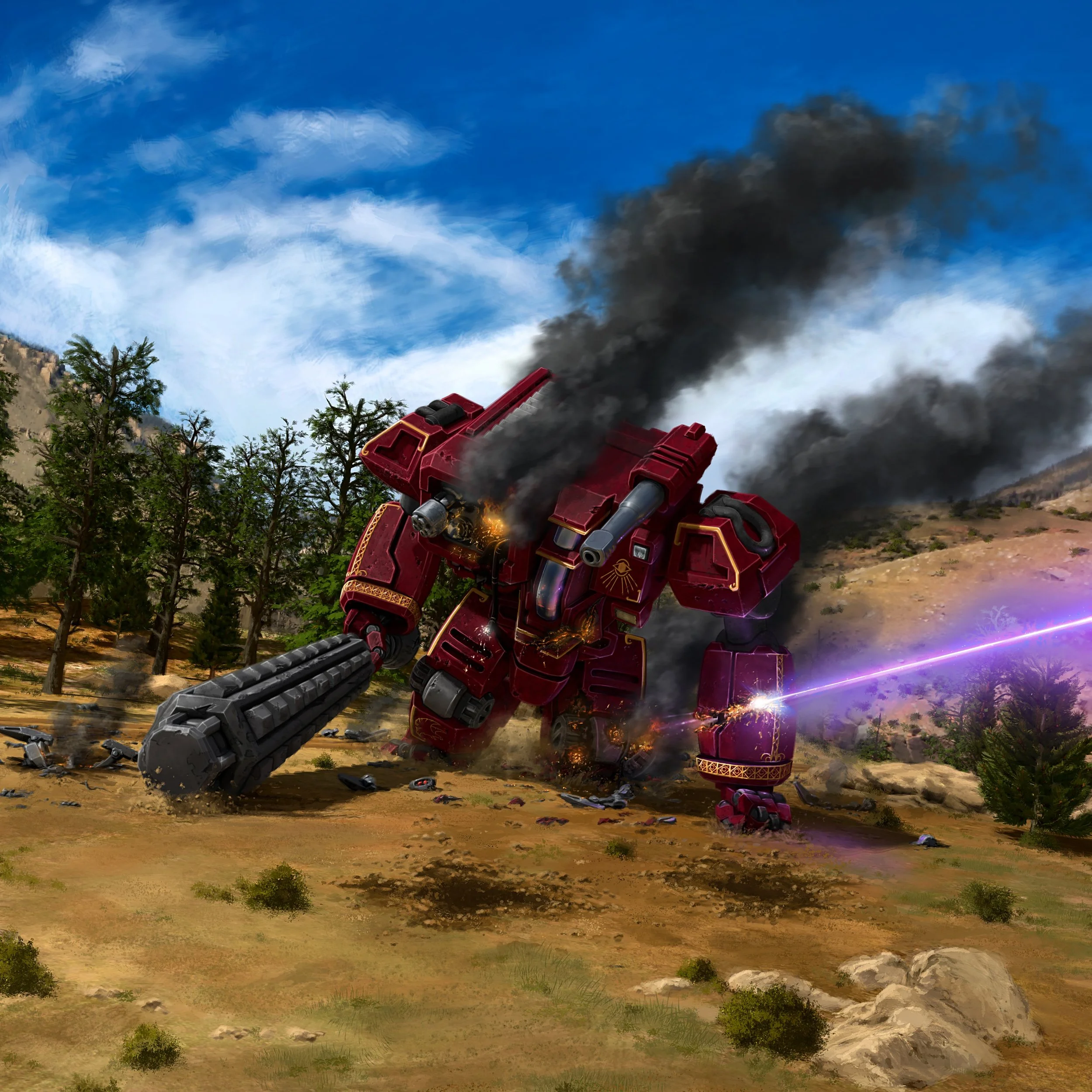
Archeology
The days leading up to a discovery were always frantic, exciting and exhausting for Dr. Higgins in equal measure. His career had taught him nothing if not that meticulous, grueling preparation was the foundation on which success was built. Soon the mission preparations would be complete, and not long after his prize would be in hand.
“Norm, please. You aren't seeing the upsides, the possibilities. We've been handed a lifetime opportunity here-”
Dr. Normand Higgins, dual doctorates in heliophysics and atmospheric physics, warily straightened up from the map table, looked to the ceiling, and massaged the bridge of his nose.
“No, Dee, I don't see an upside. There isn't one, besides laying hands on that data,” he fixed his younger colleague with an acidic scowl, half annoyance, half fatigue, and jabbed a finger at her. “You are compromised. Your sentimentality for these people has you snatching at any justification for us to just give up-”
Dupre and Ramirez, the senior security operators sharing the cramped mission planning space in the expedition van with the two doctors, both wished they were anywhere else.
“Sentimentality!? That's what you think this is!? You really are a bastard, Norm-” Seethed Dr. Deirdre Leah Culbertson, P.hD., biostatistics, like a rattlesnake with a toothache.
“I do. We aren't here to study the lives and times of some brain-addled, sun-worshiping hicks that went crazy in the pines. We are only after that atmospherics log. Dee, you're smarter than this.”
She was furious now, hissing. “You dragged us out here for yourself, for your own ends!” She swept an arm theatrically, indicating the staff in the van and outside in the camp. “The company sent us here to find-”
“Oh, cut the crap, lady! We all took the ride for our own reasons, you included!” Higgins was shouting now, and she flinched from his dart.
Because it was true: The two scientists, their many other colleagues and the security detachment besides, were originally detailed to Earth by the Selegin Cooperative in search of pre-Rift data and technology. But the Fargo Scientific Collective, as the group had dubbed themselves, went rogue years back. Independent. Off the preserve, as Dupre liked to say. Now they set their own agenda, far from the oversight committees and ethics boards back on Luna, still seeking long-buried secrets and insights that would bring fame and fortune, but for their own ends. For some in the group, the adventure was reward enough; freedom at last from labs, cleanrooms, and boardrooms.
Dupre took a measured step closer to the table and the raging scientists on either side, raising his scarred, bear paw hands in a placating manner. Scott Dupre was a battle-tested lifer with Selegin. He had led many expeditions with the Collective on Earth and, it felt like, endured many thousands of arguments between the scientoids just like this one.
Experience and knowing when to act counted for a lot in a gunfight and also when emotions ran high: Culbertson was going volcanic, her fumarole smoking and cracking. Another exchange and Higgins would lose his wits and become singularly focused on winning, actual objectives be damned. That outcome would cost them all time.
Dupre spoke quietly, soothingly, to Culbertson. “It's alright, Doctor C. We're not going in there to clean house. A little sneaky snatch-and-grab and we’ll have the data. Minimal casualties.”
She fixed him with a hard stare, glaring up at the tall, muscular trooper with the boldness of an angry child. “Minimal! Psh!”
Dupre’s manner and pitch didn’t waver. “We're good. You know that. If we're lucky we won't have to fire a shot for keeps. The lightest touch, doctor, I promise.”
Dr. Higgins spoke up, milder now, imploring gently. “Deirdre. If there was any other way, we would do it. We tried to negotiate, we tried to pay them off. You talked to them yourself! And who better than you?” He said the last with sudden, jarring sincerity. She wilted a little and he pressed. “And if not you, then who could get them to hand it over?”
Now it was Dr. Culbertson's turn to raise her hands, looking each man in the eyes in turn. Dupre knew this part of the song: her last-ditch try. “Please, gentlemen, just hear me out.” She was emphatic now, pleading, certain. “The Hand of Ra is a religion, a microculture, that has developed in-total, under extremis, and in isolation within just a couple of generations! Practically within living memory! This is the kind of thing that can make us in anthropology-”
Dupre indulged her with a gentle smile. Ramirez was stoic, eyes straight ahead on the compartment wall. Dr. Higgins sighed, exhausted. “Dee…”
She held up one hand, four fingers, started ticking through them. “Ever heard of Malinowski? Evans-Pritchard?”
“No one gives a shit about any of that anymore, Dee! Even if they did, and we put in the work, peerless work, we'd all end up dying broke. See reason! We can't set the terms off of something like that. You know that.”
Dupre watched the air go out of her, then. Her sad eyes, welling with tears, boring a hole in her colleague. She looked from Higgins to Dupre and back, searching for something to assuage her conscience. “I want your word, both of you. Your word! No killing! These aren't bad people.”
“I promise, doc.” Dupre lied, still smiling.
Higgins stuck his hands in the pockets of his cargo vest. His tone was chilly with implicit doubt. “Are they good people, Deirdre? They've dropped a few KKVs on folks because they didn't want to share. And you didn't feel quite so charitable about preserving that lot squatting in Boston U…” He glanced tellingly at Dupre.
“That was different. They were murderers. Rapists! Evil people that got what was coming to them.”
“Indeed. And fine,” Higgins turned to address his security operatives. “Boys, let's keep the body count as low as practical, eh? We don't want a hissy fit. Now,” His tone conciliatory. “Can we figure out how we're going to do this?”
—
The team had gathered plenty of intelligence on the Hand of Ra prior to approaching them, and in the days following the conclusion of negotiations. Despite access to a dreadfully powerful kinetic mass driver satellite, the balance of their technology was mercifully limited. A few armed industrial HE-Vs, basic firearms, technicals, and that was all.
They lacked any sort of drone support or even sophisticated sensors, as best as the Collective’s operatives and technical staff could tell. The borders of their domain were watched by single- or two-man units in the bush with binoculars and rifles, and one HE-V or another was operated around the clock on patrol. A week of long distance observation revealed coverage gaps during shift change that could be exploited, particularly at the northern fringe of the basin.
Higgins, Dupre and Ramirez went on for hours, pouring over the digital map table’s 3D topographics, along with an old, ivory-toned paper map illustrating the nickel irruptive, igneous and sedimentary formations in the region. Dr. Culbertson sulked in the background, listening, occasionally chiming in helpfully with her insights on the Hand’s psychology.
The plan resolved into a lightning asset raid. Two commando teams would go in on foot: one three-man team to neutralize the sentries, one five-man team to breach the old smelter complex, what the hand called the Temple of the Seeing Sun. The entry team would locate the control room and its data drive that served the attached weather station. It was suspected the detailed logs encoded on the drive, ones regarding coronal emissions prior to the Rift, would be most illuminating, or so Dr. Higgins believed.
In support of the commando teams, three HE-Vs: Dupree in the Aegis, Ramirez in a Buckler, and another pilot in an ultralight Kite. The heavier HE-Vs would move in to intercept any patrolling Hand forces as needed. The ultralight would accompany the entry team for close support and to ensure the Hand’s ace, their kinetic mass driver satellite, was taken off the table.
Eliminating that trump card was critical to the success of the operation and survival. This necessitated the jamming of the Hand’s communications apparatus, particularly the uplink that communicated with the satellite above, and their radios. This would be accomplished in tandem via a cutting edge ECM system installed on the Aegis, and by the sophisticated scrambler array backpacked in by the Kite. The two remaining Kites, another Buckler and a few squads of operatives on foot would remain behind at base camp for security.
As a contingency against a pitched battle or an unexpectedly large patrol, mine drones would be infiltrated overnight in the wee hours of the morning and left in ambush, if needed. The expedition had a whole rack of them slumbering in the belly of their LAS transport.
The Collective owned and traded on a vast stockpile of these deadly, modified “spiders”; sacrificial munitions able to position and conceal themselves, and even pursue targets. Each possessed a ferociously potent two-stage, armor-piercing charge and a rudimentary AI brain that was, basically, a simpler version of an HE-V’s combat controller.
The three men went over the rough details and timing of the plan several times. Careful consideration was paid to the numerous, round depressions, old and recent, dotting the Hand’s domain; certainly mass rod impacts, Ramirez noted grimly. Higgins would leave the intricacies of the tactical briefing to his men-at-arms. He would, though, personally brief the entry team regarding what they were looking for and how to extract it. If the data were to become damaged or corrupted by careless handling after so much work and risk, emotions would indeed run hot, then.
The days leading up to a discovery were always frantic, exciting and exhausting for Dr. Higgins in equal measure. His career had taught him nothing if not that meticulous, grueling preparation was the foundation on which success was built. Soon the mission preparations would be complete, and not long after his prize would be in hand.
—
The infiltration of the perimeter and entry teams took the better part of 16 hours. Good fieldcraft, optical camouflage systems and constant coordination with observer drones overhead allowed both teams to avoid detection and hide, waiting for the command to execute. Dupre ably directed it all from the cockpit of the monumental Aegis while he and Ramirez crept into their staging position deep in the forest beyond the northern rim of the great crater forming the basin. Doctors Higgins and Culbertson nervously watched the icons representing their team crawl over the illuminated map. Culbertson habitually chewed on her knuckle.
All the elements were set. Dupre left the timing of initiation to the perimeter team. The silent wait in the planning compartment of the expedition van was intolerable. Only the humming air conditioner was audible.
Suddenly, a gruff voice over the channel. “Sentries at point alpha subdued, no call, no casualties.” Culbertson shivered in gratitude, or relief.
Dupre, then. “All units, this is Lead. Green light, green light, green light.”
The jammers would be activating at that moment. The Aegis and Buckler would scramble up the Northern rim of the basin, descend, and hold position in cover a few miles north of the settlement where they should encounter a Hand HE-V on its usual patrol. At the same time, the entry team would break from cover and sprint to a building in the Temple complex to gain access. There was no way to know ahead of time how extensively the interior of the complex had been modified; they'd have to find and perhaps fight their way through. Tailing behind the entry team, the Kite, with scrambler active, would move to secure the Hand’s HE-V sheds, preventing any serious reinforcements from standing up.
After a few more minutes of silence, things happened fast.
The Kite’s pilot spoke, her machine’s rapid footfalls audible in the background. “We're spotted! Yeah, civilians are running around in town, now. En route to HE-V hangar, containment proceeding!”
“Entry team has breached structure, beginning search n- You! Don't move, don't move!” Then silence.
Dupre, again. “I’m set, Ramirez. One, count one, HE-V coming our way. It’s a big one, packing for CQC. Watch the distance, wait for my cue. Steady, bro…”
“Roger, lead, I’ve got him on scopes. I’m behind the spoil, ready to rabbit.”
Higgins watched the map and saw a large orange triangle closing on two, friendly green ones. The smaller green one dead ahead of the hostile contact, Ramirez’s Buckler, was concealed between mountainous piles of rocky refuse, leftover waste from decades of mining. Dupre’s Aegis was tucked in a scrubby woodline, perpendicular to the approaching HE-V’s path, hidden and ready for a flank shot. Higgins looked up to a monitor relaying a hovering recon drone’s camera: the fuzzy feed showed a huge, patchworked mining rig. It was an old ultraheavy Klondike, packing a barbaric, flanged club the size of a tree in one hand. Whatever heavy tools it once carried had been pulled from the voluminous torso bay; only a pair of short, thick cannon barrels protruded from within.
“He’s still coming, Rammy. Get set, I’ve got you covered.” Dupre whispered over the comm.
“Turn off, turn back, turn somewhere, you motherf-” Remirez growled under his breath.
“He’s getting too close. Get his attention, now!” Dupre snapped.
Higgins was sweating despite the AC. Culbertson was as pale as flour. Ramirez hopped the Buckler sideways from cover, directly in front of the Klondike approaching some 200 yards away on the northbound road. It jerked to a quick halt, pilot no doubt surprised at the sudden appearance of the birdlike, stone gray Buckler. The machine’s great club came up defensively, cocked to strike. Most fights began as a conversation, Dupre knew, but the aggressive jamming his ECM system was pumping out precluded a simple radio call.
In the Klondike’s cockpit, one of the Hand’s protectors, shocked, was indeed trying to hail and raise home at that moment. Shrill, warbling noise and static was all that greeted him on the headset. He abandoned his attempt, quickly aimed, and fired two short bursts from his autocannons. Luckily for Ramirez, the industrial HE-V’s retrofitted targeting system was shoddy and both went wide into the mountains of spoil, sending little avalanches tumbling down. The Hand pilot pushed forward, full throttle, and the Klondike hurtled toward the smaller Buckler like a juggernaut.
“Light him up and git, Rammy.” Dupre moved one hand to a subdisplay’s controls as he spoke, clicking a succession of four keys. He returned his hand to the stick and advanced himself, the powerful Aegis pushing aside and felling mature trees with ease. The Buckler’s right arm laser snapped up and a brilliant beam of light appeared between it and the Klondike, a spray of slag pattering to the dirt around it, smoking. This had no other effect than scarring the industrial rig’s torso. Having bloodied the rushing bull, Ramirez spun the Buckler nimbly, hard, on one foot and dashed behind the spoil before the Klondike’s autocannons spoke again.
Around the Hand HE-V, on either side, from four patches of oddly disturbed soil sprang four robotic terrors, each the size of a compact car. The Collective’s mine drones pivoted and homed on their target using four, pointed, stilt-like legs. Together with the legs, optical sensor clusters at the front of their squat, rounded casings leant the weapons an appearance that earned them their nickname. They closed in quickly, too quickly, and the Klondike struggled to cancel its momentum and react.
The first mine neared, crouched and lunged for the right leg a moment before the club flattened it, explosives detonating harmlessly into the ground and against the club’s raw bulk. Before another could be intercepted, they converged. One reached the left knee, latched on, and detonated. A jet of molten copper from the mine’s belly lanced through the joint, mangling actuators and motor bundles within. The Klondike staggered, but its pilot expertly shifted the weight to its good leg as tip-over alarms howled in the cockpit.
Another targeted the already-savaged knee, nearly severing the lower left leg assembly entirely. The last agilely scaled the tall HE-V, summiting the weapons bay before exploding and wrecking both autocannons inside. Inside the stricken machine, the Hand’s devout pilot prayed that Ra might save him as he had done before. His prayer was cut short as he was whiplashed forward twice: failing to arrest the fall, the Klondike dropped first to its knees, then fell forward to its hands, its balancer unable to cope with the sudden, catastrophic damage.
Inside the FSC expedition van, safely removed from the violence unfolding some miles away, this drama played out on the map in only a few seconds. For the Hand of Ra’s most faithful and capable protector, the fight was over before it started. Riveted, the scientists watched and listened in silence, barely breathing.
“Good takedown.” Ramirez remarked coolly.
“Circle back, I’m about to pin him. I’ve almost got the shot.” Dupre had reached the edge of the woods. He had a clear line of fire on the damaged Klondike. Not one to take any chances with a wounded predator, the Collective’s security chief aimed carefully and fired one of his primary weapons, a Tri-Tac Sapphire Series laser. A beam of searing violet, so bright it turned the light of midday sun into stark photonegative, cleaved through the left forearm of the huge rig in a blink. The metal of the limb glowed and it buckled at the cut, and the Hand’s huge HE-V crashed hard into the dirt.
The Aegis emerged from the woods, articulated shoulder mount holding the deadly laser absolutely steady. Again Dupre fired, this time at his target’s remaining arm to take away the Klondike’s only remaining weapon. Now his enemy was crippled, defenseless and utterly helpless, but probably alive. Promise made, promise kept. He turned his focus back to the mission and asked his team for a sitrep.
No word from the entry team. The Kite’s pilot, Jankowski, reported she’d had to back off a few bold souls trying to slip past and get to their HE-Vs, and others had taken potshots at her bulbous ultralight with rifles. So far, no casualties, though she anticipated a warning shot from her handheld would soon be needed. Situ under control, then, but maybe not much longer. Dupre decided to escalate and close in on the little village. If any significant reinforcements were to appear, they would come from there. The Klondike was certainly out of action for good.
“Ramirez, hustle up there and give Jankowski some back up. It’s getting hairy. I’m right behind you. Weapons tight, but sing out if the locals act up. Stay ready for the handoff.”
“You got it, sir.” Ramirez emerged from the hills of crushed rock, Buckler sprinting flat-out down the road toward the village.
Dupre glanced again at the smoking Klondike, face down in the dust, and the laser followed his gaze. No movement, though its reactor was still hot. He turned to follow Ramirez. “Base, this is Lead. Operation still underway, no problems. Standby for updates.”
It was another 20 minutes before the entry team emerged from the winding innards of the old smelter complex, objective in hand: A bulky, crystalline data drive, about the size of a small suitcase, tucked safely into a protective bag as Dr. Higgins had instructed. This was promptly handed off to Ramirez who then raced back to basecamp. The rest of the security operatives took pains to cover their withdrawal by collapsing the flimsy building around the HE-Vs inside. None of the Hand’s protectors felt brave with the lethal Aegis standing watch. The aerial drones monitored the security team’s backtrail for any pursuers. None followed. Regrettably, one robed fanatic, a woman, encountered inside the Temple had been armed, and was shot and killed by the entry team in self-defense.
All in all, the operation was textbook. A great success for the Collective. Dr. Higgins waited anxiously in the side door of the van for Ramirez to arrive. He did, and his spindly HE-V was scuffed and sticky with sap from collisions with innumerable tree branches during the sprint home. The sleek corporate HE-V squatted as Higgins jogged over eagerly. The hatch over the pilot’s compartment opened and Ramirez, still hooked up, stood and set the precious cargo into the palm of his machine’s giant, waiting hand. The Buckler reached down smoothly and delivered the drive to Higgins, beaming, who picked it up like his own precious, baby boy.
Illustration by Florian Mellies
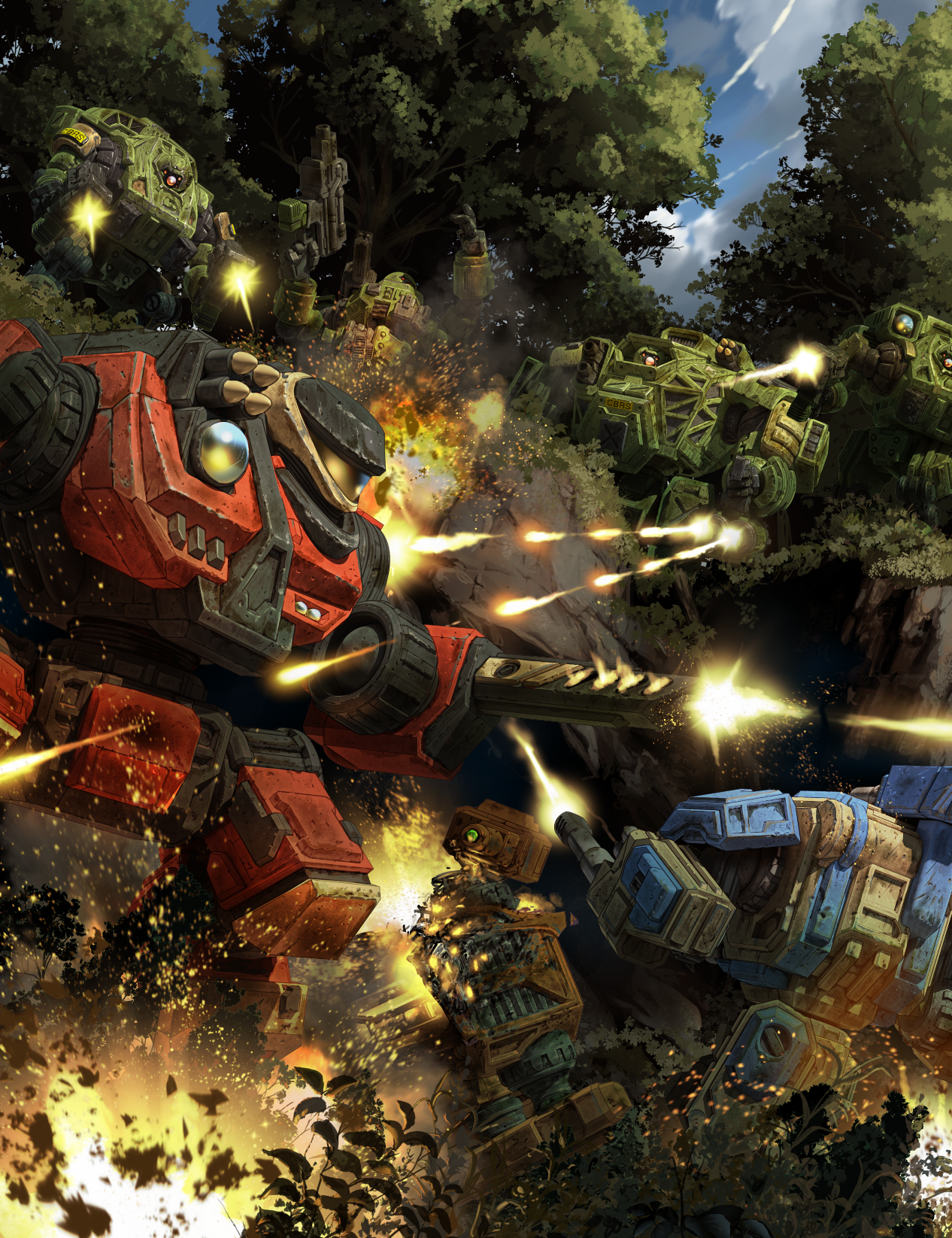
Code: Typhoon
Barron laid into a rust red Daiko, the nearest threat. The chunky medium had peppered him with autocannon and railgun fire but his Zuma’s armor was unbreached. Barron hoisted his over-under shotcannon. Ejected cases the size of trashcans spun to the dirt as the cavernous bores boomed, raking the Daiko with clouds of forged penetrators.
Cerberus Short Story “Code: Typhoon”
1532Z
May 4th, 2385 ESY
Somewhere in the Rocky Mountains, North America
Guran brought his HE-V to a halt mid-stride, watching the dead branch tumble to the forest floor, the panoramic cockpit display tinting the scene in high-contrast electric blue. He had little doubt the tremors of his squad’s passage sent it falling. External microphones relayed the splintering, snapping racket to the earcups of his helmet.
Guran’s jaw clenched. It could not have been louder than the squad’s clanking footfalls, but even so he feared compromise. The remoteness of the hidden cache was in part its own protection, but complacency was the mother of many defeats.
“Clear, no contact. Falling debris,” Guran said into the mic of his helmet, transmitting directionally on a short range millimeter wave band. “Forward on. Barron, tighten it up, you’re a step behind.” He willed his own machine back into motion, winding through the towering trunks covering the foothills of the mountains.
“Yessir.” Barron’s terse reply, laced with background static. In truth, Barron’s heavy Zuma was hardly out of position. Guran’s correction was more a demonstration to Keene, a recent inductee who served during the recent two-fer contract in Africa.
Keene spoke up. “Sergeant, a question?”
Guran pivoted left, verifying Keene’s machine was in line-of-sight of his own. A quick glance at his comms board showed he had already switched to optical transmission, point-to-point, reducing the possibility of discovery to almost nil. Smart.
“Go ahead.”
“About the last contract. Won’t our turning on Empyrean hurt our prospects in the future? I mean to say, how can people trust us to honor a contract if we publicly double-cross our original employers?”
Guran smiled to himself. Keene was a sharp pilot with a fighter’s instincts, and a natural in the speedy Chesty he rode now. But he was not yet attuned to how Cerberus handled the business of contracting.
“We didn’t turn on them,” Guran catechized him. “Empyrean breached the contract their legal department agreed to. They signed. All above board. In breaching, the contract was voided in total, including the loyalty clause. The Sahel Alliance legally hired us, and their credits cleared. It’s all on record.”
And that whole situation was just as well, Guran thought. Empyrean had threatened hellfire and damnation in the aftermath. He also knew, but did not add, that Cerberus’ hopes of furthering their secret cause through that same contract with the megacorp had not panned out, so it wasn’t any great loss.
“Gotcha, sir.” Keene said.
“War is just another form of economics, young gun. Don’t worry about where the money flows from as long as it spends.” Barron chimed in with grim delight.
“That’s enough. Cut the chatter, watch your sightlines.” Guran ordered lightly, and the three pilots moved on through the remote wilderness under the towering trees, leaves trembling in their wake.
Elsewhere, not far away from Guran’s squad, Cerberus Colonel Alton Mitchell swayed with the movement of the command wagon as the convoy crawled over the rough, undulating terrain. The dim interior was lit in actinic tones of green and yellow from workstations and banks of displays. Those displays relayed a riot of data: the locations of the elements in his platoon, radio traffic and transcriptions, sensor relays, atmospherics, more.
A veteran of dozens of campaigns, Mitchell took it all in at a glance, understanding the disposition of his forces, his men, instinctively. In a few hours time they would be at the pickup point and then boosting for orbit, freshly resupplied and safely away from the hidden facility where HE-Vs and other war materiel was stashed: Cerberus’ ace in the hole.
“Roger that, wait one!” At a nearby station the tense tone in the junior officer’s voice alerted Mitchell instantly.
“Talk to me, Kelly.” Mitchell said from over the man’s shoulder.
“Sir, advance team reports a large group of armed unknowns, looks like an expedition. Civilian vehicles, earthmoving equipment and HE-Vs with mechanized infantry in attendance. Probable freelancers. They’ve hailed them, attempting to ascertain intentions.”
“Cover story?”
“Standard. Warning them of trespass in a ‘North American Prefecture’ restricted area. They aren’t backing down.”
Mitchell felt the familiar buzz of adrenaline seeping into his blood. “Visual? Punch it up right here.” He tapped one of the monitors.
Mitchell deduced from the grainy image that his advance element, two light Chestys and a trio of Grunt ultralights, were hull-down in a draw. The camera feed was relayed from one Chesty’s sensor suite. Installed at the end of an articulated boom, it peeped over the ridge like a periscope.
The camera showed a swarm of civilian off-roaders, immense mobile digging machines, complicated-looking surveyors, and five HE-Vs of various classes and colors. One, a massive Strix ultraheavy, sported neat rows of missile launchers in the hull and twin, long-barreled railguns on the right arm. The other arm was a big, powerful-looking mining drill. Also in attendance were thirty or so infantry, presently spilling out of their APCs and taking up hasty fighting positions near the edge of the clearing.
“Patch in to Beagle One.” Mitchell ordered.
“Live, sir.”
“Beagle One, this is Devil Six Actual. Any markings on these vehicles?”
An affirmative from the radio, and a moment later the camera feed zoomed in. On the industrial machines, new and relatively clean, a crisp logo against a white background: Ember Geologic Solutions.
Corporate sponsored. They were out here looking for something. Digging for something. Mitchell suspected enough and that sealed the fate of the expedition. He looked at the camera feed one more time: armed or not, there were plenty of civilians, innocent civilians, among them.
Mitchell’s conscience gnawed at him over the waste of life, but there was simply too much at stake. Countless lives, the very future of human endeavor rested upon Cerberus’ innermost and secret cause. He could not risk it, would not allow it. He would uphold his oath, the one he swore, bloodily, at his own induction so many years ago.
He snatched the mic from the comms station and keyed it to address every vehicle and every HE-V in his command. “All elements, this is Devil Six Actual. Code Typhoon is in effect. Repeat, Code Typhoon is declared.” He replaced the mic and issued orders to his staff at an auctioneer’s pace.
Guran heard the Colonel’s declaration and chills crawled over his skin in the Earmy’s balmy cockpit. Code Typhoon! A second later, the computer updated his own displays with threat locations, attack vectors and timetables. Friendly ECM jamming notifications popped on. Not far ahead, the rippling thunder of heavy ordnance and explosions.
Guran answered the order. “Broadsword copies, Typhoon is in effect. On the way!” He switched back to his squad. “Check your vectors and advance to contact, now!” Guran spat into the mic as he lit his particle cannon’s coils. He strode headlong through the trees, battering down smaller trunks without slowing.
“Sir, Typhoon-?” Keene spoke with trepidation.
“Full cleanup, no witnesses,” Guran replied. “Do you copy, Corporal?”
A long beat. “Yes sir, understood.”
“Good.” Guran answered, icily. They had less than a minute at this pace until they joined the battle. Ahead smoke drifted, foliage was shredded by tracers and the searing glare of battlefield lasers boiled sap and burst trunks.
Guran watched the three Grunts from Beagle squad scramble down the draw, preparing to counterassault the encroaching infantry. While difficult to root out of built-up areas, the lightly armed ultralights would not endure in a direct clash with larger HE-Vs. Another member of Beagle in a Chesty rose to reposition, pilot unleashing a covering burst from his rotary cannon.
It toppled suddenly, cored out from two railgun hits, glowing holes appearing on its reactor housing in a gout of glowing shrapnel. In one side and out the other. Guran flicked a glance at his tactical map, saw the Chesty’s status indicator dim to charcoal gray and he knew the operator must be dead.
“Barron, with me, go straight in. Close and destroy. Keene, go right, flank and cordon,” Guran ordered briskly. Barron and Guran crested the ridge nearest the clearing together. The scene was chaos: Shattered or flaming wreckage, bodies and parts of them, everywhere. Just ahead, four remaining hostile HE-Vs maneuvering and aiming weapons. Guran’s computer bracketed a nimble, bird-like Scarab crossing fast ahead of him. Warning chimes sounded.
Shooting from the hip, he triggered his particle cannon, once, twice. Both bolts struck the Scarab, one just under the cowl, the other in the hip. The Scarab’s armor and metal skeleton melted and ran together in rivulets of orange as it slowed. A third bolt, well aimed, slagged the cockpit and instantly roasted the pilot inside. It went down smoking, plowing up a trench in the tormented earth.
Barron laid into a rust red Daiko, the nearest threat. The chunky medium had peppered him with autocannon and railgun fire but his Zuma’s armor was unbreached. Barron hoisted his over-under shotcannon. Ejected cases the size of trashcans spun to the dirt as the cavernous bores boomed, raking the Daiko with clouds of forged penetrators.
The freelancer HE-V withered, smoke and flames licking from rents in the hull, and finally fell backwards, one arm pointing dramatically skyward. Then the Strix hove into view from behind one of the giant industrial rigs. Its low, long torso tracked toward Barron and Guran saw its killer railguns swinging toward a firing solution.
“Barron, jink left!”
Too late. A bright line of rotary cannon tracers from Keene washed over the Strix’s mining drill and left side, most ricocheting and doing little harm to the monster. A beat later two concussive flashes and one hypersonic slug lanced deeply into the lower torso of the Zuma, the other just missing the pauldron and slicing through the right shoulder ball joint. The entire arm tore away in a shower of tortured metal, dragging Barron’s dual shot cannon down with it.
Barron had long flirted with Death, and he knew today she would finally kiss back. “Cover, I need cover! Broadsword Two is in trouble!” He pivoted right and tucked his left arm to his head, bringing the Zuma’s left arm up in a shielding gesture. Unseen, two enormous missiles lashed out from the closing Strix, multi-stage warheads further mangling the beleaguered warmachine.
Barron’s main display crackled, sparked and went dark together with the subdisplays. With the complex web of sensors inside the Zuma severed, his haptic suit imparted no sensation and relayed no instructions. Blind and helpless, Barron awaited the crushing moment that would end him.
Guran pushed his Earmy into a dead sprint across the clearing and toward his brother-in-arms. Past wreckage, past the two remaining Grunts bounding from cover to massacre hapless, routed infantry. Closing in, the Strix’s drill spun up to full speed, a blur. Barron’s HE-V keeled over to its side, wrecked. Guran wasn’t unnoticed. The Strix’s pilot swiveled to aim its railguns at the onrushing Earmy. A threat warning blared shrill and insistent in Guran’s helmet and he slipped right, twin slugs flashing past and burrowing into the ancient flank of the mountain.
No time to shoot after the evasive maneuver. He ditched the particle cannon and with his left hand drew the combat blade, fully six feet long, point down. The Strix again pivoted, seeking to mangle the onrushing Earmy with the drill, but Guran fired his jump jets and raised the blade, leaping and colliding with the Strix before driving the molecular-reinforced carbide tip of the blade straight through its canopy. The two machines went down in a tangle, metal howling in protest. Guran shook off the impact, wrenching the great knife free; a slick of red gore on the blade confirmed the kill.
—
With the fighting over, the cleanup operation went on for some time. The dead among the freelancers were ensured so. VIPs were rounded up from among the survivors for interrogation. They eventually joined their departed comrades. Every Cerberus operative upheld their sacred oath, Keene among them. Intelligence analysts pulled storage drives and recovered telemetry from HE-V wrecks, collected personal PDAs, pilfered journals and notebooks; anything that might provide actionable info on who these people were and who sent them.
Arrangements were made to move most of the wreckage and many of the bodies to a site far distant from the cache but no less remote. That unsavory necessity of deniable operations was a red herring for whoever might come looking for their lost expedition. Since the Rift, terrible things happened to the unwary all the time in Earth’s northern hemisphere.
In the command wagon, Mitchell mused over the most important revelation gleaned from the aftermath. Ember Geologic Solutions was a wholly-owned subsidiary of Empyrean Reach; their spurned and badly beaten former employer.
Someone at Empyrean now wanted to know all about Cerberus, and they weren’t just asking. Drawing the curiosity of a megacorporation would complicate things, but Mitchell knew from past experience such curiosity could be turned to their own ends.
Much later, and far removed from the battlefield, an Empyrean Reach executive re-read a report, considering implications, probabilities, possibilities, and the intersections of each. The summary had said simply, Contractors overdue, missing, presumed lost. No further status reports from embedded asset; expungement probable.
Closing the report he set the tablet on the inky vastness of the volcanic glass desktop, a slab cut from the heart of Io. Fingers steepled in the cool, silent vault of his office, he thought for a time. It was curious that the Cerberus Group, conceptually, was a black hole. Their purpose was, in reality, defined by who and what disappeared around them. A boundary that nothing could probe and escape.
Answers resolved in his mind, more plans and possibilities taking form. He opened the tablet again and began composing a directive to one of the many black bag resources at his disposal.
Illustration by Eldon Cowgar
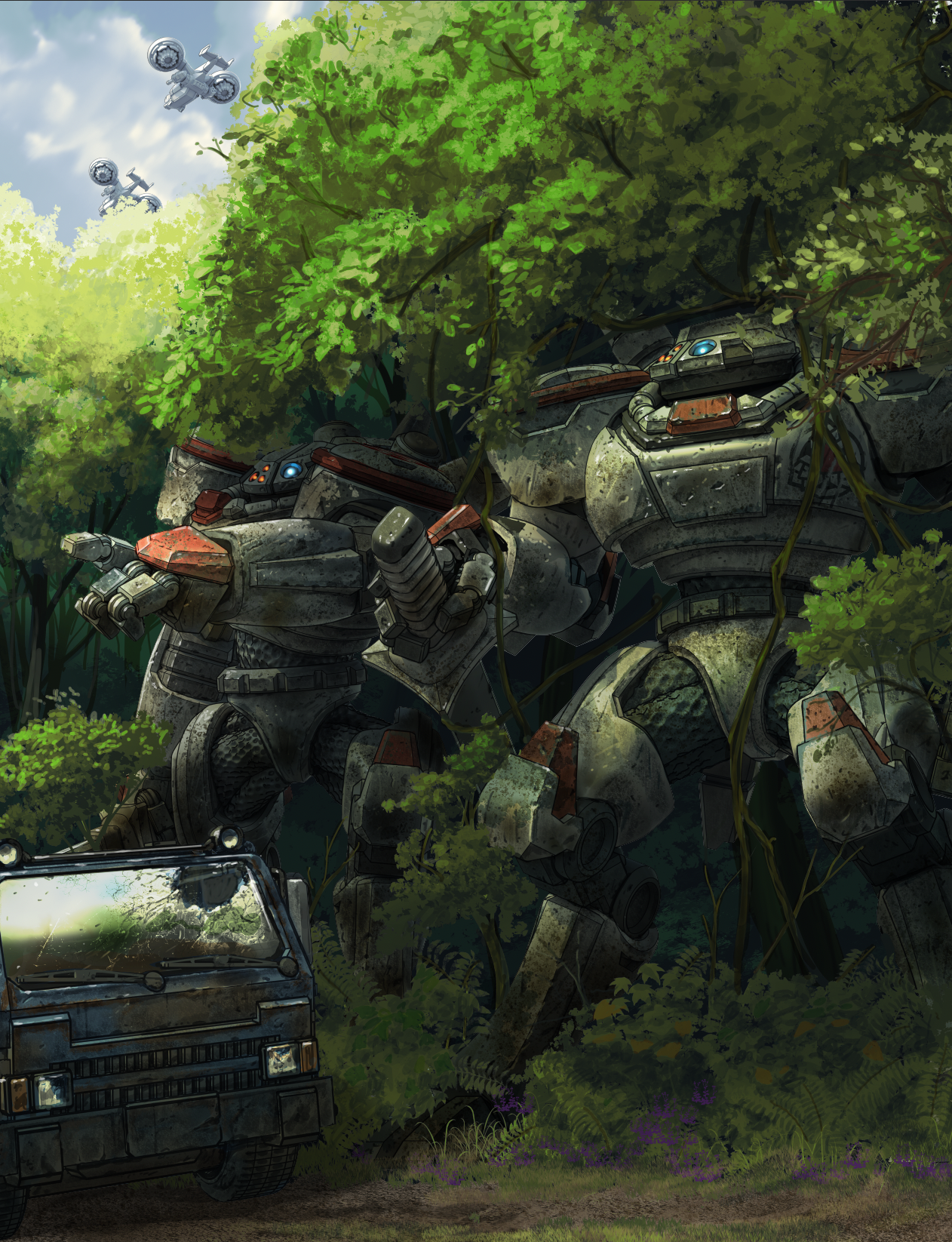
Takedown
A sleek, rounded, bipedal HE-V rose on roaring plumes of superheated air, over the ruins on the formation’s left and directly into their midst. This was no Redback machine. Berg knew in the first second. Pale, porcelain white bodywork, blood red trim. Bold. Had to be corporate. No other belligerents wanted you to know exactly who and where they were.
February 2nd, 2386 ESY
Lunar Security Authority Surface Protection Force Annex
Mare Serenitatis, Luna
“Eleven. Twelve. Come on, Lex, bust ‘em out! Sloppy, that last one didn't count. Twelve…” Lucas Stefanson stood spotting for his teammate, Lexine Benitez, as she ground through the last set of bench presses. Her face was shiny with sweat and tense with exertion. The Protection Force team room on Sublevel Two was a cave, a rat's nest, converted from an old storage room for the express use of the Lunar Security Authority’s HE-V pilots. Workout equipment, tattered furniture, an impromptu bar surrounded by trinkets and talismans, and other paraphernalia packed the space. It was shabby, a little grimy, and smelled faintly of hydraulic fluid and lunar dust.
“Eighteen. Nineteen. Aaand, you got it, you got it, you got it, twenty! That's the way, Lexi!” He took the weight of the bar and helped her rack it. She sat up with a gasp and reached for her water bottle.
“Man. I swear the gravity decking still isn't enough. You lose your muscle tone so fast up here.”
“Nah, you just got to spend more time moving the weights. That's all there is to it, lady.”
“I'm telling you, there's a difference.” She had a long pull off of the water bottle. “Hey, you hear Third Section got into it down at Tranquility yesterday?”
“Something about a raid on a storage site?”
“Yeah. Some piece-of-shit belters moving weapons through. Had a couple glowflies with them. One of the guys from Three told Ma one of them spilled his guts, swore Echelon hired them to do it. Big money.”
Stefanson wiped his hands off on a towel. “Right! And the moon's actually hollow. Gun runners’ll say anything.”
“Yeah. Whatever, we just don't need a repeat of Ellison's Rise. Terrorists are going to get what's coming to them, no trial if I have my way. And if any corp death squad types want to try their luck, I'll burn them down too.” She held out her hand, and Stefanson delivered a stinging high five.
“Damn right. We’ll show those arrogant dicks how it’s done. Suits playing at being soldiers, psh. Try me.”
Across the team room, an older pilot sat on a tattered vinyl couch reading an old, dog-eared copy of Firepower! He lowered it and glared over the top at his younger associates.
“I never pinned either of you as suicidal types.”
“What the hell do you mean, Berg?” Benitez asked derisively.
“I mean I don’t even want to hear you joke about that. You don’t know what you’re talking about.” He glared now, serious.
Youthful arrogance covered much, including obvious warning signs. Buzzing with the high of his own hard workout, Stefanson fired off a retort, smirking. “Yeah? If you’re scared of the salaried slobs you should maybe hang up your guns then, eh, Berg?”
Benitez’s lip curled for a moment in second-hand regret. Erik Berg’s eyes grew cold and distant in the way a man’s do when he’s ready to fight for keeps. The space between the two pilots vibrated with animosity for a moment, then stilled. The veteran closed the magazine, set it aside, rose and walked to the table, never taking his eyes off of Stefanson. He flipped a chair around and straddled it. Hoping to defuse the tension, Benitez also sat and Stefanson followed.
The older pilot spoke again, solemnly. “No joke, kiddies. The best rigs. Best equipment. Best training. They’re no amateurs, none of them. All the corps pay the best and so they get the best, or raise their own. Killers. Real killers. VisalCorp, hell, even Selegin will give you a hell of a fight. You don’t have the stomach for it. Echelon sends in one of their stabilization teams? Your story ends there.”
Neither of the young pilots said a word. Recycled air rattled loudly through the vent. “But you fought them.” Benitez said.
Berg nodded slowly. “I did. When I served on Earth. Australia.”
—
Colonel Mosby’s entourage was two teams, eight machines total. Two Corsos and a Daiko escorting the Colonel’s Shepherd, his personal guard, his praetorians. The other team brought the big guns to pound the corporation’s mercs into the mud. Two more Corsos and a pair of old, gnarly, tracked Volstreckers, all set up for direct fire support. Berg was the Colonel’s second in the field for this op, and rode one of the Corsos in an escort slot.
Their opposition was a mercenary outfit called the Redbacks. Well-equipped, fairly competent, aspirations of going big league. VisalCorp was displeased with Victorialand’s refusal to sell or lease their restored germanium refineries near Adelaide. The government and the Victorian Army’s leadership found it self-evident that they’d hired the mercs to cause trouble in retaliation. Visal had denied everything, of course, and the mercs had coincidentally taken over one newly opened facility the day prior, one of several in the region. The Ministry of Defense had decided enough was enough, and Colonel Mosby elected to lead the liberation sortie himself.
Berg had reflected privately during the march that such an operation did not, in fact, require the Colonel's personal presence. Direct action missions never benefited from the presence of senior officers. Mosby was like that, though. A mustang who had come up through the ranks running an HE-V and leading fellow pilots, and the grunts adored him. Some twenty years of service, and he still liked to be out front.
Cynically, Berg judged the propaganda value of such stunts immense for the Colonel, politically speaking. A staunch and very vocal anti-corporatist, and patriot, it wouldn’t be long until he retired and made an immediate bid in politics with the full support of the Australian Shipbuilders Guild. The Colonel’s peers and immediate subordinates, though, feared it was only a matter of time until he went down in flames, something sure to throw the ranks of the Army and the nation into turmoil.
"Passing nav point lambda, coming up on the refinery access road. Check grid reference, maintain formation,” Mosby said over the net. "Recon confirms Redback pickets approx twenty-four klicks out. Immediate engagement expected on approach, but keep weapons tight. Do not fire unless fired upon."
‘Copy’ and ‘yessir’ all around. Despite the Colonel taking personal command, the mission was standard. Routine. Berg and the teams had done this sort of thing many times. The HE-Vs maintained a formation like a squashed diamond with the Colonel in the middle. Better to allow overlapping missile defence while permitting most of the formation to bring their firepower to bear in any direction, on demand. The two Volstrekers, loaded for bear with heavy autocannons and HE-V-cracking missiles, rolled along, side by side, at the front.
Berg assessed his sensor board; passive pickups showed nothing in the skeletonized, old facilities ahead, on either side access road. He spoke into the helmet mic. “Tighten up, don’t hug the shoulders. Watch the flanks.” He watched the blue icons representing his fellows compress on either side of the Colonel’s HE-V. Sparse, broken ruins surrounded them; slag heaps, rubble, and forests of old, rusty pipes. Leftovers from a bygone time. Not many places to hide, and the Redbacks were far ahead yet.
But he had long ago learned to recognize the feel, the scent, of imminent peril. An instinct most combat HE-V pilots developed early, or else perished. Right then, his flesh crawled.
"Break! I've got near signature, eight thirty," said one of the other escort team members, Carrow, a woman he'd served alongside for two years. "Faint, though. May be-"
Then they were on them.
—
“Who did you fight? Which corp?” Stefanson asked, no longer cocky.
“Visal once, technically. They had a few of their own advising the Redbacks. The other time, the last time, I, I don’t actually know who they were. Echelon? I think they had to be. But…”
“Don’t know like ‘deniable’?” Benitez asked, slightly confused.
“Not exactly. They, uh, just came out in some shit you wouldn’t believe.”
—
A sleek, rounded, bipedal HE-V rose on roaring plumes of superheated air, over the ruins on the formation’s left and directly into their midst. This was no Redback machine. Berg knew in the first second. Pale, porcelain white bodywork, blood red trim. Bold. Had to be corporate. No other belligerents wanted you to know exactly who and where they were. At first glance, he thought the ambusher was a Buckler, and feared that VisalCorp had taken off the gloves and sent their best. The rig’s silhouette, too, was unknown to him: Smooth and sculpted, a flat, pan-like head. And no articulated missile pods, no long-barreled laser. Just a single, thin combat blade gripped in the machine’s hands, nearly as long as the HE-V was tall. Some six meters of molecularly-reinforced carbide alloy, its cutting edge reflecting the orange light of the Australian sun in cold silver.
Orders were shouted over the net, and the formation reacted, but too slow by half. The unknown attacker landed, struck Carrow’s Corso twice from behind and it collapsed, legs cut from under her. It then launched into a sprint, fast and utterly without hesitation toward the Colonel, into the teeth of machines far outmassing it and their killer guns.
Situated between the attacker and Colonel Mosby, Berg had just pivoted to lay his own weapons on the rushing HE-V when other hostiles appeared. One plowed through the roll-up door of an old service bay ahead, emerging the moment the leading Volstreckers had stopped and swiveled to address its comrade. That one also carried a long blade. Then two different, larger, machines leapt from the opposite side and laid into the formation, the cutting edges of their larger swords wreathed in barely-contained plasma.
He and his compatriots were embroiled in a wild, point-blank brawl, one they were ill-equipped to win. The smaller hostiles converged on the Colonel’s Shepherd from opposite angles. The other two quickly dismantled the hulking Volstreckers, their heavily-armed linebackers, with fluid, flashing strikes, carving through tracks and weapons and hulls. Explosions bloomed from sundered metal as screams of rage and fear sounded over the net. The phantoms dashed between the Victorian Army HE-Vs, never allowing more than a moment of exposure as they hacked and dodged.
Far too close for rockets, Berg aimed and fired both rotary cannons at the cyclical rate, struggling to track and inflict some damage on his far nimbler foes, to catalyze the assault. It was then he understood in that desperate instant, with shivering clarity: they were there for the Colonel.
Berg shouted over the radio for his commander to fall back, to get clear. Unheard or simply too embroiled to respond, the Colonel’s shot cannon boomed and scoured one of the charging lightweights, staggering it and turning its blade aside as the other lunged, thrusting like a fencer. The Colonel’s Shepherd rotated, clawed fist rising to meet it. The surviving escort team members rushed to intervene.
—
Neither of the young pilots felt even the embers of their earlier bravado. It was sobering to see an accomplished, brave pilot’s face etched with such fear as he recounted the tale. Berg’s eyes, bright and wet with moisture, went from Benitez to Stefanson and back as he spoke, boring into both in turn. He seemed to falter at one point and coughed, looking down at the pitted surface of the table.
“Holy shit, Erik.” Stefanson whispered.
“Indeed,” He swiped a thumb across his nose. “And it was two to one odds.”
—
What started as a melee turned into a massacre within sixty seconds. Berg drove forward hard toward the two smaller machines, firing bursts, careful to avoid hitting the Colonel in the back. As he just about had a bead and settled to drill out one of the lights, he was hammered sideways in the cockpit, a wall of noise ringing through the interior of his Corso. Red damage indicators lit across his panels; something had detonated the rockets in the right-side launcher. His Corso stumbled sideways off the roadway, nearly falling, and it took some fancy footwork to go with it, pivot and regain his balance.
As his viewscreen revolved and settled one of the larger assassins was already bearing down on him again. Half his firepower was now gone, but Berg gritted his teeth, ignored the rising alarms and slewed hard right to bring his remaining rotary cannon on target. A second before his enemy’s deadly plasma blade came down, Harris, in the Daiko, barged forward, trying to come to grips, chest-mounted particle cannon spitting lightning at perilously close range. Harris’s shot struck home, blasting an ugly, glowing crater in the white armor. The mysterious pilot reoriented and reacted with inhuman speed, cleaving off one of the Daiko’s arms at the elbow assembly before a follow-up backhand slice neatly split the machine’s protruding head. Harris was gone. Deprived of human input, the Daiko’s computers carried it forward, past his killer, for a few sluggish steps, a sleepwalker, one arm and a glowing stump still outstretched before it tottered and pitched forward.
Berg’s courage broke in a blink, and craven fear replaced it. These pilots were better than him, better than all of them. Not better in the way of ratings on a spreadsheet, or qualifications, or numbers in a file. Better at the savage dancing steps of close-quarters mechanized combat. Better at wetwork, at the bursting of the most delicate and important components in these warmachines that weighed dozens of tons. Far from the clumsy brawling that HE-Vs sometimes engaged in, this was a way of combat that he knew not.
His brain was screaming at him to turn and run, or else bail out and pray. Training alone kept Berg in the fight. A quick glance: everyone else was gone, save the Colonel and he. Mosby was holding his own, but his rig was coming apart. A vicious uppercut from the Shepherd’s claw crunched the chest of a smaller HE-V, lifting and dropping it in a heap. He swiveled to engage the other behind him, shot cannon belching smoke as fast as it could load its enormous shells. The other, larger attacker was sweeping in from his right side, plasma blade lit and ready to strike. Berg’s own assailant was still on him, and he got his first good look at its weapon: the wavering, arc-bright light surrounding the cutting edge cast a sickly glare across the surrounding devastation.
The machine closed quickly, its pilot confident, the blade arm pulling back. Ready to kill at will. Berg aimed and opened up with his remaining rotary cannon at fifty meters, rounds sparking and spanging off his target’s layered armor that looked so much like the sode worn by samurai of old. His executioner fired directional thrusters, surging forward in a heartbeat. Erik Berg’s life stretched to fill the fraction of time between the swing and impact. The Corso’s temperature readout spiked an instant before every screen and every monitor glitched and died. A violent, whiplashing impact sent his arms flying off the sticks, and then he knew no more.
—
“Response unit pulled me from the wreck. I was half dead from inhaling burning hydraulic fluid. And Carrow, Carrow lived, too. Her Corso was just disabled, but the fall had knocked her out cold. Bad concussion. That saved her, I think. Her HE-V being dead in the water. They got the Colonel, though, cut him down. He fought like a man possessed. I think he took out one of them. I remember that. I think I do. But there was no sign of the attackers, after. Not a wreck, not a part. Nothing.”
“Who were they? Echelon, you said. Stepping out in that kinda high-tech, it had to be them.” Benitez asked, half as haunted as Mac looked. He gave her a strange smile in response, eyebrows raised, turned his head up and back as if to say ‘who knows’.
“The way they fought,” He trailed off, clicked his teeth. “It wasn’t their way. I believe they were corp, though. Yup, had to be. Some special strike unit, field testing… Something. Message was received, though, wasn’t it? Cross us, and nothing will protect you.”
“What happened after? What did the Army say?” Stefanson asked.
“Oh, that part.” Berg grew stoic again, painful emotions gathering and disappearing behind his typically gruff exterior. “They said my conspicuous incompetence allowed the Redbacks to ambush us. And, naturally, negligence resulted in the death of my commanding officer. Had to be someone to hold accountable. Our injuries made it easy for them to drum me and poor Carrow out. She took such a whack the docs didn’t think she could ever run a rig again, at least nothing with a neural control element. I mustered out, came up here. Safer chasing smugglers.”
With that Mac rose, flipped the chair back around and slowly pushed it forward, pausing and collecting himself. He addressed his younger teammates once more, with sincerity. “If you even have a dream where you want to lock horns with the corpos, you’d better snap out of it and then pray against it. Got it?”
“Got it.”
“Yup, got it.”
Berg strolled from the team room without another word. Left behind, the two young pilots stared at each other as if they had witnessed something great and terrible.
Illustration by Eldon Cowgar
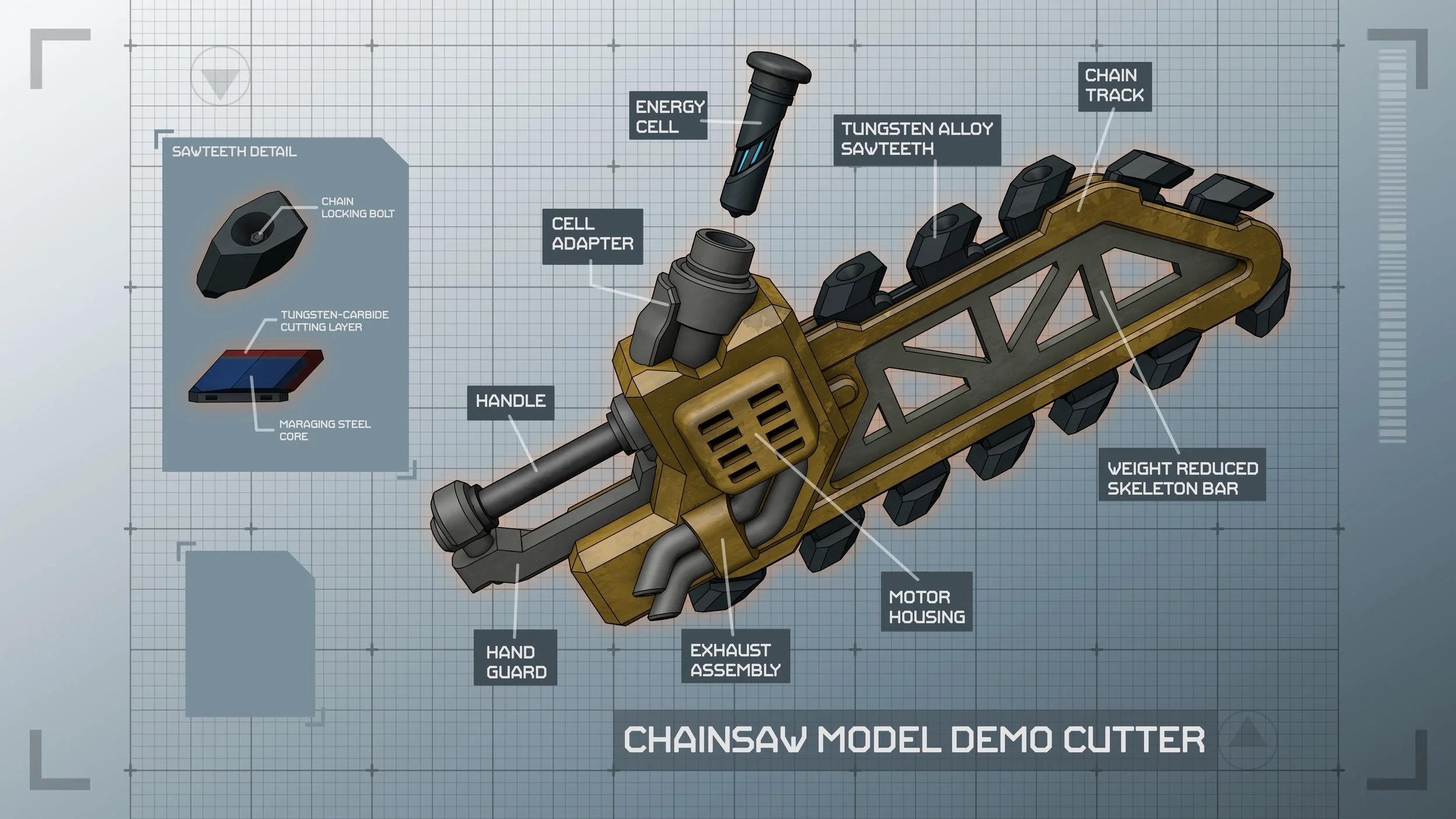
MEDIA RETRIEVAL SERVICE REQUEST
VILT: Only one of the best heavy tools in an HE-V operator's toolbelt: demo cutters!
HUANG: Ahhh. Yes. Some might say it is the subtlest tool…
VILT: [laughter] Subtle? Ty, did you hit your head?
HUANG: You got me, you got me. I should rephrase: how about underappreciated? They aren’t only for heavy demolition work like-
VILT: Well, it’s in the name after all.
User ID: Young, Laura
Ansb. Address: Error <Masked: administrator contacted>
Request Tag: 78-91-01417
User Comments: “**** ***, corpocrat!” <Reported for misuse: profanity>
TRANSCRIPT ATTACHED
Title: Machinery Matters - The Industrial Equipment Operator’s Show
Topic(s): Demolition Cutters
Hosts: Jaimes "Jim" Vilt Jr.; Ty Huang
Segment Air Date: <REDACTED> - Syndicated DeepCast Format
TRANSCRIPT EXCERPT BEGINS
[INTRO MUSIC FADES]
VILT: Annnnd welcome back, friends! This is Machinery Matters. I'm Jaimes Vilt Jr.
HUANG: And I'm Ty Huang. How’re you doing, Jim?
VILT: Real good, Ty. You doing good, pally?
HUANG: Better than I deserve. What’s on the docket, now?
VILT: Only one of the best heavy tools in an HE-V operator's toolbelt: demo cutters!
HUANG: Ahhh. Yes. Some might say it is the subtlest tool…
VILT: [laughter] Subtle? Ty, did you hit your head?
HUANG: You got me, you got me. I should rephrase: how about underappreciated? They aren’t only for heavy demolition work like-
VILT: Well, it’s in the name after all.
HUANG: True, but they can be used for so much more than that. Different models make a big difference in your workflow.
VILT: Well, that's what we're here for today. To give these magnificent machines their due. Ty, for the greenhorn and casual viewers, we should probably explain what a demolition cutter is. Do you want to tell them?
HUANG: Sure. Demolition cutter is really just a category for any powered, or motorized, HE-V scaled cutting tool. Usually it looks like a big chainsaw, or a wheel cutter, sometimes a drum cutter. They can be designed as handhelds for a HE-V’s manipulators or for direct-mounting as a limb or sometimes on a chassis accessory mount.
VILT: Yessir, and in case you all are wondering what the real perk of a demo cutter is compared to similarly equipped heavy construction vehicles it’s that you get all the capability of a dedicated attachment, but you still get the true all-terrain, all-conditions uptime of a walking rig.
HUANG: Precisely, Jim. It isn’t just a cool factor to attract new workers. Proponents of traditional equipment overlook the flexibility of HE-Vs. The efficiency benefits and time savings alone are, my goodness, substantial. They will more than pay for the higher upfront costs. You can tell who’s never had to budget for tires on a haul truck!
VILT: Ooh, I can’t even laugh at that. So tell us what sorts of jobs you’d pick up a cutter for, Ty.
HUANG: More than just demolition work, for starters. It depends on the make, and size, too, but I’ve found them invaluable for forestry, disaster response, salvage, jobsite prep... the list goes on.
VILT: Right on. Now, let’s talk specifics. You've been in the industry longer than most guys, and I know you’ve spent a long time on “heavy duty” running all kinds of cutters. Ty, what's your pick for a GP model? What’s a real gem a procurement manager or owner-operator should know about?
HUANG: For general purpose, oh, there’s a bunch of good ones. I'd say, hmm. I’d have to go with the Culgan Exo 850A. It’s hard to beat for pure value. Inexpensive, not cheap. It's a wheel-style cutter, carbide teeth, runs off a standard HE-V auxiliary power tether.
VILT: So it’s corded!?
HUANG: [laughter] Well, yeah! [laughter] It hooks up to an external power socket on rigs, or you can even run it off a standalone power source. I know it sounds like a lot of trouble but the Exo is reliable and affordable. Easy to service on site if you have to. The blade is just a disc of hardened tool steel, and the teeth are swappable.
VILT: I have to stop you here, Ty. Reliability? The thing is primitive, Ty. This thing-
HUANG: No, come on! [laughter]
VILT: -primitive. The viewers, Ty, the viewers need to know this. Single-speed operation, short reach, and those teeth dull so fast if you're cutting anything harder than structural steel and they have to be welded on!
HUANG: [laughter] Jim, you're giving folks the wrong impression. Grab two guys and you can weld on fresh teeth in under an hour with a good setup, and if you are smart you’ll have a second wheel ready to swap-in instead. See? It can take two days to swap a chain on some more exotic models-
VILT: Such as the Komatpillar KP-1200!
HUANG: I knew it! I was getting there. Yes, the KP-1200, the Megacutter. “The king of the cutters,” isn’t that what you keep saying, Jim?
VILT: Now that right there is a real fine piece of industrial engineering. Unbreakable nanocomposite bar, dynamic chain tensioning, hyperalloy teeth that can chew through damn near anything.
HUANG: But that tool costs as much as some lightweight workrigs! More than most, anyway! Whew.
VILT: Now, Ty, a professional worker would appreciate the 1200’s onboard microfusion engine. That means no draw from your rig’s reactor. That has to be a huge, huge boon for sustained work.
HUANG: It’s got some issues, though, real ones-
VILT: You can’t just let me have this? This one moment?
HUANG: The people need to know, Jim! They need to know! [laughter] If you do manage to break that "unbreakable" arm, er, bar, which can happen, trust me, you're not field-repairing it. You're sending it back to a Komatpillar depot and waiting and waiting and…
VILT: I'd still argue the KP-1200 justifies its price for the right job. Old growth timber, remote salvage jobs, anywhere else you need that power with minimal logistical snags. That microfusion cell is a game-changer. Just heft and cut.
HUANG: Agreed, really. And I'll tell you, having seen one in action firsthand, the performance is, wow. I watched a Klondike operator with a KP-1200 drop and section one of the last big redwoods in North America. Staggering! Breathtaking.
VILT: It was something, huh?
HUANG: I'm underselling it. Speaking of breathtaking sights, we should maybe talk about the other uses for demo cutters.
VILT: Ah. You mean the weaponization thing.
HUANG: That's it. Everyone has seen or heard of these incidents by now, I say. We'd be remiss not to acknowledge that cutters are sometimes pressed into service for combat.
VILT: Unfortunately true, sir. Unfortunately. The Australian Shipbuilder's Guild rebellion is probably the most known instance.
HUANG: Yes, in late <REDACTED>. The Guild operators stole a shipment of cutters, and kitted out dozens of industrial HE-Vs with them. Did a lot of damage. Echelon’s corporate security forces were caught off guard by that stunt.
VILT: “Off guard” is putting it gentle. Those cutters tore through them like anything else. Limbs, operator cabins…It was terrifying.
HUANG: Not a surprise, Jim. Ask anyone who’s seen a bad accident on the jobsite.
VILT: No sir, no sir. No doubt. And on that slightly sobering note, we're going to take a short break so we can hear from our sponsors. We’ll be right back, and then Ty will tell you about best practices for maintaining your demo cutter. Thank you, as always, for listening to Machinery Matters.
[COMMERCIAL BREAK]
TRANSCRIPT EXCERPT ENDS
Illustration by Florian Mellies
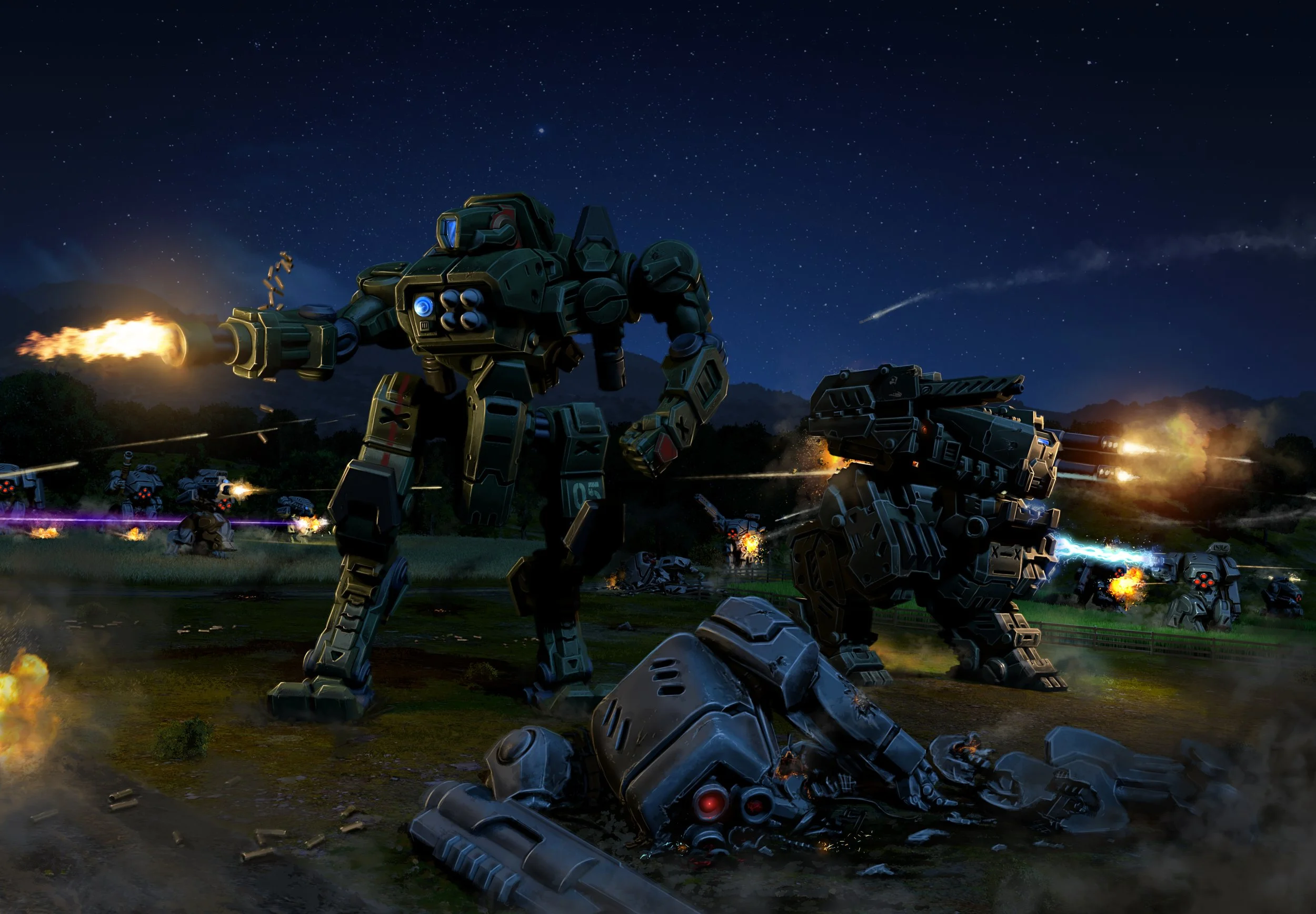
No Exit
The first actual sighting was one night at the end of June. Cook himself had been on watch, up on the walkway crowning the settlement's grain silo. A cloudless night, and the moon waxed nearly full. The eerie light of the aurora, too, painted the swaying grass like an alien sea. Almost as good as daylight. He saw them out the prairie, a mile out. Black, darting shapes, stopping, starting, moving gradually closer as if unsure or very cautious. Arrayed in a rough line. Cook had rubbed his eyes furiously, fearing they were playing tricks, as adrenaline jolted him to full alertness.
July 8th, 2386
Vicinity of Great Falls, Montana
The bar setup in the old garage had no name. No quirky adjective, no novel animal. It was too cheerless for all that. The bar’s roof gave shade from the blistering sun, and it didn’t leak, and that was enough to make a sanctuary for those who entered with coin in hand.
Inside, men and women in dirty clothes slouched, bent from cruel labor, on chairs arranged around scattered crates, cable spools, and one immense steel cog, provenance unknown. They whispered to one another or sat in silence, and resembled the newly resurrected or else those given a short refrain from purgatory. A bartender stood behind a U-shaped wood and metal hightop, doling out local brew and bathtub spirits.
A man named Cook had ended up here after three days riding south in quest of men that could help him, and help his rural village. Great Falls was the closest and best place to look. The town itself was little more than a remnant or a fragment of the once-populous city’s carcass. Just across the river to the east, was a sprawling, desolate expanse of shattered rubble and scavenged ruins; some old military base flattened in a war long ago. The town served as a waystation, a hub of sorts, for haphazard commerce in the region. A natural confluence of humanity situated at a bend in the river. It was one of many such pitiful echoes of civilization scattered across North America and the northern hemisphere.
When Cook had arrived with his companion, Jewel, the town was flush with a typical assortment of travelers and transients. That was a good thing considering his predicament. He’d received no warm welcome, asking around as he was for men-at-arms: banditry and predation were near-constants on the continent. But in time, and with a good word from two locals that knew him, he was told that he might inquire of two traveling guns-for-hire. Pilots. They were at the bar right then. Their HE-Vs squatted, shutdown, in an overgrown lot not far from the bar. One of the machines was wide, low and heavy; the other somewhat taller, thin and spindly. Though not unseen in these parts, a clot of townsfolk had nonetheless gathered to gawk at them; two men with rifles kept the onlookers at a respectful distance.
The men Cook sought were seated at a corner table with the remains of drinks and meals between them. Cook approached and introduced himself, and the men did likewise: Ballard and Snyder. Jewel was not inclined to palaver with characters such as they, and she waited alone at a nearby table, watching.
Ballard was a middle-aged man that looked older than his years. His deeply tanned and lined face was preternaturally still, save his eyes and brows that betrayed his inner sentiments as he spoke and thought. Snyder was a decade younger, or a little less, lean, and outwardly friendly. He made no attempt to hide the bellicose tattoos proclaiming loyalty to Empyrean Reach on the back of his left forearm.
Cook inquired of the men’s profession directly, and Ballard answered. Snyder clarified: they were both freelance purveyors of violence, the third oldest and most-honorable profession. Cook told them that he, and his neighbors, had need of their services, specifically the kind armed HE-Vs could provide.
Ballard had nodded almost sleepily at that. "What can you pay?"
Cook listed off commodities: Grain; meat, preserved or on the hoof; fuel alcohol; various sundries. He died a little inside as he spoke but maintained his outward composure. His village was the furthest thing from materially wealthy. He watched Ballard closely for his reaction but the man’s stony expression revealed nothing.
Snyder had no such reserve. He leaned back in his chair until it was on two legs, creaking, and his expression mildly insulted. "Dear friend. HE-Vs are expensive to operate. And we cannot haul your cows for exchange elsewhere. We aren’t in the business of livestock," He said.
"It's everything we can offer. We farm to live, and try to trade for what else we need. But we’re in danger. The whole town is," Cook said with earnest dignity.
“Sir, do you lack guns or balls? Cannot the men of, eh, nowhere drive off a few rustlers and thieves?” Snyder settled in his chair and reached for his glass, tone needling.
"If only. We have guns and men but we aren’t facing flesh and blood. They have machines. HE-Vs, I reckon, and armed. Like yours, but smaller.”
That changed the temperature of the conversation. Ballard’s eyebrows went up. "Is that so? Yet here you stand, alive. Could be you are trying to lure us someplace.”
“It is, sir. I couldn’t guess as to why, but so far they haven’t turned their guns on us. And I tell you true. I have plenty of witnesses.” He gestured to Jewel.
“How many? How many, we’ll say, attackers?” Snyder inquired.
“Many. I counted almost two dozen, once. At least that many.”
Snyder whistled long and sharp, drawing looks from the dour patrons of the bar. “Well! I am sorry! You do indeed have cause to bone up the old homestead’s security. But cause alone, Mr. Cook, does not pay-”
Ballard waved two callused fingers toward his companion, cutting him off. “We may be able to help you. You and your friend, there, should tell us what all has happened.”
Cook looked back at Jewel and gave her a nod toward the table where the men were seated. She rose and walked over to join them.
“Sirs, we could perhaps discuss this somewhere with fewer eavesdroppers?” Cook asked, unsure of what and how much to reveal in mixed company.
"We should discuss it now." Ballard said flatly, and that was that.
Snyder picked up his drink. “Go on, go on. Tell us everything." He smiled at Jewel over the rim of his glass like a Cheshire cat.
—
Cook’s tale followed the beats of a bad dream. The first sign of trouble was downed fences around the western pastures. New post-and-rail they'd spent the better part of six months setting, smashed flat or knocked loose. This was not unprecedented: agitated animals and the blistering storm winds that pushed through year-round had caused plenty of headaches before.
Their herds of long-haired cattle had seized the opportunity to flee from whatever did the damage, scattering across a vast range. The folks sent out to round them up the next day reported odd, large depressions in the soil by the broken sections and within the pasture: Four-toed, smooth, and very regular footprints measuring several feet long, and wide. Deep, too; made by something heavy. Some of the men figured whatever it was had four legs, but was obviously not any animal anyone had ever heard of.
Then the sounds started. Echoing through the night. A low, bassy pulse, like a truck horn blasting through a busted speaker. Another that was a high, rhythmic, electronic ticking. Jewel described it almost like Morse code, but with no discernible pattern. Both sounds carried for miles in the darkness of the moonless prairie night. Most of the villagers woken by them had a hard time getting back to sleep after, and none felt bold enough to investigate the noise despite the distant lowing of the cattle.
The following day, two men were sent out on horseback to the wooded hills west of the village. They failed to return. The brother of one went out after them days later, but returned early the very next day. No trace, he said. The look of fear on his face made Cook doubt how thoroughly he had searched.
The first actual sighting was one night at the end of June. Cook himself had been on watch, up on the walkway crowning the settlement's grain silo. A cloudless night, and the moon waxed nearly full. The eerie light of the aurora, too, painted the swaying grass like an alien sea. Almost as good as daylight. He saw them out the prairie, a mile out. Black, darting shapes, stopping, starting, moving gradually closer as if unsure or very cautious. Arrayed in a rough line. Cook had rubbed his eyes furiously, fearing they were playing tricks, as adrenaline jolted him to full alertness.
Quadruped, compact, ultralight HE-Vs. No arms, but paired weapon mounts at the shoulders. A group of glowing red sensor lenses in the middle of each hull. Cook had been frozen with fear and fascination. One had come within a stone’s throw of the outermost buildings before it sounded that awful chittering. Cook had snapped out of it, then, and rang the simple bell he had carried up with him.
Lights came on in homes across the village, including the cottage nearest the machine. Shouted questions, screams; the germ of panic spreading fast. A man named Jeremiah had burst through the back door of the cottage in nightclothes, flashlight in hand. The thing saw him and aimed, pivoting with feline agility. It sounded its awful horn and advanced on the poor man, a tarantula from the pit. Jeremiah fell back with a yelp of terror, scrabbled, and regained his feet, sprinting away. Jewel had taken him in and later told others that the man was unhinged from fright.
Curiously to Cook, the operator of the machine seemed to lose interest, stopping and watching him go. After a moment, the bastard turned and marched through his erstwhile victim’s home, splintering wood and pre-fab panels like crackers. Something inside sparked and caught, and the wreckage quickly went up in a bonfire, a total loss. Clear of the blaze, the machine stood motionless and waited for some twenty minutes before turning and heading back the way it came.
Nobody else in the village had been hurt, mercifully. Not yet. But all were certain it was only a matter of time until things escalated, and no one had any illusions about their chances of stopping one, much less multiple, of the damned things.
—
When Cook finished, Snyder looked pointedly at Ballard, who sat quietly for a minute, thinking.
"Centaurs. Has to be. Only kind fits the description," Snyder said after an interval of silence, somehow aware of Ballard mentally surfacing for discussion. Snyder referred to the relatively rare VisalCorp-manufactured quad ultralight design. They were well-regarded for swiftness and stability, but disliked by many operators for their unintuitive gait.
“Mm hm. Sounds like it. But where did anyone down here come by them?”
"And what would they be doing out there? Has to be one corporatipon or another," Snyder finished the dregs of his drink and glared mirthfully at Cook and Jewel. “I hear they sometimes send probbies down here to Earth for live-fire final exercises. You know. Blood them in, if you will.” He seemed to enjoy the look of disgust and horror on Jewel’s face. Cook glanced at the tattoo on Snyder’s arm and started to reconsider his plea for help.
"Table that for now," Ballard set down his own glass. He studied Cook for a moment. “Mister Cook. Miss Jewel. We can offer our assistance with the condition that we have full rights and consideration to salvage anything brought down or left behind in the defense of your homes. Do you object?”
“No, of course. We don’t need it,” Cook said. Jewel shook her head in agreement.
“I’d beg to differ, but thanks all the same for your understanding,” Snyder quipped.
"Y’all have done this sort of thing before. Just who are these people? Why would they attack us? Surely you’ve got some idea?" Jewel blurted.
Ballard rose. "That, miss, is a good question. We'll take on the job,” He looked at Snyder, and back at the villagers. “Excuse us for a time. We have to discuss particulars and make preparations. Meet me back here in three hours, and I will accompany you."
—
The two freelance pilots speculated and talked through contingencies, timetables, betrayal, ambush, backup plans and other possibilities privately. Even if the number of attackers was exaggerated by a factor of two, Ballard and Snyder agreed there was no way they alone could handle the onslaught: Snyder’s Buckler had been repaired, refitted and modified so often it was no longer top-of-the-line, and Ballard’s mighty Shepherd wasn’t invincible. With the promise of substantial, tantalizing, high-tech salvage as payment, it was decided to recruit allies to the job. Ballard had remarked that it was pigs that got fat, while hogs got slaughtered.
Snyder, well-travelled and connected, left at once heading south. He spent two days pitching the job to reliable men in the region that he knew from prior experience or reputation. In that time, he signed on two other pilots, their HE-Vs armed and ready to walk, plus secured a handshake deal with a man of dubious reputation named Haywood, he of Haywood’s Boys, an alleged private security provider for hire. The trio operated shabby Kobold ultralights, rusty little gremlins packing handheld canister rifles and an assortment of other weapons. Snyder had seen rigs like them in worse shape, he was sure, but he could not remember when. Haywood could not depart with Snyder’s ad-hoc team, but promised timely arrival hot on their heels; he owned a heavy transporter truck that could carry their Kobolds cross country.
Ballard left Great Falls heading north with Cook and Jewel. The village was about sixty miles north, a little more than two hard days' ride along the remains of a highway buckled and overgrown from decades of neglect. Ballard kept way back from his companions’ horses, and occasionally called Snyder over the radio, hoping for a break in the disruptive solar weather. Twice he caught garbled and broken snatches of his business partner’s voice between the endless, squealing static. At night, Cook and Jewel camped in the open beneath the dome of the iridescent sky overhead. Ballard camped in the cockpit, dozing, while the Shepherd’s sensors remained alert to any approaching threat.
On the morning of the third day, the village was visible on the horizon. It sat in a gentle depression in the prairie, some thirty miles east of where the hills started their slow ascent to the Rocky Mountains. Solar arrays glinted on shingled and earthen roofs, and two windmills turned slowly between threads of chimney smoke. The burnt wreckage of the ruined cottage lay on the western edge, surrounded by blackened grass.
The appearance of Ballard’s Shepherd on the southern road drew a crowd first in alarm, and then in greeting once Cook and Jewel were spotted in attendance. Nothing on his sensors suggested a threat, and Ballard judged the risk of disembarking minimal. He set the Shepherd’s minifusion reactor to idle, locked its joints and dismounted, heaving himself up and through the roof hatch in the rear of the cockpit before descending a cord-and-peg ladder over the back to the ground.
He was introduced to and shook hands with the village eldermen, and he said the same polite things to each of them. The crowd marveled at the Shepherd, its long autocannons and railguns, and already murmurs of certain salvation ran through the multitude.
Ballard endured a cursory tour of the village, finding little of note that would aid its defense, and then walked the perimeter while Cook talked. Ballard mentally catalogued background fields of fire should the attackers get in among them. All around, clear to the horizon save a few stands of trees, it was wide open, and flat. The unobstructed expanse would work in favor of the larger HE-Vs and their titanic firepower.
The structures in the village were split between aboveground and partially belowground; he was told the latter could hold most of the population in a pinch, around a hundred and twenty people, if they had to seek shelter. Ballard told Cook to start planning exactly that, and rehearsing, at once.
Ballard was shown the tracks. He crouched by one clean impression and lowered his hand in it to judge the depth. A few moments figuring over ground pressure and weight distribution cemented his opinion. Ultralights, very likely Centaurs, indeed, or something similar.
Snyder arrived at a jog with the other hires late afternoon of the same day, his many-times refurbished Buckler in the lead. Behind him came Stokes, in a camouflaged Daiko bearing scars and dents on nearly every surface of its hull. Its left arm ended in the oversized fist the prolific design was known for. An autocannon occupied the right shoulder mount, while an anti-air cannon and howitzer were fitted to the torso bays.
Beside Stokes was Lahtinen in a tan Scarab. Stripped of most of its armor packages it resembled an overgrown bird, and moved with the same jerky quickness. The light HE-V carried a rotary cannon, shot cannon and a searchlight, nothing else. Another round of introductions followed, and later with Ballard on watch the night passed without incident, though the Shepherd’s sensors picked up ten small, distant signatures.
The next morning, the growl of a heavy diesel engine was heard long before the huge truck carrying three Kobolds in its bed appeared. Slathered in mud it pulled in, and two of the Kobolds, manned, stepped heavily off the bed, rocking it. Haywood hopped out of the cab to greet Snyder, the villagers and the rest of his new companions. One of the Kobolds - Agli or Ringer - kept its canister rifle muzzle-high and waved with the free hand.
Ballard stood back and watched the colorful assortment of characters Snyder had assembled. He had misgivings about Haywood and company, but trusted Snyder’s judgment on such things, as ever; the man had superb instincts.
They ran constant watches in pairs from then on. The day after Haywood and his boys arrived Ballard sent Snyder and Lahtinen west to scout, into the foothills and along the forest’s edge. Tracks from the mystery attackers were everywhere, but seemed to be roughly converging somewhere beyond the forest. Snyder noted several distant sensor contacts, and was certain that he and Lahtinen were undetected. Curiously, those contacts made no moves to close with or withdraw from their encroaching HE-Vs. Both pilots’ hails went unanswered.
The people of the village gave the band of gunslingers a house to share and stayed mostly clear of them. For two nights, the sentries posted in their HE-Vs reported distant contacts, closer each time, moving along irregular routes to the west. Ballard could not make sense of the situation: the raiders had ample opportunity to flatten the village and plunder it in the time Cook and Jewel were away. Now with the appearance of substantial defenses, they still followed some logic known only to themselves. That made him uneasy. A discussion with the others offered no insights.
It was the bellicose Stokes that suggested what ultimately became plan of action: move to contact with the unknowns on the prairie when they neared, force the interaction, and deal with them accordingly. The following evening Stokes, Haywood, Agli and Ringer were on watch, about a kilometer from the hills, and six contacts were on scopes, closing, in a wandering way, toward them. The call went out.
Ballard was already waiting in the cockpit of his Shepherd.
"They're coming. Count five, make that six, right now," Stokes said.
"Copy that." Ballard keyed the common channel. "All gunhands, it’s time to earn it. Snyder, Lahtinen, mount up. Cook, and anyone else that can hear me, get everybody else underground, right now."
Ballard buckled his harness, armed his weapons, set the radar to active and LIDAR imager overlay to constant. He unlocked the Shepherd’s joints and directed his ugly machine gracelessly west across the open prairie to join his fellows. Snyder and Lahtinen passed him in short order. Ballard’s sensors picked up the approaching hostiles, and he reviewed the previously discussed order of battle one last time.
“Stokes, Snyder, on-line with me. Wait until I give the okay to open up.”
“I’ve got your back, brother,” Snyder replied with earnestness.
“Party time. Let’s get to it,” Stokes, eager for action.
“Lahtinen, I want you far left, pick up any flankers. Be ready to push out and turn theirs. Don’t overextend.” Ballard had rehearsed some finer points with Lahtinen earlier. He was green yet, jumpy and anxious.
“Will do, Ballard.”
“Haywood, you and yours on a second line behind us. Take out any that get between us or go for the village. Don’t let them get past, but let us draw most of the fire.”
“We can handle these fellas, don’t you worry, boss man! We’ve been in worse scrapes than this, ain’t that right, boys?” Haywood sounded positively nonchalant. Brave or foolish, Ballard could not tell.
The defenders were set, and on came the quads, descending out of the wooded hills. Ballard could see them, now, with his display’s magnification. What the machines carried was most troubling: small autocannons, rocket racks, and the tuning fork shape of an arc gun on each. Very heavily armed. Six contacts, and six visually tallied. Ballard hailed them one last time.
“Unknown force, unknown force, you are trespassing. State your intentions, or be fired on.” No response, only the hiss and warble of interference. He waited thirty seconds. They kept coming. No answer, no challenge, no hesitation, and no change of course. Ballard switched to the team circuit.
“Pick your targets, push them to the network and deconflict. One last try.”
“Unknown force, this is your final warning. Halt and respond or we will fire on you.” Still nothing.
“Take ‘em. Weapons free.” Ballard said over the radio, and the night flashed with heavy ordnance as the HE-Vs opened up. A barrage of rockets, howitzer shells, lines of tracers and more all plowed into the oncoming hostiles. Ballard had his reticles on one as he spoke the order, and he waited but a moment longer for the combat AI to finalize a lethal firing solution. Ballard fired one railgun, its boom splitting the air, and the hypersonic dart turned one ultralight inside out, a glowing fountain of slag trailing it as soil erupted from the earth where it impacted.
Two contacts winked out on Ballard’s display. The remaining hostiles reacted with impressive speed and coordination. Immediately their posture changed, increasing speed and juking, all while returning focused autocannon and rocket fire into each of the HE-Vs in turn. They bobbed and weaved, or hunkered to shield themselves. The accuracy of the defenders outgoing fire dipped as they took evasive maneuvers of their own. Lahtinen took a serious hit when he dared a bit too close, but his Scarab was still mobile and he darted away.
Two more hostile contacts dimmed on Ballard’s tac map, but his sensors now relayed many more, approaching fast. The remaining two turned to six, then nine. Eleven, then fifteen. Finally twenty.
“Wrap this up and regroup, we’ve got a lot more coming!” Snyder, urgent.
Too late. There was nothing artful about the melee that followed. The attackers moved in precise formations, spread just enough to avoid being an easy target. Rushing in, they concentrated their continuous fire to deadly effect. Ballard fired both of his autocannons at one group, mangling two of the small machines before another group raked him with their own guns. The small bore shells sparked off the Shepherd's glacis plates, biting hunks from its armor where they hit square, doing little damage overall.
Ballard had to lift fire and step sideways to clear Stokes as he kicked one Centaur aside. To his right, the Kobolds were working from the edge of the fight, shoulder to shoulder. They weren't built for this kind of slugfest, but Haywood and his men fought efficiently, picking off damaged attackers with coordinated salvoes of explosives from their handhelds and prioritizing any Centaur that got into an HE-V’s rear arc. Snyder’s laser pulsed in a killing rhythm, each discharge turning the night to day for a quarter of a second. Speed was life for Lahtinen, and he circled the fray, strafing any he passed when he had opportunity.
But there were just too many. Cohesion vanished as the fight turned into a wild scrum, every man for himself. The defenders’ HE-Vs started taking fire from all sides. The Kobolds ended up fighting one-to-one while badly outgunned. Haywood was knocked flat from a rocket strike, and the quad moved to finish him with its gun before Agli, his canister rifle missing, leapt for it with both arms raised to smash it. The two ultralights collided and went down in a heap, limbs thrashing.
Ringer ran up to aid Agli, but his rig was blown apart by autocannon fire. Stokes was beset on all sides. His Daiko, aflame, turning and blazing away with both cannons as his attackers dodged and riddled him with fire at point blank. A bolt of lightning cracked from one, and the Daiko slowed and staggered like a palsy victim, systems overloaded.
Stokes bellowed curses over the radio, damning the Centaurs’ builders and the very ship that first carried their kin from Earth. Helpless as he was, the swarming machines laid into him and the Daiko’s armored magazine was finally breached. Ballard saw it happen. There was a momentary flash of blinding blue-white as the damaged reactor vented and the Daiko came apart in a colossal, fiery blast. One arm whirled away and fatally crunched one Centaur, and only the Daiko’s toppled legs remained as debris rained from the sky.
The surviving defenders fought on, destroying more of the quads with every shot and every blow. When only a handful remained, they turned and retreated in unison. Lahtinen moved to pursue and Ballard called him back. Many acres of the prairie had been churned into smoldering, blasted ruin. Wreckage was scattered everywhere. In the aftermath, Agli did not check in. His Kobold was found prone, one leg sheared away below the hip. No response on the radio.
Haywood rolled his squadmate’s rig over and discovered it had been hit by a burst through the right side. Agli had died messily.
Haywood was distraught. “Damn. He went fast, at least. Just me now, isn’t it? Adios, boys...”
“I’m real sorry about your friends, Haywood.” Lahtinen said.
“Yeah. Yeah.”
“They fought bravely, Haywood. We owe them a debt.” Ballard offered solemnly.
“They knew the risks. Mourn them later, this isn’t over.” Snyder said.
Haywood offered no reply to that. In an unforgiving mood, he began picking over several of the wrecked Centaurs looking for enemy operators to vent his wrath upon. Ballard thought for a moment he’d have to stop the man personally before Haywood revealed there were no pilots, and no remains. A more thorough investigation proved it true: each of the Centaurs was a drone, operated remotely or else it functioned completely autonomously.
Ballard was floored. “Snyder, did Empyrean ever-”
“No sir, never. Never even heard the idea seriously floated, in my time. Couldn’t speak for the other corps, though.”
A piece of the bigger picture started to resolve in Ballard’s mind. “That explains their reactions, and their seemingly nonsensical behavior. They’re following programming.”
“Are they old? Breaking down and glitchy, maybe?” Lahtinen asked.
“Not that old, kid. But, I dunno. Maybe. Rift emissions are real hard on sensitive electronics. It’s possible,” Snyder concluded.
Ballard reviewed his ammunition count and damage reports. He’d made it through the fight with only a few minor, penetrating hits, and more than half his warload remaining. Rotating one stick, he noticed the left arm pod lagged behind the right, now, but was otherwise functional. He turned and looked west, to the hills.
"Form on me, we’re following them." Ballard said.
He informed the village of their intentions, and the defenders pursued the fleeing Centaurs.
—
They found the origin of the Centaurs at the edge of a wide, bowl-shaped clearing some miles into the forested hills. A complex of low structures with evidence of subterranean construction, all consumed by many years of vegetative growth. A double chainlink fence around the perimeter was toppled, flattened in sections, and so overgrown in others it resembled a hedge. Snyder said the construction was post-Rift, and the whole arrangement smacked of a corporate black site. Whatever company had built it, in the middle of nowhere, had intended to remain far beyond ethics and accountability boards. It was not meant to be found.
The thing was on the far side of the site.
Ballard saw it on sensors as they approached, a much larger contact that the AI could not classify, and held the team back in the forest. Moving in, they saw it on optics. It was another quadruped design, like the smaller Centaur bots they had fought, but where they were still recognizable and obviously mechanical, this was something else entirely. Something unknown.
It was as big as the largest ultraheavy HE-Vs. Bigger, even. But the proportions were odd: a lumpy torso hanging between limbs like those of a crab, or a cellar spider. The mottled black and gray hull had an organic texture like melted plastic that looked like nothing any of the men had ever seen on a fighting machine. Obvious weapons protruded from the top of the hull, and from a pair of shorter, articulated arms on either side. It prowled around the facility slowly, curiously, stopping occasionally to scan items of interest with sensors clustered at the front of the hull. Four Centaurs orbited it at a cautious distance, weapons aimed at the thing they were seemingly guarding.
No exterior running lights. No transponder signal. No answer on any channel that Ballard and Snyder tried.
Watching the thing from within the metal confines of their own machines, all of the men were shocked and speechless.
“Snyder-” Ballard started to ask.
"No idea. I’ve got no idea." Snyder replied, tense and careful.
“It’s always you corpo dogs messing with stuff, unleashing unspeakable shit on the rest of humanity. I never woulda signed up with you had I known-” Haywood was furious, itching for violence.
“Haywood.” Ballard warned, and the confrontation was averted. Nobody else said anything.
“Here’s our payday. The real one. We bring it down, check the facility. Job’s done.” Ballard said, matter of fact.
“Yeah, yeah and maybe we can gain control over the rest of the Centaurs, the bots. Oh, I bet there is a boatload of good stuff in there. Try to be positive, Haywood. You’ve got a much bigger share, now.”
“Snyder, enough,” Ballard was sure mutiny and probable fratricide was right around the corner. “Okay, let’s get them. On my mark…”
Ballard maneuvered to get a clean shot through the trees and the thing sensed them, flinching like a startled animal. It happened fast.
The thing broke into a sprint that no HE-V of its apparent mass should have been capable of, firing at Ballard as it came with guns and lasers. The guard bots trailed in an attack pattern and opened up, suddenly defensive of it. Ballard got two railgun shots off; one slug missed the sinuous mass, and the other blew through a front leg, doing surprisingly little damage. Such a hit should have buckled anything smaller than an ultraheavy. The thing kept coming, firing with deadly accuracy. An explosion shook the Shepherd, and the status display lit with many warnings, tones of amber, yellow and red.
Snyder moved in from its right, snapshooting one Centaur with his laser before opening up with the Buckler's rockets, scoring hits across the thing’s flank and legs. It reacted on instinct, shooting back, before turning again to the ailing Shepherd, the greatest threat.
Haywood was trading fire with the remaining bots from behind an ancient tree, keeping them engaged and away from the main fight. He launched his last missile, blowing one Centaur apart before charging the last and finishing it with a contact shot from his canister rifle that destroyed the gun. Lahtinen circled and came in from behind the thing as it bore down on Ballard, the lean Scarab moving fast.
Ballard tried to backpedal and keep the rushing monster in his sights. He pulled the trigger for both autocannons. One malfunctioned, indicator light lost in the red sea on the instrument panel. The other banged away, blowing off one of the weapon mounts as the thing reared up and struck. The Shepherd, massive though it was, was knocked backward and off its feet. Ballard’s vision swam and he felt a molar crack as he crashed down against a stand of trees, not quite flat on his back.
The thing loomed over the fallen HE-V and fired a final fusilade of shells and lasers into the Shepherd, cutting through already damaged armor. Lahtinen and Snyder poured everything they had into it, desperate to break the attack. The black shape jerked away from the incoming damage, and its movements became erratic as it retreated quickly, galloping. It smashed through smaller trees, headed north.
Dangerously low on ammo, they let it go. Snyder confirmed Haywood and Lahtinen were okay and raced to Ballard’s fallen HE-V. The Shepherd was half sitting, one leg dislocated at the hip and the left pod gone. The same side was ripped open, hydraulics gushing fluid. Sparking, jumping cables hung dangerously. The barrels jutting from the other pod were badly bent, both guns now useless.
Snyder repeatedly tried to raise Ballard with no response. He moved to disembark. It was a risk, but he had to get to his friend and mentor if he was still alive. He called for Haywood, telling him to pry open the Shepherd’s hatch. Snyder knelt, settling the Buckler into a three-point stance, and unbuckled as he keyed open the top panel above the pilot’s nest. It slid back and he scrambled out of the cockpit, jumping to the top deck of the Buckler’s torso, then to its arm and then down to the ground. He sprinted through the dark and past sizzling hot shards of armor belonging to the wrecked Shepherd.
Haywood’s Kobold gained purchase and pried the Shepherd’s hatch open. Heedless of the danger, Snyder climbed on the wreck, burning his hands, and dropped into the pilot’s compartment. Red warning lamps blinked, slow on, slow off. With the HE-V’s torso sitting at an angle, the deck sloped upward toward the pilot’s seat. Ballard’s helmet had rolled to the back, beneath the ladder and for one awful moment Snyder thought he had been decapitated.
Much of the cockpit enclosure was shattered, perforated by spalling and shrapnel. Jagged edges were everywhere. Snyder found his friend still strapped in his seat, one arm hanging limp over the armrest. His stomach dropped.
"Bal? You there, pal?"
"I hear you." His voice was weak, sleepy. Thin.
"Oh, man. How bad?" He half-climbed, half-crawled up the deck toward the front.
A long silence. "Bad. It’s all up with me."
"Nah, no way, you quitter. Let me get a look at you,” Snyder saw Ballard was bleeding heavily from multiple hits across his chest and thighs. Arterial blood seeped. Too much lost already. “We can cut all this away and get you out the front-"
"No. Forget it, Snyder. Get the salvage. Make sure the job’s a good one. Those folks have been through it." Ballard’s last command.
Snyder was quiet for a moment. He laid his hand on the crown of Ballard’s head, clammy with perspiration. "Ballard. Man, I’m sorry."
"It's fine," Ballard said. “I had a good run. We had a good run."
"You never did have a plan for getting out of the business."
"No, guess I didn’t," Ballard made a single sound like a hiccup, all that passed for a laugh. His gaze was wandering and far away. He winced, gulped for air.
Snyder gently set Ballard’s hands in his lap, in repose.
"It was worth it. All of it," A long pause. “It hurts…” Ballard went slack, let out a rattling sigh and was gone.
Snyder stayed for a little longer, the whispering of the leaves in the dark forest outside and the creak of the cooling hull the only sounds reaching him in the Shepherd.
—
The three survivors walked back into the village just as the sun rose.
The people came out again and were aghast at the state of the defenders’ machines. Cook was at the fore, face ashen.
Snyder dismounted and spoke with Cook. "They shouldn’t be back. They were robots, automated. In any case, we destroyed a lot of them."
Cook nodded slowly. He didn't ask about Ballard or the others. Snyder’s face said it all.
Everyone ate in the settlement that night, a proper meal. The whole community was present, with Snyder, Lahtinen and Haywood as the guests of honor. While warm and well-intentioned, only Snyder was able to lock away the horror and the loss to interact civilly. Lahtinen was too amped, repeating anecdotes from the battle over and over. Haywood vacillated between numbness and irritation.
The next day, the three of them took Haywood’s heavy transporter west and collected as much salvage as they could load, caching the rest. The facility itself was an enigma: it had obviously been built to contain whatever the terrible thing was, and held little else of value or import aside from automated deployment and repair bays for the Centaurs, and their spare parts. Snyder had been able to figure out that when the facility power failed the thing was released, and the Centaurs had deployed as a kind of containment system: keeping outsiders away while attempting to usher the “project” back to the site as it wandered. That was all.
On the way out, Snyder stopped by Ballard’s HE-V, now his tomb, one last time and paid his respects before shutting the hatch over him for good. They all returned to the village before nightfall.
The following morning, Cook, Jewel and many others came out to see them off. Cook had prepared what modest goods the settlement could provide. They sat in wooden crates. "If any of you want, please stay," Cook said. "We've got room, and we’d love to have you."
"I’m sure. Thank you, but no." Snyder said. He extended his hand and the men shook. Snyder looked at Jewel for a moment and some flicker passed between them. In another life, maybe. “That’s it, then.”
Haywood had already climbed his Kobold onto the truck’s bed. Lahtinen was busily checking over his Scarab's feet methodically, obviously uncomfortable with the goodbyes and the gratitude.
As Snyder turned to walk away Cook spoke up again. "I know he died for us."
"That he did, but he fought for the salvage.” Snyder gave in to the sudden, nasty urge to gig the man, and just as quickly regretted it. All the defenders had chosen their lives, had signed on the dotted line. His tone and expression softened before he spoke next. “He's buried out there, in his rig. Can’t miss it. Follow the tracks into the woods."
Cook nodded.
The transporter started up, diesel sputtering. Lahtinen had mounted up, and Snyder did likewise. The truck pulled away, laden with salvaged parts and one particularly interesting gun, and the two HE-V’s followed it away from the village, down a long and broken highway. Haywood, driving the truck, looked once in the mirror and saw the settlement's people standing in the road behind them, watching them, as the windmills turned slowly and the sun climbed higher into the sky.
Truly alone, at last, with his thoughts in his Buckler’s cockpit, Snyder wondered about the thing they’d faced. Despite its appearance, the recovered gun was entirely mechanical, but the connective material surrounding it was like nothing he’d seen or heard of. Metallic, and utterly tough, but flexible like fabric. And whatever the thing was, it was still out there somewhere. Still moving north, perhaps, its diminished bot contingent pacing behind it.
Lahtinen, on the radio, interrupted his train of thought and seemingly read Snyder’s mind. His voice was distorted by the atmospherics. "What do you think that thing was?"
Snyder watched the truck negotiate a bad patch of road ahead of him. "Something that someone built," he said prosaically.
"What for?"
"Nothing good. Why else build a black site in the sticks?"
Lahtinen was quiet for a while. "Did I do okay?"
"Mostly," Snyder replied.
The convoy rumbled south. The morning was clear, and their destination was a long way off. Far behind them, in a forested clearing to the west of a village with no name, a gunslinger and his Shepherd sat in the shade, still and cold.
Illustration by Florian Mellies
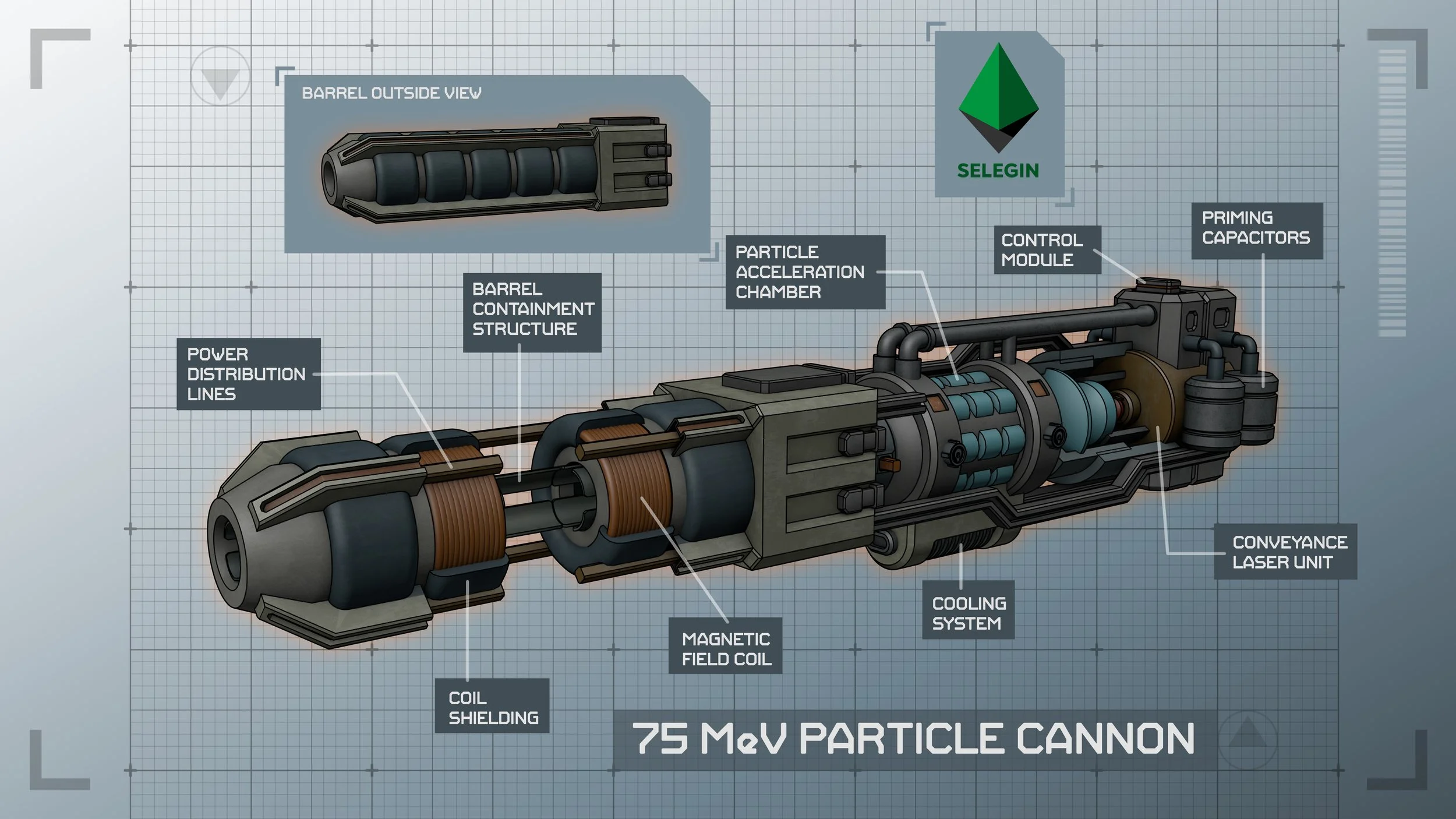
75 MeV Particle Cannon
Dr. Lawyer smiled patiently and did not break the pilot’s gaze. "Mr. Kasper, all weapons, any weapon, is just a practical application of physics. And by understanding physics, it informs us that the most inconsequential, tiny projectile can strike with shattering force if pushed fast enough. This one, though you can’t see or hold it, is more destructive than any explosive shell."
The taste of hot metal and ozone hung heavy in the warm, cloying air. A particle cannon sat on the oily workshop floor, suspended between two industrial dollies. It didn’t belong; the chrome smoothness of the polished, drum-shaped accelerator housing and the crisp, dove gray finish of the bump cage surrounding it stood out from the worn, grimy machinery of the facility. It wasn’t right. Kasper, arms akimbo, stared at the high-tech, foreign weapon. His HE-V, a weathered Corso, stood forlorn in its maintenance bay just beyond.
Robotic cranes were easing the gunmetal bulk of his trusty autocannon out of the righthand hardpoint just below the Corso’s cockpit, nearby techs closely supervising. It wasn’t right and he didn’t trust it. Shells, gunpowder; a merc could trust those in a fight. But not protons, or whatever the hell.
"No way. Naw. You tell ‘em to put that gun back or I will.” Kasper said and glared at the two men, convicted and sure of himself.
Blair, the Yellow Jackets’ quartermaster, stood with one arm folded and his other hand holding his chin. He looked tiredly back at Kasper. "Kass. Want doesn’t get. The job comes first and the job dictates-"
"Man, Blair, I’ve been running that gun for four years. Four years. Thick and thin, it just works. I trust it, damn it."
"How much do you trust it if it can’t shoot?" Blair mirrored Kasper’s posture and stared him down. "You want to talk about a drought, those old stockpiles don’t last forever and WegMa's charging insane rates. Delivery not included, either. We can’t exactly roll our own, can we?"
"We’ll find some, or trade for it. We always manage. We’ve got enough for now, anyway."
"Oh, well, please. Lead on, then and let’s bring it home. Kass, we are desperately low as it is and yours isn’t the only gun to feed," Blair dropped his chin and looked over his glasses at Kasper, eyes serious. “This is how it’s going to be. This isn’t a discussion, and I’ve indulged your tantrums enough, I think. Got it?”
“Yeah, I got it.” Kasper grumbled under his breath.
“Got it - what?”
“Yes, sir, I read you.”
“Attaboy. Now will you please hitch up your diaper and listen to the man? Dr. Lawyer, please, continue.” Blair motioned invitingly to the reedy scientist standing placidly to his left.
The third man wore a grubby windshell jacket and cargo pants. One shoulder bore patches affixed to a smart-cling field. One of them read Fargo Scientific Collective in block letters. Below that, the logo of The Selegin Cooperative. The man took a breath and resumed speaking. "Ah, so, this model is a compact particle accelerator, one that pushes electrons to upwards of 75 megaelectronvolts. Unlike predecessor designs, the beam itself provides for its own focusing via atmospheric plasma. The Bennett pinch effect; it’s a well-understood phenomenon, and we’ve refurbished and tested the unit extensively for reliable function. Our own security team members use them."
Kasper winced as if tasting something sour and turned, watching the crane overhead carry his beloved gun away, deeper into the bay. "Aww, give me a damn break! I don't care how it works, doc," he interrupted. "All I want is that when I pull the trigger, something real and real heavy is going to smash into my target, real hard.” He flicked a hand at the gleaming particle cannon and stared at the FSC man. “This, this ain’t it, nerd."
Blair’s fleshy cheeks reddened and he ripped off his glasses, eyes fiery. "Kasper! God as my witness, you shut your mouth! That’s an order!"
Dr. Lawyer smiled patiently and did not break the pilot’s gaze. "Mr. Kasper, all weapons, any weapon, is just a practical application of physics. And by understanding physics, it informs us that the most inconsequential, tiny projectile can strike with shattering force if pushed fast enough. This one, though you can’t see or hold it, is more destructive than any explosive shell."
Lawyer stepped past the two men to the dormant energy weapon, and switched smoothly into his practiced sales pitch for cavemen. Blair was sold already, but a surly end-user could bust a deal. It had happened before. Best to win Kasper over.
"I understand your concerns, Mr. Kasper. I do. But I don’t think you do yourself.” Kasper’s brow hooded his eyes as he obviously contemplated violence. “Hear me out. The weapon you see here surpasses autocannons entirely, as the firearm once surpassed the bow and arrow. You know that agile targets can sometimes dodge your shells, duck your aim, at long range. Yes? The particle cannon’s electron beam travels at near light speed.” Kasper raised one eyebrow at that, but was otherwise unmoved.
Lawyer went on. “No flight time, no leading, and when it hits it punches a hole like you wouldn’t believe. A few particles, traveling at relativistic speed, imparts more destructive force than the biggest kinetic weapon any HE-V can carry. It dumps that energy throughout the entire structure of the target. The impact will cause internal explosions, fry circuitry, and disrupt what survives with a burst of hard radiation. It is a total weapon, Mr. Kasper, and it provides the kind of certainty experienced men like you want in a firefight.”
Blair seized the opening and laid his hand on Kasper’s shoulder. "And no counting shells. We can operate for months on end without resupply. You can shoot all day, Kass. All day and all night."
"Uh huh, until some kanootsen valve or wire or something goes out of joint," Kasper jerked his chin at the particle cannon. "When it does, I could die, or my guys could die. Even if we don’t, how in the hell are we supposed to fix something like this, Blair? Huh? What then?"
Dr. Lawyer was ready for that objection. "It’s easy enough, actually. The component groups are mostly modular, easily switched and serviced. The magnetic lenses, here, are sealed units, you can swap out the whole thing. An hour job after cooldown and degauss with the facilities you have here. The accelerator housing is armored, too. The entire system is ruggedized. It will take more licks than your gun, there." He smiled again, tight lipped.
“Firing delay?” Kasper asked sullenly.
“Instant. The ion storage rings act like a, er, a battery of sorts. Four seconds to recharge and collimate for the next shot off the Corso’s reactor. Only three seconds if you’re willing to fire before full charge is attained."
Kasper walked up to and then slowly around the particle cannon, studying it. His old autocannon had scars he could read like a book. A tale of many contracts, countless shifts, and a few close calls. Eight filed notches on the edge of the trunnion. This weapon, though, he did not know.
Blair walked up to stand beside Lawyer and chimed in again. "We've got a real corporate contract lined up, Kass. A good one. But we don’t have but three-hundred odd rounds of fifty mil left. That’s it, total, bubba. We’ll burn that up in two hot engagements. It’ll be a bad look if we have to ask the client for essentials."
Kasper’s reflection stared back at him, indistinct and hazy, from the polished flank of the particle cannon’s fat barrel. "Yeah. And it’ll look bad if this thing has a meltdown three weeks into the contract."
Blair was stoic, his expression set. "It’s the same position we’d be in if your old cannon took a hit, or if the ammo runs dry. It’s all calculated risk, Kass."
Kasper was quiet for a time, staring at the strange weapon, glinting, under the yellow lights of the workshop. Time would tell if the bleeding-edge tech was worth as much as proven, ordnance steel. He knew he wouldn’t be waiting long to find out.
"Alright, then," he sighed and turned, heading for the squad bay as Blair and Lawyer shook hands, the deal done.
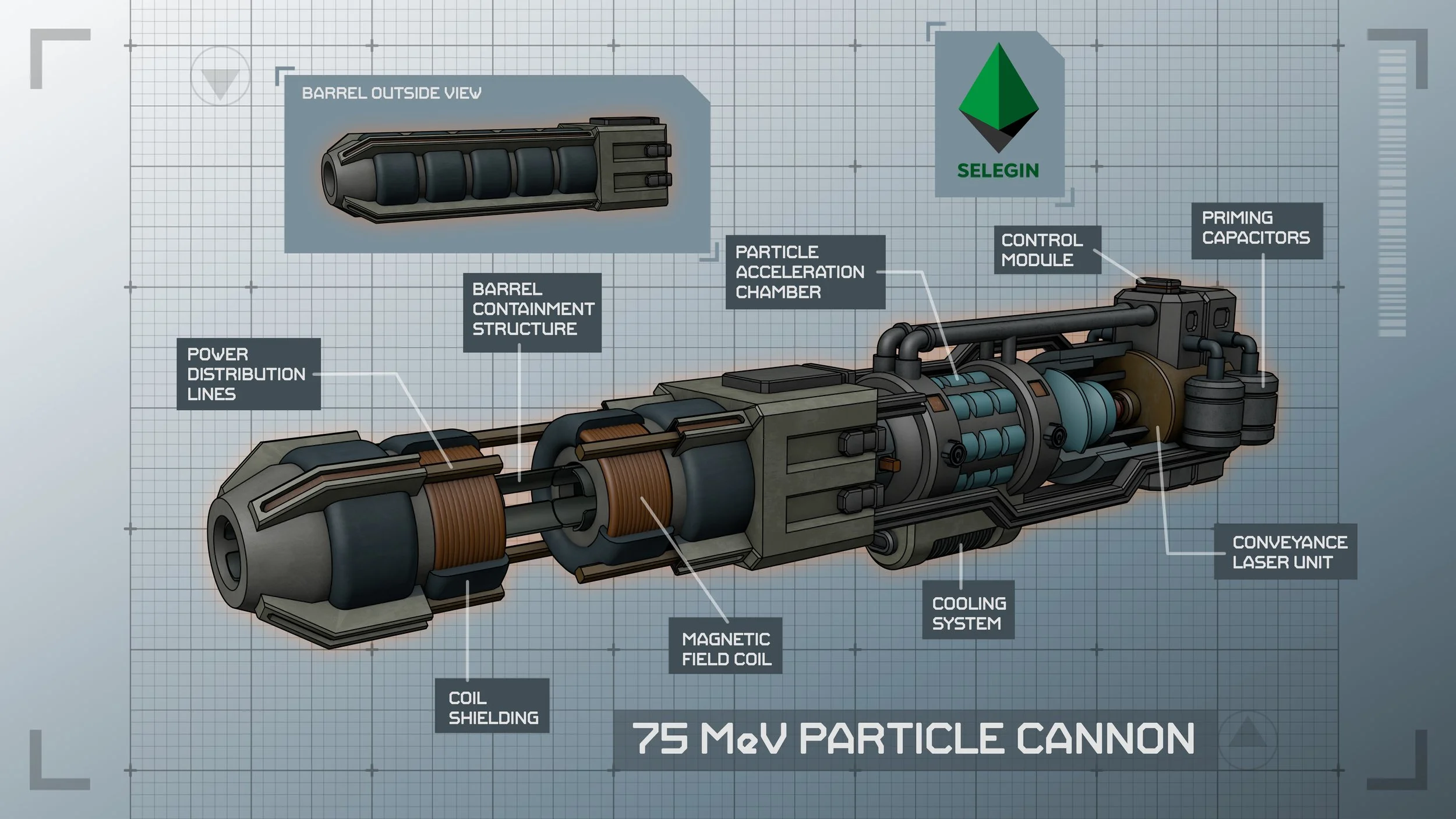
Illustration by Florian Mellies
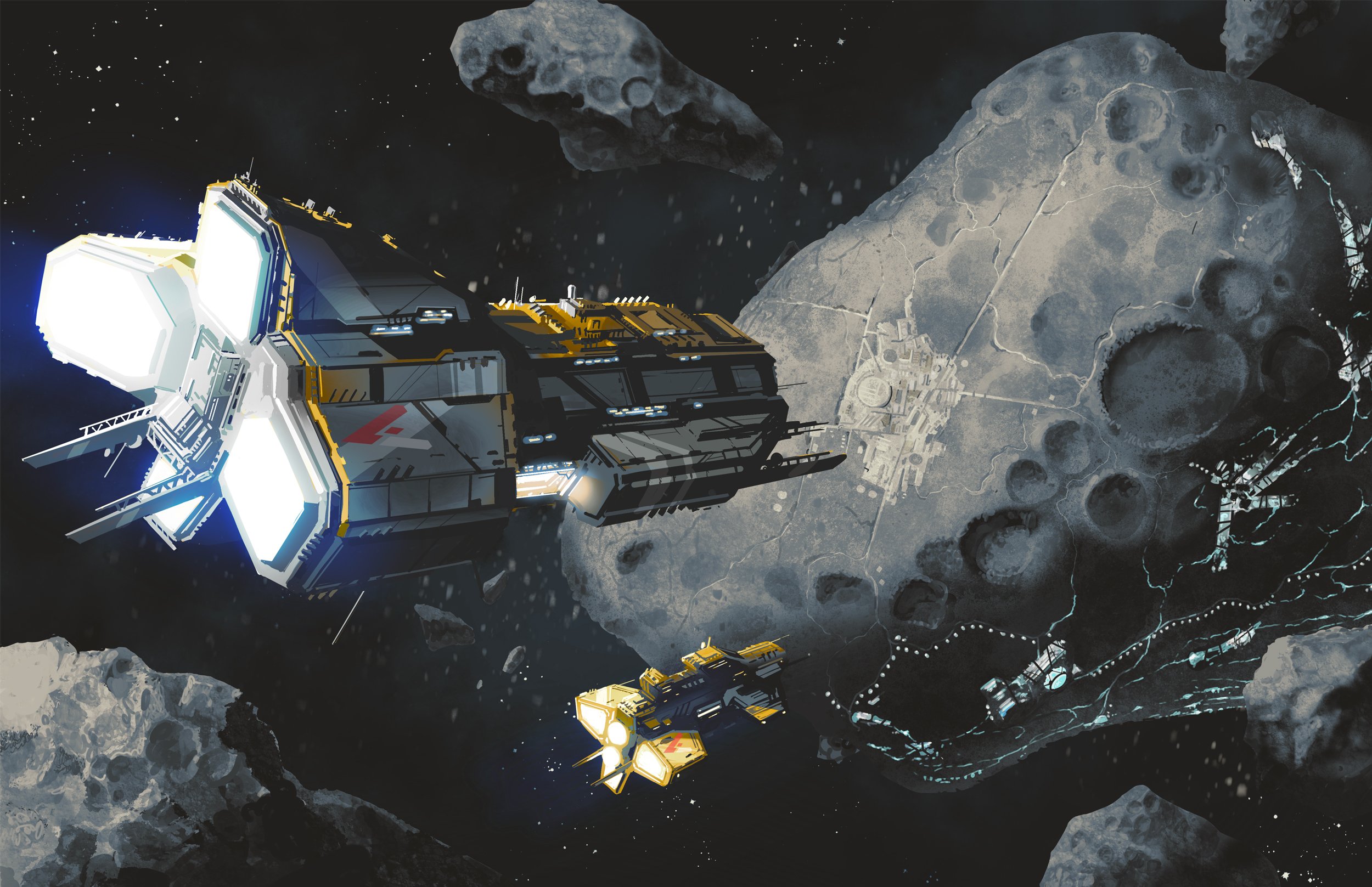
Quarterly Review
The killing properly started in the mines. DMG’s machines used heavy mining attachments as close-combat weapons of terrible potency. Power claws, jackhammers, cutter wheels, all designed to tear through the toughest rock. All had inflicted horrible losses on the VisalCorp tactical team. Their multi-legged designs, so ideal for ranged combat, were awkward and almost defenseless at point blank. Lanning watched from the command deck of his ship in orbit as an impact hammer crushed the torso of one of his light HE-Vs like an eggshell, wreckage sparking.
A solid, crescent-shaped mahogany table gleamed under lights, fantastically ostentatious. Wood, real wood, was among the rarest and costliest materials in the solar system. Lanning took no comfort from the notion that his career’s funeral would be conducted in a room with fittings that cost more than an average person made in a lifetime.
The table’s polished surface reflected the murky faces of the seven executives across from Lanning, holding court, judging, weighing. Lanning's future a trifling thing in their soft, manicured hands.
"Mr. Lanning," Dubner's voice resonated with the even tone of a seasoned C-suite exec, betraying nothing save competent control. "Let this hearing begin with your understanding of the Prosperity operation's objectives." Benjamin Dubner, VisalCorp’s chief of operations, led the inquest. A plump, stately older man, Lanning respected his leadership and prayed he would be the sympathetic ear on the committee.
Lanning straightened in his chair, smoothed his jacket. The overhead light was too bright, and a recording drone hovered just outside his peripheral vision, a bit too close for comfort. Calculated, subtle moves to be sure. He softly cleared his throat. "Our objective was two-part. Securing the mining facility assets in their entirety and safeguarding any commodities on site. Also regaining total compliance from Dairo Mining Group personnel. Failing the latter, decommissioning of any hostile parties."
Prasac, chief of efficiency, and Lanning’s most hated foe in the corporate jungle, leaned forward. "A vague assessment, one that surely influenced your practical approach to the problem. Troubling considering the botched mission cost the company more than two dozen employees and one very expensive lander. That is just the tangible assets-"
"That is a summary, only, Mr. Prasac. Our planning went-"
"Don’t interrupt me, Lanning." Prasac smiled in delight at Lanning’s predicament. “You led the security operation, and the employees under your care and supervision, into disaster with wholly inadequate planning, preparation and due diligence.”
---
Almost two months earlier, the doomed VisalCorp mission to Prosperity indeed began with exacting care. Lanning listened intently as the tactical team leader, Endou, rotated holographic displays on the planning table, long blocks of text scrolling steadily alongside a detailed topographic model.
"In the end, just ticked-off miners with heavy industrial equipment." Endou had said, closing the 3D terrain model. "Maybe – maybe – a few mercs if they can pay.” He shook his head and looked coolly at Lanning. “Either way, we’ll cut them down if they resist. Standard pacification protocols first, but if they go loud we can handle it. Minimal collateral."
Lanning had nodded. Few real fighters, obsolete mining HE-Vs, likely low morale. WegMaCo’s provided intel painted DMG as a rabble of disgruntled workers, barely held together by a firebrand’s promises. Besides, he had seen Visal’s new crop of sleek, cutting edge HE-Vs on the test range: multi-legged, like predatory insects. Swift and deadly. War machines.
“How long to secure the facility and apprehend or neutralize?" Lanning asked.
"Once we make planetfall, less than 24 hours, sir. Likely less if they surrender."
---
"Our tactical team lead’s assessment and the supplementary intelligence package showed all indications of minimal resistance." Lanning said carefully. "DMG was assessed as a would-be independent operation, merely striking workers with grievances against the company."
"Assessed by whom?" Asked another committee member whose name Lanning could not recall. A hawkish woman from internal security. She didn't look up from her tablet.
"WegMaCo furnished much of the intelligence. That formed the core of our data."
Prasac's eyebrows rose, still staring at Lanning. "It never occurred to you, Mr. Lanning, that you should independently verify this information before committing the company’s resources?"
"WegMaCo is our most trusted corporate ally-"
Prasac leaned back in the expensive high-back chair, synthleather sighing. "Was a trusted ally, Lanning. Was." Prasac replied smugly, as slick as oil on plate glass. "Your adventurism has completely compromised that relationship,” He looked to Dubner. “Permanently, I fear."
Heat rose in Lanning’s cheeks, the collar of his shirt constricting him. He felt parched, vaguely disoriented. VisalCorp had guaranteed WegMaCo that they would end the strike at Prosperity swiftly and get the ore flowing again. On schedule and no exceptions. Immense profit rested on the fulfillment of their existing delivery contracts, profits that VisalCorp would get a slice of. All of it, blown, and with him to blame.
Lanning struggled to keep his voice even, plowing ahead with his paltry defense. "The workup was completely comprehensive, according to the manual, and was supplemented by our own satellite imagery, communications logs, and internal operational analyses."
"Tell us about the initial contact after arrival." Dubner said.
---
DMG responded to their hails with curses and demands, in no uncertain terms, that they tuck tail. They’d stay free. Endou had chuckled grimly at that.
"We can all talk tough." He'd remarked, then ordered the kill-sat deployed.
Demonstrating the multi-gigawatt orbital laser on a derelict ore hopper drove most of the spotted Dairo HE-Vs underground. The landing of Visal’s own forces went flawlessly. Too flawlessly, in hindsight. Despite some retrofitted, illegal ordnance, DMG's few remaining surface defenders were swept away easily. Loader and excavator HE-Vs were no match for the sleek company combat rigs that ruthlessly flanked and dismantled them. Afterward, dozens of the miners had come out to greet them, cheering. White flags and all.
Endou sounded almost proud, then, transmitting from the cockpit of his own HE-V. "Some locals, at least, are happy to see proper corporate management again, sir."
Lanning had felt joy, a kind of relief. This would work. He could do this. Success in sight. A glowing quarterly review formed in his mind. Executive potential.
---
"Initial resistance was light after we demonstrated the potential negative outcomes." Lanning replied. "Some of the DMG personnel actually welcomed our arrival."
"Welcomed? Really?" Asked another heavyset man, skeptical, from the personnel branch.
"Yes, sir. It was apparent they preferred ongoing employment with VisalCorp."
Prasac again. "How very fortunate for you, then. You did not think to consolidate these gains and reassess the situation after encountering only a few bad actors?"
A question with no right answer. Lanning could only go on. "With the surface facilities swept and secured, we set a topside security team and moved underground, into the dig sites, where the rest of the DMG personnel were hiding."
"You mean lurking in ambush. For you." Prasac said. It wasn't a question.
---
The killing properly started in the mines. DMG’s machines used heavy mining attachments as close-combat weapons of terrible potency. Power claws, jackhammers, cutter wheels, all designed to tear through the toughest rock. All had inflicted horrible losses on the VisalCorp tactical team. Their multi-legged designs, so ideal for ranged combat, were awkward and almost defenseless at point blank. Lanning watched from the command deck of his ship in orbit as an impact hammer crushed the torso of one of his light HE-Vs like an eggshell, wreckage sparking.
But Endou rallied his men and lured several DMG groups into following his false retreats, into interlocking lanes of deadly accurate laser and autocannon fire. VisalCorp’s security operatives gave as good as they got, dropping a score of the rebels. It wasn’t enough. In a titanic excavated cavern, they assumed the last DMG holdouts were cornered. Lanning, helpless, stared in mute horror as charges detonated among the vast columns in orderly lines. Uncountable tons of stone plummeted from the ceiling far overhead.
The last words he heard from any of his subordinates were from Endou, shouting vainly for his men to get out. Then most of the force’s status monitors showed ‘signal lost’ against a sky blue background. Lanning had stood there, tinnitus in his ears, pulse hammering, tasting copper, the other voices around him on the command deck indecipherable.
Then hidden entrances on the surface sprang open, and fresh DMG machines with unaccountably advanced weapons had poured out like hornets.
---
"The ambush resulted in the total loss of the tactical team below ground," Lanning said, his voice steady despite the haunting memory. “The few security personnel remaining above ground, and the lander, were overwhelmed by the counterattack and also lost.”
"Twenty-eight employees. Good ones. Men and women with families, futures," Prasac said, his solemnity counterfeit. He read off a list of names, smiling profiles with photos appearing on a wall screen in time with each. Each a dagger aimed at Lanning. "All of them, dead, because you – incompetent as you are – led them into an obvious trap!"
Lanning’s true thoughts raged against the walls of his skull. An obvious trap. What did Prasac know about any of it? Between the company-mandated procedures, tight timetable and absolute necessity of securing all company property against loss or theft, he had been caught between Scylla and Charybdis. The only move open to him and his team was to go in at once to dispatch the rebels.
"Again, the intelli-" Lanning repeated, dumbly.
"Damn the intelligence, Lanning!" Prasac shouted, venom dripping. "This is gross negligence. Manslaughter..."
Dubner lifted his hand from the table, forestalling any further exchange. He waited a few beats. "In light of events, what is your assessment of DMG's capabilities now, Mr. Lanning?"
Lanning spared only a moment and asserted control over his words. "DMG demonstrated sophisticated tactical planning and used their knowledge of the local terrain to great effect against us. However, most noteworthy is that the modifications to their HE-Vs suggest external support."
"External support? You’re insinuating DMG had help?"
Lanning was in dangerous territory and playing a very dangerous game. He saw the additional reports in his mind, the ones reviewed during the long flight home: WegMaCo's timely maneuvering to acquire DMG assets prior to their compiling of the intelligence briefing. A too-perfect setup for a power play.
He had also put together a package with other details. Details like VisalCorp's own human intelligence-gathering methods. Methods that would make for mighty uncomfortable reading by those who valued human rights.
His reverie ended. "I'm suggesting, sir," Lanning said, "that DMG was better prepared than anyone could have anticipated."
Prasac waved a hand in contempt. "That doesn't account for the failure at the tactical level. You went in undergunned and completely overconfident, and got our people killed”.
The audacity had Lanning near the end of his tether. "The force allocation was prescribed by the resources department, and based entirely on-"
"Faulty intelligence, yes, yes. You’ve said that, Lanning." Prasac's tone drilled into Lanning’s brain like a slug of molten metal.
---
The DMG personnel that surrendered were indeed loyal to VisalCorp, but had been “quarantined” topside apart from their confederates to boost the company’s confidence. The easy victory was just shy of choreographed. Both were part of a sophisticated deception tactic. Someone had trained DMG’s fighters, helped them, armed them.
Lanning had uncovered, deliberately buried in a VisalCorp database, evidence that their own external security department had suspected as much. Info that would have changed everything. Evidence that would clear Lanning's name. Something that would implicate someone in the corporation of espionage.
---
For two hours the committee conferred behind their sonic privacy screen, voices masked behind electronic white noise. Lanning watched their faces, looking for any sign of reprieve. When the screen lifted, Dubner's expression was stern, cold. Lanning’s stomach soured, hopes dissolving.
"Mr. Lanning. This committee has found gross negligence in both operational planning and execution of the Prosperity expedition. As the manager in charge, accountability begins with you. You are hereby relieved of your responsibilities. You will be reassigned to other duties pending additional review."
The now familiar ringing sounded again in his ears, the very same that had plagued him during the long flight home from Prosperity. A corporate death sentence, handed down in the blasé tongue of all corpo dogs. People like him, his people, Lanning understood with the clarity of the condemned.
"However," Dubner continued, his tone fractionally lighter. "We acknowledge the intelligence failures involved and the complex nature of the challenges you and other employees encountered. It is hereby found that these matters warrant additional investigation."
Prasac's head twitched toward Dubner, surprise shifting his features for an instant. "Sir, it’s apparent the failures lie with Manager Lanning and him alone.” Lanning noticed this, and his suspicions unfurled. Prasac hated Lanning, he seemingly always had, but the man never wasted even a passing opportunity to extract a toll from any who transgressed against VisalCorp interests. That he would pass on the opportunity against a competitor, much less WegMaCo, was jarring. Even telling, perhaps.
"Thank you, Mr.Prasac. Your comments are noted." Dubner's tone a subtle warning. "We owe it to our shareholders, and our departed employees, to examine all aspects of this failure thoroughly. This meeting has concluded."
Lanning’s career with VisalCorp was dead, finished, even now cooling to room temperature. His life-that-was hacked apart, root and branch. The recording drone’s light winked off and it hovered away with a soft whir. He was soon alone in the dim room. But for the first time since his career began, Lanning had a goal besides climbing the corporate tower toward its lofty pinnacle.
He wanted justice, of a kind. Maybe it was just good, old fashioned revenge. On WegMaCo, for torpedoing his life and killing his peers. On Prasac, too, the prick. He thought of the reports he uncovered, the copies sitting safely in a secured device. Those reports would be very valuable to the right person. VisalCorp had taught Lanning everything he knew about problem solving, and he intended to put that teaching to good use.
Illustration by Eldon Cowgar
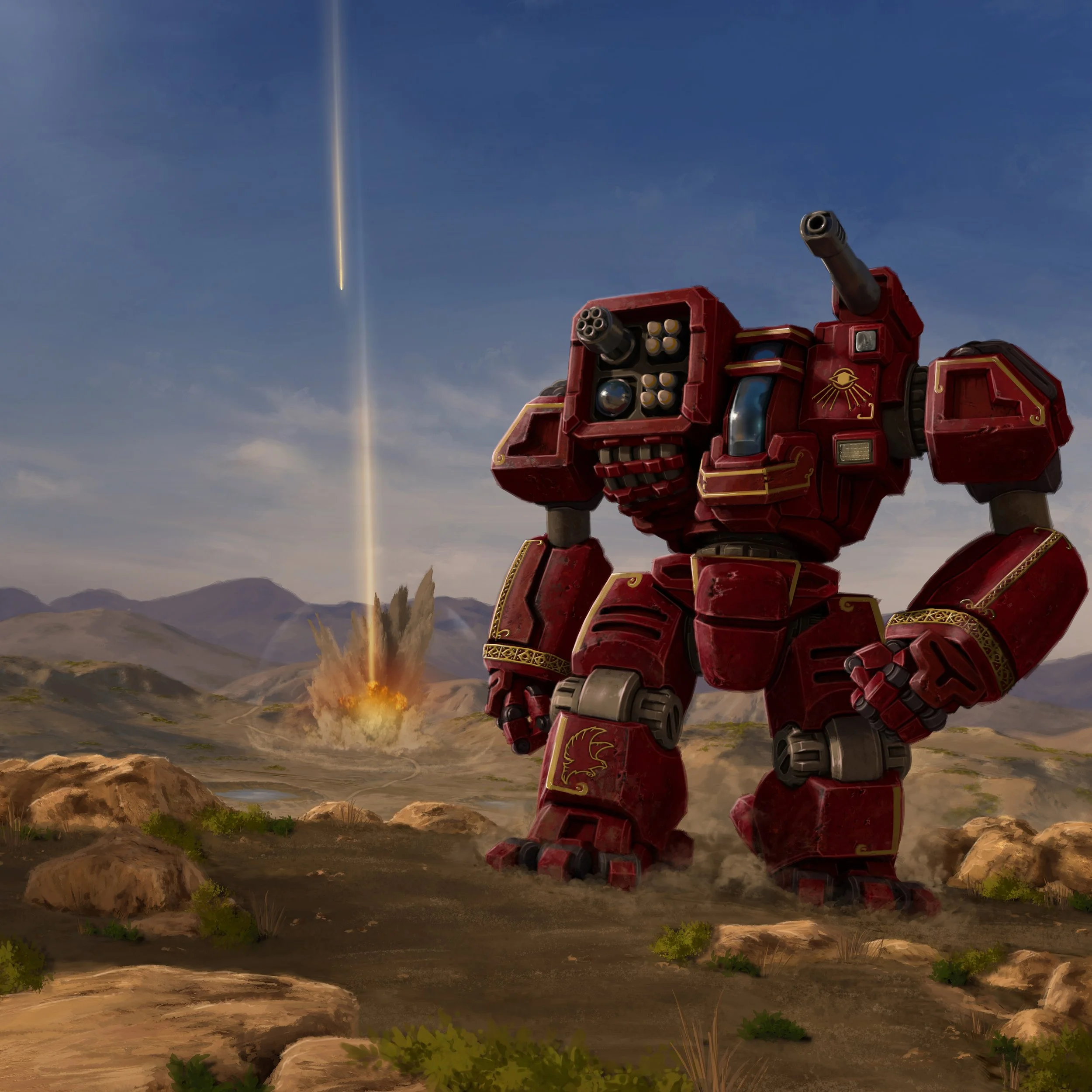
The Hand of Ra
The eastern edge of the Buried Basin, Ra's earthly domain set aside for his blessed people, was just past the ridge. Tal would see it with his own eyes in a moment. Despite the approaching threat, now was the time for patience. He knew the sentries were picking their way over the same rough ridge to meet him. Tal leaned back and savored a moment’s respite. His machine, an old, repurposed ore-mover, like himself bore signs of devotion: coarse copper and brass filigree wound along the arms, a brass sun welded to the wide chest, and everywhere else a wash of dark burgundy paint covered the rusting hull. That paint symbolized Ra's continual protection of his people, and his wrath toward those who would harm them. One and the same.
Brother Tal struggled with the HE-Vs controls as he neared the crest of the steep ridge. The machine's wide feet, caked with mud, settled at last onto the ancient stone, stable. He locked the Klondike’s joints, a pneumatic hiss reaching him in the cockpit. Tal glanced at the cockpit displays, amber tones shifted yellow by the high afternoon sun. Ra, ever above, ever kind. There was no grand view through the canopy; all he could see from where he sat was scrubby grasses, gravel, and a few sparse saplings.
The eastern edge of the Buried Basin, Ra's earthly domain set aside for his blessed people, was just past the ridge. Tal would see it with his own eyes in a moment. Despite the approaching threat, now was the time for patience. He knew the sentries were picking their way over the same rough ridge to meet him. Tal leaned back and savored a moment’s respite. His machine, an old, repurposed ore-mover, like himself bore signs of devotion: coarse copper and brass filigree wound along the arms, a brass sun welded to the wide chest, and everywhere else a wash of dark burgundy paint covered the rusting hull. That paint symbolized Ra's continual protection of his people, and his wrath toward those who would harm them. One and the same.
The dashboard chirped, a blindspot alarm. Beyond the scuffed canopy’s edge, two men approached. Three remote, weak clangs reverberated up through the HE-V; the signal. Tal checked the joint locks one more time, then unbuckled, rose from the seat, and turned to the back of the cockpit. He touched the devotional sun there, inscribed with its wide, unblinking eye, and then climbed the short ladder to the Klondike’s top hatch. He threw the locking lever, and pushed the heavy hatch up and open with the aid of its struts. Pine, hot metal, soil, wet stone and a twinge of sweat reached his nose.
Brother Ostlund had already scaled the tall machine via its handholds and was waiting for him. He helped heave back the heavy hatch and lent a hand to Tal, grunting with the effort of pulling his stocky friend up and out.
“Brother Ostlund, be seen. Punctual as ever. Thank you.”
“Ra sees you also, Brother Tal. You’re welcome. I wish I could greet you on a happier day.” The taller man unslung a pair of electro-optical binoculars and handed them to Tal. He pointed east. From their vantage on top of the Klondike they could see over the ridge and clear to the distant horizon.
Tal raised the binoculars, fiddled with the magnification, and waited for them to focus. Some 15 miles off, dust plumes on the horizon, a dun snake winding through the hazy countryside. Tal punched up the magnification to max and his view wobbled precipitously, too much for the bino’s stabilizers to overcome. He knelt, settling one elbow on a knee, and looked again. He caught glimpses of blue paint through the dust.
"Ah," Tal said quietly. "It's them." He lowered the heavy binos and made a tsk sound, between regret and disappointment.
“Who?”
“The ones from the south. Two months ago, near abouts.”
“The blasphemers! Closed eyes, stony hearts. They have chosen war, then.”
“Looks like, dear brother.”
Tal stood and turned back, looking inward and toward home. From where he stood he could just make out the hallowed ground of the Three Rebukes. He did not need the binoculars to visualize every detail of that holy place, the one Watcher Lynch always recounted so beautifully in his services. Three overlapping craters, each a perfect circle of tortured, shattered earth some two hundred meters across. The edge of each fused to glass by the pure fury of Ra's judgment. Tal had walked them as a boy, walked them still, and could feel the crunch and unnatural smoothness underfoot even now. The Founder of the Hand of Ra, the First Seen, had beseeched Ra in his time of uttermost need. Ra had answered, and saved his people. Three brilliant lances of sunlight made solid streaked down from the sky. Three roars of anger shook the Earth. Three craters where the wicked had dared the Sun God.
Three Rebukes.
—
Brother Tal had watched their faces during the negotiations. They were desperate, tired people. Their leader, a man named Verlan, had been respectful enough regarding the acquisition of nickel and copper. His people needed both for repair of water reclamation systems. Left broken, it was sure to doom their struggling settlement. Clean water was of paramount importance for trade with neighbors and travellers. Verlan had offered much for the metals; weapons, labor, expertise. Then his wicked tongue uncoiled.
Verlan had argued too strongly during a time of scarcity. Elder William tried to placate him with assurances that Ra would provide enough for both peoples, enough for Verlan and his folk, in time. Verlan had scoffed, then blasphemed, laughing.
Negotiations ended at once and they were sent away under threat, and twice more since then their envoys were turned back. With such people there could be no trade, no fraternity.
—
"They were warned," Tal said as he turned east again. His voice was neutral. "They chose their words."
Ostlund did not reply, turning to spit as if his mouth were suddenly filled with rust.
"Remain here, on watch. I will send others to relieve you. Ra sees our plight, brother.” Tal said
Ostlund climbed down off the towering Klondike with the agility of a spider. Tal reentered the cockpit and strapped in. He called home, alerting the Elders, and carefully turned his hulking machine around. He steered the massive HE-V down the ridge, its gait jarring and ponderous. By the time he reached the bottom, Watcher Lynch was ringing the great chimes to gather the faithful. On level ground, Tal set a fast pace. The nearest rim of the Three Rebukes caught the afternoon sun, glinting like the eye of Ra himself.
—
The Temple of the Seeing Sun was part of a vast smelting works and refinery before the Rift. While the many vats were still functional and indeed used by the Hand for their original purpose, the sanctuary, originally an immense furnace of some kind, had forever been cold. Now the cavernous, echoing space served the Hand of Ra as a place of worship. On the high ceiling was a brilliant sun of gold, the Eye of Ra, and surrounding it were small points of copper, stars symbolizing his lesser light. The air here always smelled of herbs, charcoal, smoke and beeswax, a wonderfully comforting aroma to Tal and his kin.
Watcher Lynch stood before the granite altar, the cold stone draped in an embroidered crimson cloth. His copper circlet glinted in the firelight as he raised his hands and the seated congregation hushed. Lynch’s face was deeply tanned and creased, weathered by sixty-odd years of ascetic devotion and survival. Around him, dozens of Ra’s faithful had assembled: Tal’s fellow Brothers and Sisters, the warriors who protected Ra’s domain on Earth, along with miners, artisans, whole families. Tal took his place at the front, shivering in his sweat-dampened haptic suit.
"Ra sees all, be seen you who would." Lynch intoned solemnly, voice strong and sonorous despite his years.
“See us, see us.” A chorus of voices, hands raised and fingers touching, circles, overhead in unison.
Watcher Lynch continued. "From his high place, Ra watches over his faithful. He watched over our ancestors when he first set his ire against the world. He watches us now. My own father was only eight years old when the First Seen saved him," Lynch said softly. "Him and sixteen other children, hiding as the heathens railed against Ra’s correction. The First Seen, our Founder, was once only a simple soldier. So moved was he by pure pity for the defenseless that Ra saw him, and revealed his benevolence to him.”
"The Founder, blessed be his memory, was led to an old school bus, as yellow as Ra’s light. A sign of favor and protection. He gathered the children and brought them here, to this basin, to safety. There, in time, Ra further revealed his goodness and his ways. Ra had called upon his First Seen to save us all, to build something good on the Earth he cursed. Every night, the Founder told my father and the others stories about the Sun God, happy, kind, watching them from above. They learned of Ra’s great Eye that never blinked. About the certain wrath that would fall on any who dared threaten his faithful."
Tal had heard this very sermon countless hundreds of times, and still he listened intently.
“Then, one day, Ra tested his chosen. Evil men came," he leaned on the altar, eyes downcast, hands tense. "The Founder begged them to leave. They laughed at him, they said they would take what they wanted and burn the rest."
Lynch looked up, his voice trembling with indignation. "The Founder walked out alone in another machine Ra provided for him. Ever peaceful, he begged again that the evil men should leave so that Ra might spare them. They would not go. Then, he prayed to Ra, and Ra heard his prayers! Ra then sent down his Three Rebukes..." Only the crackle of burning firewood was audible in the Temple.
"That was when the children truly understood," Lynch went on, voice softer, full of reverence. "The Founder’s word was true. Ra watched over them. Ra protects, as he always has! He watches over and protects us still! Be seen!"
Watcher Lynch stood tall behind the altar and raised his arms, voluminous sleeves shimmering like oil in the torchlight. "Two months past, evil men came again, seeking trade. We faithful welcomed these strangers. We offered fair terms for our minerals, minerals bequeathed to us by Ra for our provision. But they were greedy. They mocked Ra’s wisdom. Their leader called us fools clinging to insanity!"
Murmurs rippled through the crowd, hissing with anger, disturbed.
"They blasphemed," Lynch said coldly. " And now they return with weapons, showing themselves as the thieves they are. They would steal what Ra has blessed his chosen with. And so they too will face judgment, as all who threaten Ra and his chosen must." He half turned and gestured to Tal.
“The Brothers and Sisters go forth bravely to confront these pillagers, and Ra’s ever-open eye burns hot against our foes! Be seen, you faithful!”
“SEE US!” The crowd erupted in jubilation as Tal and his fellow warriors stood.
—
Brother Tal monitored the approach of the raiders all night in the command center, a room little more than a converted office space fitted with a map board and radios. The approaching band had camped some distance off, resuming their journey the following morning as Ra’s eye rose behind them. A good omen.
Tal departed with his fellows in their own HE-Vs to meet them. Four in all, along with mining trucks carrying heavy weapons and brethren who would fight on foot. They would meet two other Hand pilots already afield and watching. The weight of what was to come settled over Tal like mist, and his heart was troubled.
He had long ago memorized the prayers of salvation, every variation of the holy numbers, and repeated them, under duress, during drill and practice until he could not speak them wrong. But he had never done so with his heart ablaze, in battle, had never sent up his prayer with the real fervor that would bring Ra's burning judgment upon living souls.
The Hand’s meager force stopped south of the Three Rebukes and awaited their foes. In time, their foes arrived, rolling and walking over the ridge in the distance, stopping at the bottom across a broad plain, roughly a kilometer away. Brother Tal stoically observed it all from his Klondike, a lengthy flanged club gripped in his rig’s right hand. He was positioned with the five other Hand HE-Vs, all variously ornamented, in a simple defensive gunline blocking the most direct route to the village.
The calculus of the battle to come was brutal: six against fourteen, and among the raider ranks were actual warmachines and many more vehicles, besides. Without Ra's intervention, this would be a slaughter.
Tal opened a general channel. "You there. You were warned. Again you stand in Ra's domain, in opposition to his Hand. Withdraw now, I beg, or you will face judgment."
A response came right after, a man’s familiar voice. Verlan, their leader.
"Sir, we came in peace. We came in friendship. We offered fair trade. You refused over- over jest, a joke.” His voice was even wearier, not truly angry. "Our children may die because of your-.” He cut himself off. “We need the metals we talked about, and that’s all. We're not here to destroy you. That is the last thing we want. Can we not… Can we figure this out peacefully?"
"Your blasphemies are counted," Tal replied harshly. "You called Ra a false god. You called his faithful lunatics."
Across the plain, Tal could not hear the many whirring motors and servos that aimed guns, nor the silent cogitation of fire control systems fuzing shells and charging capacitors. None of the Hand’s HE-Vs, simple as they were, sounded alarms at the questing attention of hostile targeting lasers and radars.
"I only questioned- I sought to understand. I meant no offense, no harm. Please! Please…”
"Leave," Tal repeated. "I will not say it again." He struggled against a rising hatred for these people. He sought to channel the Founder’s mercy and compassion.
Silence stretched for too long. Then Verlan’s voice returned, harder. "We can't. I'm sorry, but we can't.”
Their formation advanced as one across the plain. No shots were fired.
Tal watched them come. His hand moved again to the transmission key. "Sister Casie, we must beseech Ra for deliverance." He rattled off a lengthy, sacred numeric prayer, and another after that, owing to the great peril he and his kin faced. The numbers’ purpose was knowable only to Ra.
They chose this, they blasphemed. Tal reminded himself. They were warned. They blasphemed and now they come as thieves. Against Ra.
—
Deep in the innermost sanctum of the Temple of the Seeing Sun, beyond even the sacred reliquary shrine of the Founder's bus, Sister Casie, robed, sat in the Founder's own HE-V. It was merely half an HE-V, at this point. One leg was gone, the other was stripped to the skeleton. Neglect, rust and wear had locked every joint. The paint was so old and brittle it flaked like cicada husks, crackling at the slightest touch.
In the dim cockpit, cramped and cluttered, she waited, anointed for a most holy and important duty: serving as the bridge between the protectors’ lips and Ra’s ears. She heard her brother’s prayers, committing the numbers of both to memory in an instant. Her hands trembled slightly as she punched the numbers in, and watched them populate a display. Two prayers, two sequences each: a string of numbers that would call Ra's judgment. She pressed a single, larger key and waited
"Sister Casie?" Brother Tal's voice crackled, insistent, over the radio. "Have you heard? Does Ra see us? Has he heard us?"
She’d been distracted by her own troubled thoughts and blinked back to the present, focusing on the screen, still dark save for three green, winking dots. Soon, a cheery tone sounded as an image of a dish, on Earth, pointed at a satellite in the void, above, appeared. A checkmark glowed between them, then all vanished.
"Yes, Brother Tal. Ra has heard us, has seen us. Even now his light gathers." Her voice sounded steadier, surer, than she felt and she was glad of it.
—
Far above the Sudbury Basin, a forgotten satellite waited among the ever-multiplying constellation of junk in orbit over Earth. Decaying and decrepit though it was, it had been built to last. Unusual for commercial satellites, this one carried a tremendously heavy load of cargo meant for delivery to the surface: sleek, pointed kinetic mass rods, made of cheap and abundant tungsten, each a little shorter than a power pole and about as wide.
In its day a product of graft and blackmail, the satellite was once used to break up deep formations of ore throughout the Basin, doing so easily, quickly and cheaply. When the Rift struck, it was forgotten about soon enough. It waited, geosynchronous, patient and potent, until a kindly, desperate man happened upon a still-functioning, credentialed controller in a tucked-away HE-V.
Once again, coordinates were received. Twice the hopper revolved silently. Though it operated with feline smoothness once upon a time, it now hitched and scraped through the deployment procedure. Twice, two gray spikes puffed away from the launch bay, one after the other. They seemed to fall slowly, at first.
—
Brother Tal tried to count the seconds, seemingly stretched into minutes, stretched into hours. His mouth was dry. Onward their foes marched. Was something wrong? Tal strangled the doubt at once. Ra was watching. Ra protected.
The oncoming raiders were halfway across the plain, still holding fire. Hesitant, perhaps, or hoping against hope that the faithful would break or surrender. Tal knew that Ra’s gaze, ever heavy on the hearts of the wicked, stayed their lust for bloodshed. Proof!
It was then that he looked up again, and this time saw. Two tiny, thin, bright streaks in the sky. The signs! Drops of the sun’s unquenchable fire, Ra’s might made manifest! Stretching, angling down from on high, their speed impossible and gathering. Tal had heard the stories, had touched the very soil of the Strikes, but knowing was not the same as seeing. They grew and grew, lengthening, ever brighter. Ra, reaching out to smite the evildoers! Time compressed now. Years squeezed to a fraction of a second.
The faithful would be preserved!
The first tungsten rod struck. Its impact was apocalyptic. One blue-and-white checkered HE-V was beneath it at the impact point. It ceased to exist, smashed to its constituent atoms by incalculable force. Unseen, the rod burrowed into the earth instantly, a shockfront of displaced, superheated stone and soil screaming outward. A perfect circle, a scouring hurricane. The ground leapt, heaved and rolled, as waves on the sea. Another HE-V near ground zero was thrown skyward, arms outstretched, upward, in a facsimile of supplication, before disappearing in the rising cloud.
The second rod fell. More HE-Vs tumbled like bowling pins. Trucks flipped or sank in the now-treacherous earth. In another moment, all was concealed by dust. The shockwave reached Tal and his brethren. Even some five hundred meters distant the mighty Klondike was rocked by the pressure wave, and he had to work to keep the top-heavy machine from tilting over backwards. Over the radio, awestruck prayers of thanks, of glory, of praise from his brothers and sisters filled the channels. Singing, too.
Tal ordered them to stand, to hold position. They all waited some time. Still no shots came. As the dust and smoke slowly cleared, the faithful saw: where a moment ago stood their enemies, now was only ruin. One HE-V, battered and prone, struggled to flip onto its back. It managed, and was still for a moment. Then one giant steel hand reached up and tore away its canopy, dropping it to the smoldering soil before going slack. A man slowly crawled out from the cockpit, as if from a tomb. Two men and a woman, all injured, tried vainly to force open another shredded machine before flames engulfed it.
Tal and the others stood and watched. They watched the few survivors go, as ghosts, back the way they came. Those spared among the defeated who had dared challenge Ra. Later, one survivor, a young man pinned in the wreckage of a transport truck, leg crushed beyond saving, was found weeping. Weeping not from the agony that was certainly terrible, but from revelation.
—
The victory convocation lasted hours, the Hand of Ra gathered in their entirety inside the Temple. Watcher Lynch led the ceremonies. Hymns were sung and thanks offered. Sister Casie slipped away, walking through the twisting innards of the complex to the old bus in its shrine. Its wheels sat on carved stone blocks, tires long ago rotted to nothing. Surrounding it, the faithful had placed their simple votive offerings: bowls of soil from the Three Rebukes and the new Strikes, written prayers on paper, sketches of loved and lost, simple candles.
Casie knelt and studied some of them. A child's drawing of the sun, a hand-beaten copper prayer wheel. A long letter, written in unsteady script, thanking Ra for another year of life.
These people, her people, believed. Truly, deeply believed. Faith, the kind that gives purpose, structure, and hope. That made sense of a deeply confusing world. She had been anointed to fortify that faith, to serve as the sacred link between earthly followers and Ra above. She rose and considered the driver's seat inside the bus, barely visible through the cloudy, grimy windows, where the Founder had sat.
She glanced at the small shrine box installed beside the seat containing a picture of the Founder from life, faded and tattered. A man in camouflage, with hard bark but kind eyes. His smile was thin, tired. Had he truly prophesied this faith, their faith? Or was it half-remembered myth meant only to comfort frightened children? Did he believe his own tales? Did it matter?
Casie closed her eyes to pray. The whispered words fizzled out and she was silent; doubt had fully risen to cover her heart, and no words escaped those murky, black waters. The Founder was a kind man. But merely a man who’d had enough of war and decided to protect orphans instead. A man who then told those orphans stories to comfort them. Had he known of the mining satellite beforehand? Had he discovered it by accident, sheltering in this abandoned mine?
Casie walked closer to the bus and pressed a hand to the cool, rough bodywork. There was too much at stake, too many lives. She would keep the faith, for their sake. But she understood it could not, would not, last. The satellite, unreachable, was slowly failing. And its payload depleted with each called strike.
How many rods remained? A dozen? Five? Two? None? Casie wondered if Ra’s judgment would even fall at all next time.
She pulled her hand back and touched the sun medallion at her throat, the copper surface warm from her skin. She felt suddenly trapped, panting, walls closing in, shadows whispering of the destructive enlightenment sure to befall one and all in the Buried Basin. She gathered herself after a time and walked back into the Temple to join the festivities. Her tears would be mistaken for those of joy.
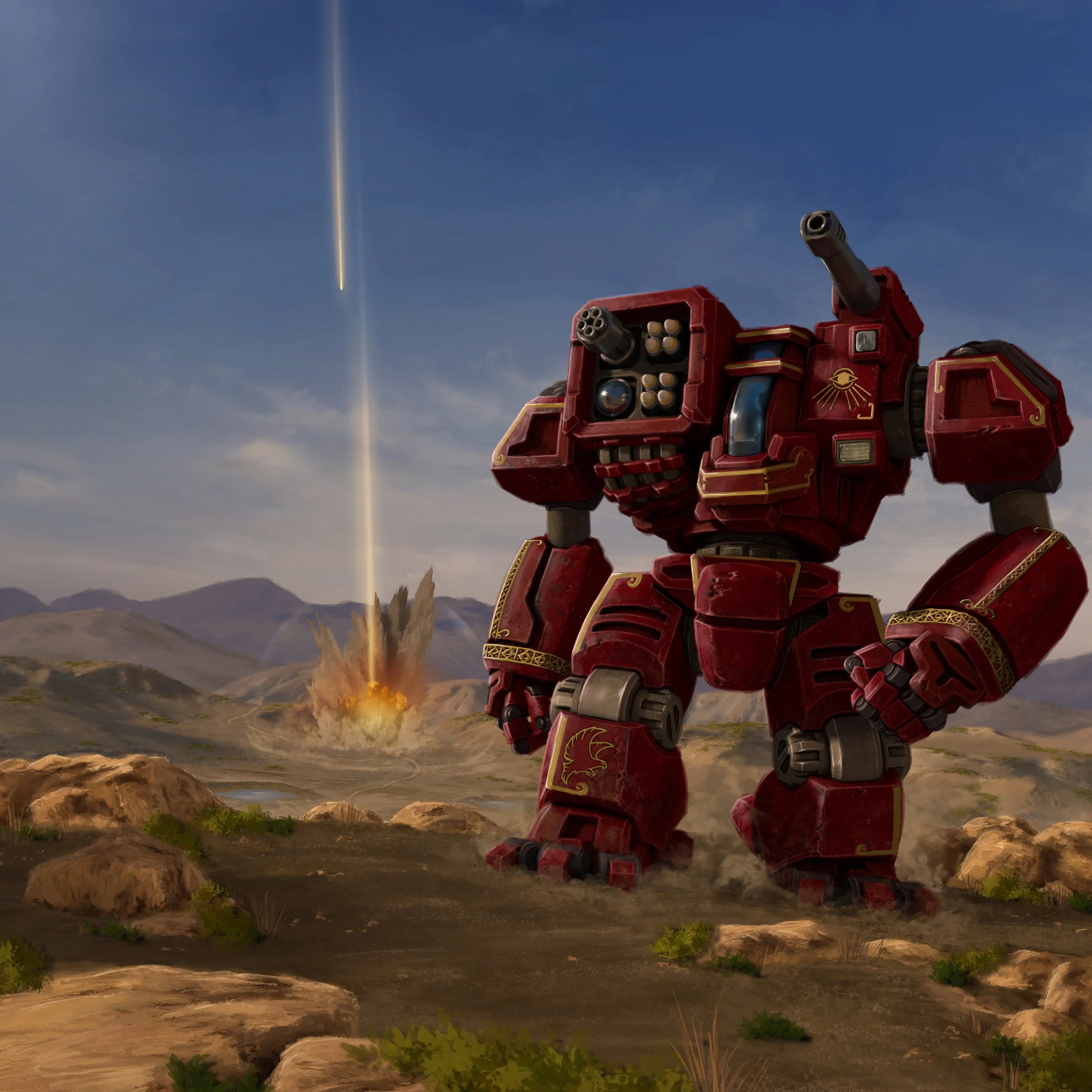
Illustration by Florian Mellies
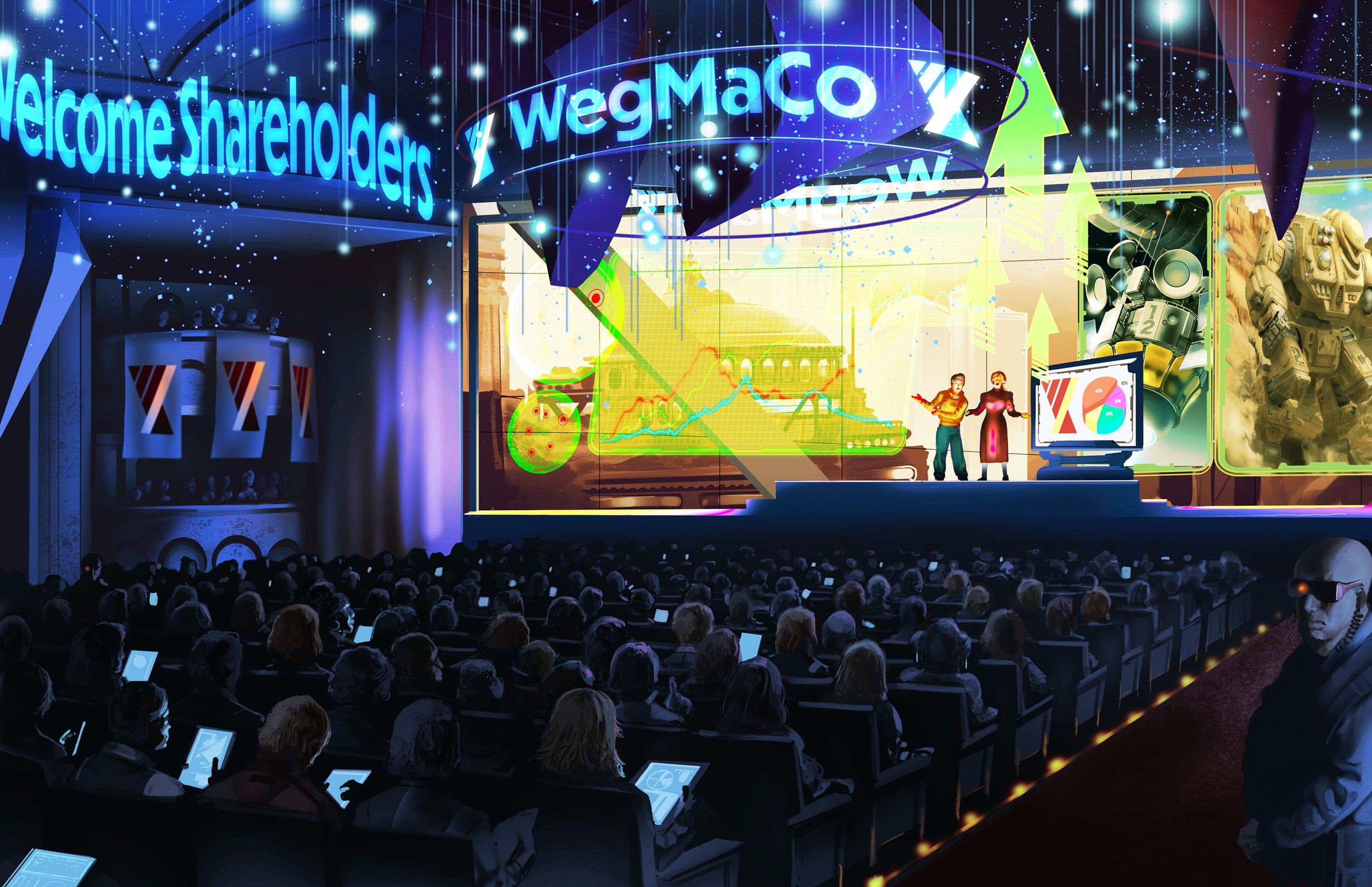
WegMaCo Shareholder Address
Good morning, everyone. Shareholders, board members. Dear friends, thank you for being here. Some of you made a long journey. So if you’ll allow it, I will skip the preamble. I am ecstatic to share that your investment in WegMaCo, your continued trust in our vision and expertise, has been rewarded: Every single revenue stream, from consumer goods to interstellar transit, has seen significant gains over the last fiscal year.
Title: “WegMaCo”
Transcript of Shareholder Address
Speaker: Arthur Martinet-Farris (Vice President)
April 9th, 2385 ESY
Gavin Martinet Memorial Corporate Summit Center
Ophir Planum, Mars
(Podium Microphone: On)
(Portable Microphone: On)
Good morning, everyone. Shareholders, board members. Dear friends, thank you for being here. Some of you made a long journey. So if you’ll allow it, I will skip the preamble. I am ecstatic to share that your investment in WegMaCo, your continued trust in our vision and expertise, has been rewarded: Every single revenue stream, from consumer goods to interstellar transit, has seen significant gains over the last fiscal year.
Overall profit has increased 26%. (Long Applause). Our direct-to-consumer products are ubiquitous, now found in 95% of all human habitations and businesses, and 90% of those contain six or more of our product lines. We, of course, continue to do far more than just deliver our own products to the far corners of space. Our transport fleet services every human inhabited planet, moon, station and asteroid in the solar system - and more than a few automated installations!
That fleet numbers an astounding <REDACTED> space-going vessels, including bulk freighters and tiny, fast courier ships. Each ship, every crew member, has a singular goal: on-time and intact delivery of critical shipments, be that drinking water, a complete orbital platform module or a single data drive. Last year, our efforts moved more than 471 billion tons of cargo, and accounted for 78% of all freight. (Light Applause)
Amazing, isn’t it? Our customers know that whatever they are ordering or shipping, wherever it is going, we will make it happen. Not some other corporation, cooperative or government entity. It's hardly a boast. I say that with all humility. Our partners and clients don’t merely hire us; we don’t just do a job for them. When you contract with WegMaCo, you join the WegMaCo family. This company was founded, built and run on family ethics, and that is how it is still managed today. If you call someone family, you’d better mean it. That’s because you have a responsibility to them. We have a responsibility. A responsibility to humanity. No, not just to you, our shareholders! (Laughter).
Despite these uncertain times, business must go on, and business owners from Earth to the Belt know that seamless supply chains are prerequisites for profit. Logistics are, in fact, destiny. You can’t leave destiny up to chance. Our friends understand that if they want their own endeavors to flourish, they must partner with WegMaCo. Only we work so closely with our partners that we can anticipate their needs before they do. It’s no wonder they stick with us for the long haul: they can count on us to be there for them, right behind them, every step of the way.
Take the Echelon Group, for instance, one of our longest and most prosperous partnerships. At first, they turned to us because they were forced to. In desperation. They were out of options for delivering their sensitive, valuable products to the most demanding clients and the wolves were at their door. Early on in discussions, they frankly told us it couldn’t be done. In time, WegMaCo showed them that, when everyone works together, it could. We, in turn, learned so, so much from them.
We learned that we don’t just make and sell goods. We don’t just ship cargo. We don’t just provide logistics. (silence for 3.1 seconds) We deliver outcomes. WegMaCo sells something, one thing, that money has never been able to buy, not since time immemorial: WegMaCo sells certainty. And in today’s competitive marketplace, certainty is the only commodity that matters.
(Wild applause)
My friends, on behalf of the executive staff and every WegMaCo employee, from our assembly line workers to our brave spaceship crews, thank you for your trust and investment. I can promise this year, and every year hence, the rewards will be even better than the last. Together, we’ll keep civilization moving through the stars. (Applause) Thank you, thank you. Please, enjoy yourselves and your stay. I will speak with some of you shortly. Thank you!
<Podium Microphone: Off>
(Footsteps, indistinct speech) Uh huh. If they like those numbers, the fourth quarter is sure going to blow their hair back. Just watch. You, fetch me a water, won’t you? Mineral water this time, please! Are we ready for our ten-thirty? Good. To real business, the Prosperity situation. The fix is in. Ah, what was the name of that dirtgrubber collective moving the ore, Daimyo something? (indistinct speech) Dairo, that’s it, thank you, Thomas.
VisalCorp and Echelon both look like fools thanks to the efforts of the valiant miners, a real PR disaster and as intended. The last screw we had to turn. Their shares are already floundering and we’ll soon have majority ownership. Patience. (indistinct speech) What about the ore? Eye on the ball, Thomas, a hundred-million is a rounding error. In any case, we can shift a few bulkers from the Triangle to move all they can dig up. They’ve got no one else, make sure the rate is outrageous.
My what? Damn it…
<Portable Microphone: Off>
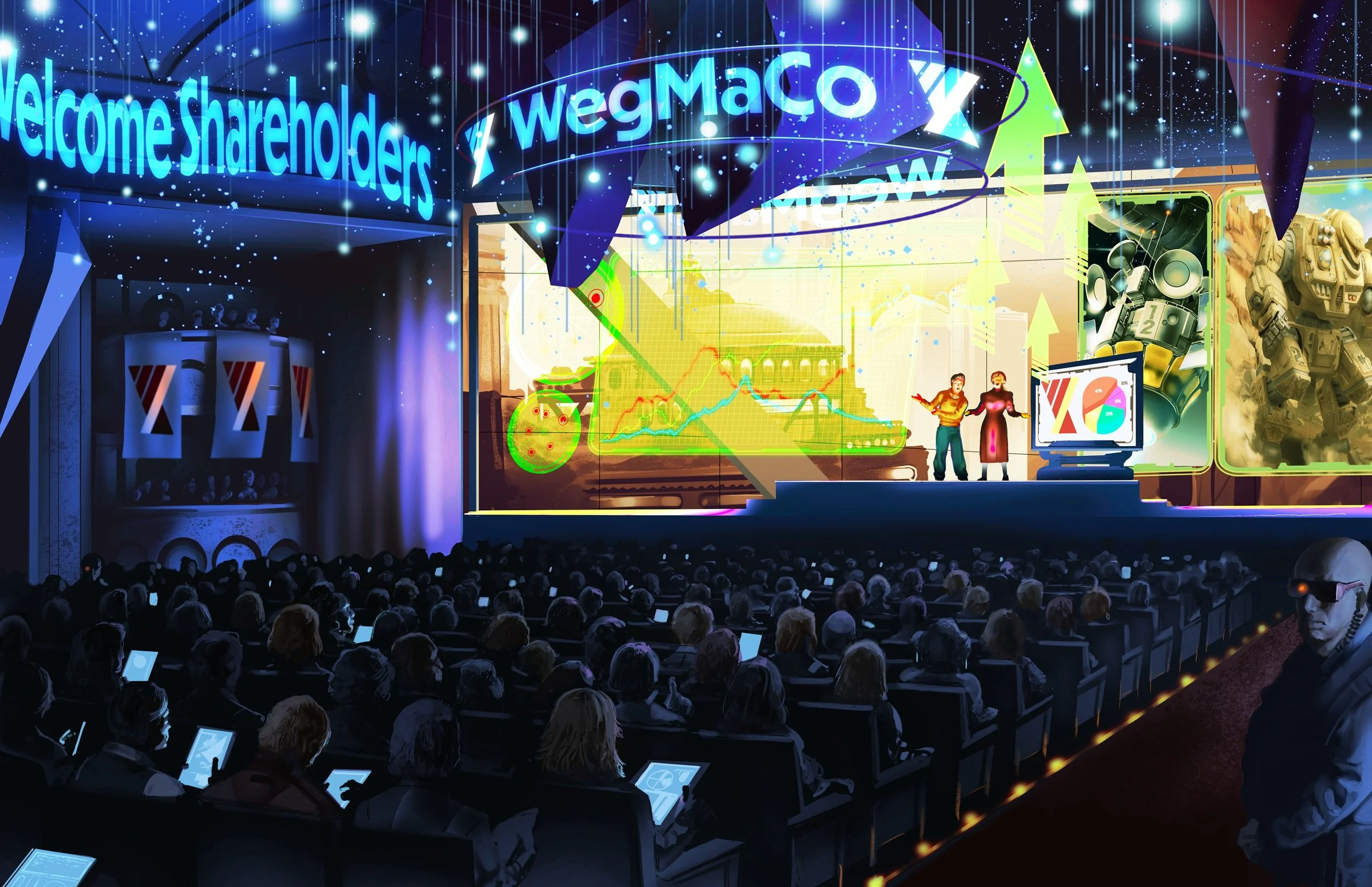
Illustration by Eldon Cowgar
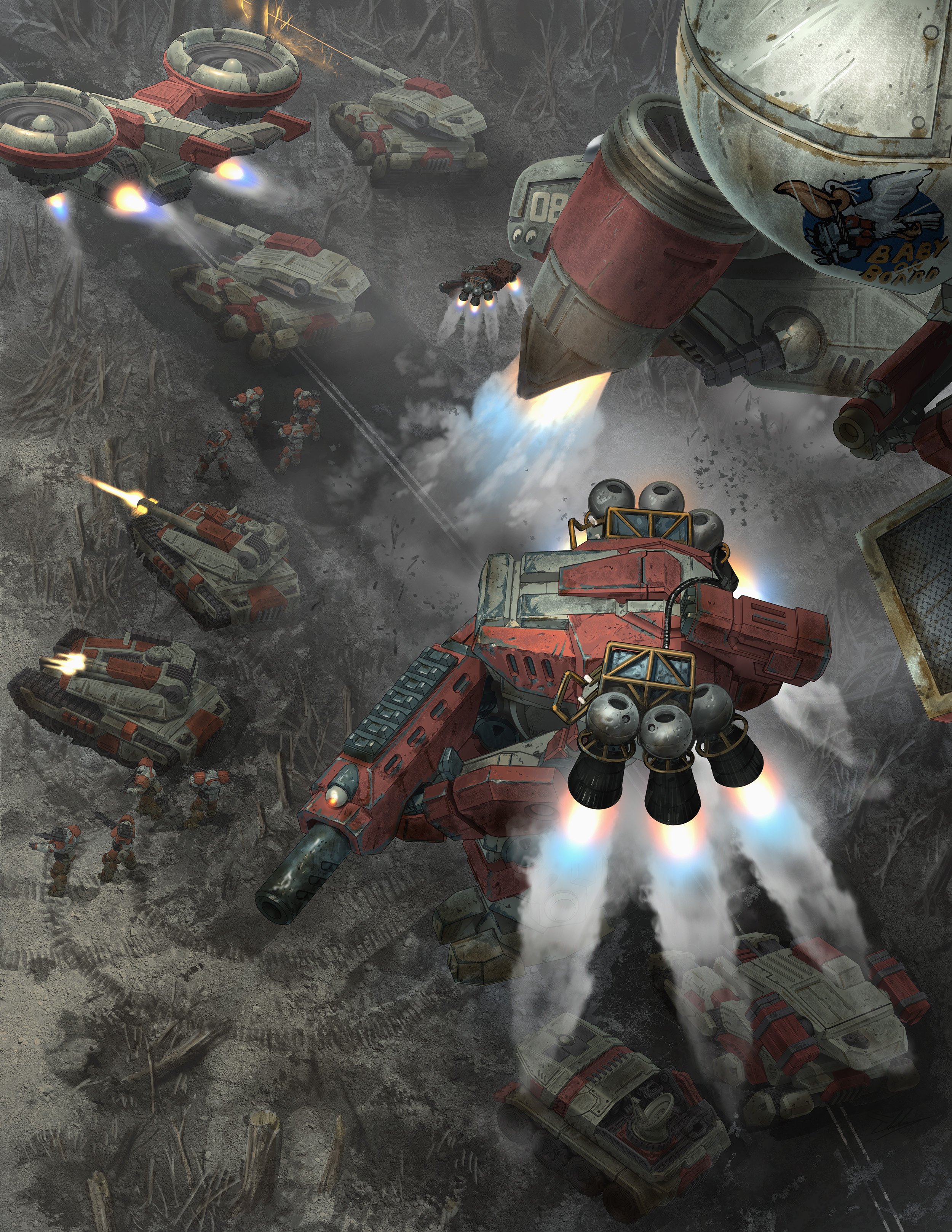
Reunion Day
Lewis felt strangely nervous. He’d seen combat, had fought the scum that prowled Michigan’s badlands and elsewhere. But in little more than a quarter of an hour the 67th would have its answer to a century-old question. Collecting his rifle and spare drum magazines, he marched out with his brothers to the pair of Orca LAS wing transporters, waiting to carry them to where they were needed.
The third floor briefing room smelled of old upholstery, plastic and stale coffee. First Lieutenant Jared Lewis lingered for a time after his peers had filed out and the ancient holographic projector had flickered off, hum fading. It was made to keep on serving. Just like everything else in the 67th North Horizon Corps. Just like him.
Outside the hazy reinforced windows, Lewis watched a returning patrol of Fennec and Corso HE-Vs trundle through the monolithic gate and across the marshalling yard. Across the complex, the nearby hangars stood open to receive them, maintenance drones and robotic gantries prepped to service the giant fighting machines. The boxy HE-Vs had been refurbished dozens of times over the decades. All of them had outlived their original pilots. Each was treated with reverence.
The 67th had been completely isolated since the Rift, that great catastrophe that had utterly broken mankind’s mastery of Earth and the solar system at large. Cut off, alone, and plunged into a new world of lack and paranoia, they'd maintained discipline through thick and thin. Upheld their traditions and their faith.
This was all Lewis had ever known. Born 2359 in the hospital complex on the same base, the son of a logistics officer and a combat medic. He was a professional soldier, but the 67th wasn't merely his unit: it was his culture, his people, his world. To Lewis, the 67th was civilization in micro, all of it situated on one mostly self-sufficient military installation in southern Michigan.
Throughout the region where they projected force, the 67th stabilized an otherwise wild and lawless northern hemisphere. Their martial prowess, technology and professionalism had proved one hell of a ‘thou shalt not’ for many a raider and two-bit warlord. Lately, though, the natives were growing bolder. Word had reached the 67th that the long-enforced Solar Republic blockade of Earth’s skies was crumbling. And no one really knew why; seemingly the last remnants of their forces just gave up their posts.
Lewis briefly wondered over this before the iron discipline instilled in him since childhood reasserted itself, shaking him out of his reverie. His thoughts returned to duty and he left the briefing room. Descending three flights of stairs, Lewis was just beyond the stairwell door when raised voices drifted down the corridor leading to the command center. Was that a tinge of anxiety he heard? Probably another insurgent attack on a nearby hamlet, most likely. He changed course and headed toward the command center.
Then two officers sprinted out of an adjacent corridor and piled into the C3; the command, control, and communications center. Lewis knew then something was definitely amiss. Disregarding protocol, he jogged to the still-open door and let himself in. It was packed. Lieutenant General Perez stood at the main bank of consoles, an earpiece pressed to his head with one hand. Other personnel frantically worked keyboards amid a dozen hushed, huddled conversations in the room.
"Quiet! Lock it up!" Perez barked, and the C3 fell quiet. Another officer flipped a switch on one of the control boards and a speaker came to life, static pouring out.
Through the static, a voice: "—say again, this is the Peregrine to Dusk Base. Authentication follows. Dancer July Silver, seven-seven-niner-one-five-five-one. Repeat, Dancer July Silver, seven-seven-niner-one-five-five-one. Requesting immediate approach clearance for planetfall and landing at your coordinates. How copy?"
Save for the hissing static, the room really was silent then. Lewis recognized the sequence, and his pulse quickened. The string of words and numbers were an authenticator, a code from before the Rift. A code, one of many, that identified friendly forces. Not many members of the 67th held out hope those codes would ever be needed after so long.
Perez's hands trembled slightly as he briskly thumbed through a book. A book, ancient and precious, that usually resided in a locked safe. Finally his finger traced a line, then again, slower. Around him, his senior officers barely breathed.
Perez looked up, expression stoic as ever, and cleared his throat softly. "The code is legitimate," he announced. "It's the 42nd. Our sister corps."
Stillness for one heartbeat, then the room erupted. Shoulders were slapped, some laughed, others gawked in disbelief. Lewis was numbed, overcome by the same sensation of unreality felt in the aftermath of a bomb explosion. A century of isolation, of wondering if they were the last, left totally alone. Wondering if their commitment counted for anything.
“Attention!” Perez's mild reprimand snapped all assembled back to order. Military bearing or no, Lewis saw no dimming of the excitement in his fellows’ eyes.
Perez addressed his staff. "To work. Major Koenig, respond to that transmission. Clear them for approach and direct as needed. I want verification protocols running continuously. Everyone else, on alert. I want the quick-reaction force ready to roll with 30 seconds notice, as of right now."
"Sir?" Major Koenig looked concerned. "Could this be a deception ploy?"
"I don’t think so," Perez said carefully, "But we will be ready for that eventuality.” He turned to address the rest of the C3. “Let’s go, people!"
His soldiers leapt to obey. Alert notifications sounded across the entire complex. His brothers and sisters filed out and more came in. Lewis was swept along with those heading out. He led a Viper power suit squad, and his squad plus another were part of the quick-reaction force. The mission clock was already ticking. Following a winding series of corridors to the power suit bays, he sensed the posture of the base transform as troops double-timed to their posts, the shrill whine of fusion reactors cycled hot, and LAS wing engines spun up, baking tarmac.
He made it to the bay in three minutes, finding his squad — Heller, Roberts and Svensson — already assembled and quickly suiting up, each attended by two technicians. Heller, keen to any change in the status quo, looked at him with a questioning, cocked eyebrow.
"It’s go-time," Lewis told them. "We might have friendlies inbound. Or we might have hostiles jerking our chain. Either way, we're heading out."
“Friendlies!? Like who?” Roberts, his tone incredulous, was in half-dress. He had stepped into the leg assemblies of his Viper suit, and techs were hastily joining and securing the first pieces of the upper half around his undersuit-clad torso.
Lewis had already hopped up on the metal stepladder and dropped into the waiting legs of his own suit with the ease of an acrobat. The techs set to work with tools buzzing, and the familiar second skin of the power suit clamped shut around him: chestplate, backplate, bracers, and gauntlets. Two full tons of radiation-hardened composite armor, sensors and target designators. He'd been training in these suits since he was sixteen.
“The 42nd.” Lewis replied, and Roberts’ eyes went bright and wide against his olive skin. Then a grim-visored helmet and cowl was lowered over Lewis’ head and he was in darkness. Connections were made and after a moment the visor depolarized, the HUD flickered on, and speakers came to life.
“Ain’t no way, el tee!” Roberts continued, his voice now tinny over the suit radio.
“Looks like.” Lewis said, tasting the dry, coppery air now circulating over his face.
Svensson was listening in and let out a low whistle and the squad chattered speculatively as Lewis ran through his standup checklist, completed pre-op diagnostics, and then confirmed pending data links using a combination of the suit’s jaw switch and facial gestures. His own suit and the others, all in the green. Clearing the HUD’s subdisplays he regarded his squad. The men stood fully eight feet tall in the bulky suits, and had lined up to retrieve their heavy 25mm rifles from a nearby rack.
"All personnel, be advised." A voice crackled over the command net. "Incoming ship has completed atmospheric entry. ETA is twenty-one mikes."
Twenty-one minutes. Lewis felt strangely nervous. He’d seen combat, had fought the scum that prowled Michigan’s badlands and elsewhere. But in little more than a quarter of an hour the 67th would have its answer to a century-old question. Collecting his rifle and spare drum magazines, he marched out with his brothers to the pair of Orca LAS wing transporters, waiting to carry them to where they were needed.
—
Back in the C3, fresh drama unfolded. "Sir, new contacts! Multiple launches detected from Old Detroit metrozone." A sensor officer said urgently. "Signatures are supersonic now, resolving… SLASSMs! We’ve got six snakes in the air! Vector coincides with the 42nd ship!"
Perez’s blood chilled. SLASSMs, anti-starship missiles. Was it the Solar Republic firing on blockade runners? No, they had no ground forces present in Detroit, or elsewhere in Michigan. The Sable Cadre, then? That council heading up the coalition of local bandits, brigands, and renegade military units plaguing Michigan. They had been stealing, salvaging and trading war toys for years. But the 67th’s own intelligence had never once suggested they’d obtained any weapon that could threaten large, spacegoing craft.
"Broadcast on all frequencies!" Perez shouted. He leaned over the comms officer’s shoulder and spoke directly into the mic. "Peregrine, Dusk Base, you have missiles inbound, mark six snakes inbound! Deploy countermeasures."
The sensor display revealed the brutal calculus of the situation as acidic yellow icons. The 42nd's gargantuan transport ship, ponderous and ungainly in atmo. The missiles, relentless and accelerating. Seconds to intercept, two missile contacts winked out, shot down by the ship’s point-defense arrays. Two more veered off course, decoyed. But two struck the Peregrine. Perez watched its icon fragment.
Another sensor technician spoke up. "Peregrine is hit! Breaking up, no, wait, she's holding together but going down. Trajectory puts her in the Ann Arbor metrozone."
Catastrophe. The remains of Ann Arbor were a Sable Cadre stronghold. Lieutenant General Perez knew from bitter experience that its bowels were studded with cleverly hidden armories and HE-V workshops. A worst-case scenario. He straightened, expression grim, and turned to the warboard. "QRF, immediate deployment!" Voice booming with implicit command. "Direct all combat elements currently in the field toward the crash site.”
—
The Orca shuddered as it climbed hard over hills, Lewis and Heller locked into the cargo compartment’s deployment rails. Svensson and Roberts would be just off the starboard wing in the second transporter. Streaming an exterior camera feed to his HUD, Lewis watched the Michigan landscape below blur past. Forests had swallowed most of the highways, and up ahead the sprawling corpse of Ann Arbor spread beneath a towering column of oily smoke.
Lewis’ workday had just gone from ‘interesting’ to ‘terrifying’. The old metrozone was a literal concrete jungle: trees burst through rooflines, vines and creepers swallowed whole blocks, and skyscrapers stood draped in tattered cloaks of vegetation. Another carcass of civilization-that-was on Earth.
"Two minutes to insertion," the pilot announced. "Advise LZ is likely hot. Can't get you closer to the crash site than three klicks. Other elements are getting lit up with surface fire."
Through the feed, tracers arced up from the ruins, lasers strobed, and missile contrails lit like angry fireflies. The Orca banked steeply, settled and dropped with a hard bang that jolted Lewis through the suit’s padding. The rear ramp unfolded on an overgrown parking lot.
“We’re down. Out, out!” The pilot barked. The clamps released both suits and Lewis charged his heavy rifle before stepping down and off the ramp, metal-shod feet crushing the already crumbling pavement. The midday sun was obscured by smoke and ash, casting everything in shadowy relief. Mercifully, the gloom was no impediment whatsoever to the Viper suit’s sensors, and Lewis saw the rest of his squad, outlined in green, deploying a scant hundred yards away through a wall of dust.
The Orcas departed. Close by, the crash and roar of combat. Overhead, the 67th’s attack LAS wings buzzed and banked, strafing targets, while larger transports settled to deploy more troops. "Form up," Lewis ordered. "Objective is two-point-eight klicks northeast, bearing zero-three-one. Watch your sectors, the enemy knows this place better than we do." Heller took point and the squad moved at a pace no unaugmented human could match, their power suits eating up the intervening distance in long strides.
The remains of outer downtown were oppressive, every doorway, window and alleyway promising danger. Around them, the background thunder of HE-Vs and their heavy ordnance sounded nearer. Lewis flicked a glance at his tactical display to suss out if they were friendlies or not.
"Contact front!" Heller shouted into the comm.
Concealed Cadre infantry sprang from their hiding places in an old storefront, opening up with rifles, machine guns and portable rocket launchers. Lewis immediately relayed the contact to command as he felt dozens of dull impacts thud harmlessly across his body; a Viper suit’s plating would stop nearly all small arms rounds cold, but not anti-armor warheads or large caliber threats. Simultaneously, the 67th troopers fanned out and poured on immediate counterfire, targeting systems outlining threats in red as they fired from the hip. Heavy 25mm slugs punched through much of the cover the now-shocked Cadre troops sheltered behind.
The initial ambush proved ill-timed. Several Cadre fighters burst open like rotting fruit under the withering fire from the power suits. Roberts caught three flankers in the open as they left cover, hewing them limb from limb. Svensson worked over a handful still sheltering in the storefront, killing them and suppressing a machine gun team in the same building.
When the incoming fire slackened to almost nothing, Lewis seized the advantage, ordering his squad forward to finish it, capitalizing on the shocking carnage already wrought. Lewis neared a burned-out passenger car by the storefront when a lone Cadre soldier, face inscrutable behind the visor of his haz armor, rose just beyond it, a disposable anti-armor launcher perched on his shoulder and pointing right at him. Lewis reacted on raw instinct. Lunging, he delivered a power-assisted kick to the car’s midsection, sending it rolling over onto his hapless attacker, crushing him. The launcher the man carried pitched upward and discharged, the rocket streaking away into open sky.
Crushed though the infantry were, the fight wasn’t over. Before Lewis could rally his men, a torrent of heavy weapons fire scythed down on his now-exposed squad from an adjacent parking structure. Emplaced autocannons raked the street, dealing Svensson a bad direct hit. He shrieked into the comm as his left arm assembly and the limb inside it shattered. Heedless of the danger, Roberts sprinted to his comrade to drag him out of the kill zone as Lewis and Heller sprayed the concrete face of the structure on full auto in a desperate bid to throw off the aim of the Cadre crews. All around, the street erupted with the impact of explosive shells, and Lewis mentally braced for the one that would cut him down. He prayed silently that he would die like a man.
Deliverance arrived not on wings, but on two legs. Over the radio Lewis heard a calm, almost bored, voice. "Viper team, this is Hotshot 3. I’ve got your back, grab some cover.” Emerging from the gloom behind Lewis’ stricken squad, a heavy Shepherd crunched up the street, pavement heaving and splintering under its feet. The brick-like warmachine was clad in slabs of reactive armor, hardpoints bristling with long-barreled howitzers and rotary cannons. The ugliest angel imaginable.
Lewis and Heller scrabbled out of the Shepherd’s path as it strode forward imperiously to lay its guns on the parking garage. The Cadre weapons teams showed fight and peppered the monster, but to no avail. Two apocalyptic reports from the howitzers and from the ground floor up the structure vanished in a volcanic geyser of debris. Lewis’ suit rang like a bell, and he watched half-stunned as the Shepherd’s pilot combed the rubble with both rotary cannons, firing wide open. Then, almost as an afterthought, he rotated and walked fire through the length of the nearby buildings, carving through and collapsing them.
Looking back, Lewis saw a pair of speedy Fennecs, the other members of Hotshot, arrive and take up supporting positions, followed closely by a convoy of support vehicles. If any Cadre forces remained alive and near, none risked the wrath of the 67th combat team. The crash site was close, but Svensson was in a bad, bad way. Lewis requested medivac and ordered Roberts to stay with his wounded comrade and administer what aid he could in the meantime. He and Heller would carry on to the objective. Collecting Svensson’s ammo, the pair moved out.
A broad, scoured trail of destruction led to the 42nd's ship, jutting from a sprawling commercial office complex. Smoke poured from rents in the hull and flames licked at the surrounding debris. Lewis watched with dismay as an enemy HE-V closed in from an opposite thoroughfare, toward their own position in a spillway. He cursed to himself and reported its presence.
The Sable Cadre machine was smaller than the 67th's own Shepherd and seemingly cobbled together from salvage, but that was no consolation; they were spotted, and a Viper suit could not stand against such firepower, not for a moment. Lewis and Heller hunkered as heavy autocannon impacts walked up the street and over their heads, while searing particle bolts darkened their suit visors.
Staying as flat as possible on the incline, Lewis inched upward, just enough for his shoulders to clear the curb. "All 67th elements, this is Viper team leader. Enemy armor at objective, need priority fire mission! Flashing target data now." Lewis lit the enemy machine with his designator, making it known to every friendly smart weapon in range.
Across the surrounding metrozone, howitzer shells, rocket barrages and missiles streaked skyward, converging on the same destination. Lewis received the fire confirmations, counted seven hammering heartbeats, and the world came undone. Guided munitions pulverized the enemy rig into smoldering scrap and cinders. Nothing but a smoking crater remained.
Heller rose and quipped, "Overkill is underrated!"
“Right on, brother. Let’s get a move on.” Lewis checked his heavy rifle before he clambered up to street level. The pair crossed quickly to the ruined office complex and crashed through the maze of rubble and twisted metal. Small arms fire echoed from somewhere deeper inside.
After barging through a jammed door, they found themselves face to face with a squad of Cadre troopers near the ship’s flank, apparently trying to find or make a way in. After a moment of surprise, a point-blank slaughter immediately ensued. Despite outnumbering the suits five to one, the infantrymen died fast, blown apart by massive slugs or else hideously mangled by suit-augmented blows.
Lewis and Heller picked their way further into the increasingly jumbled building. They soon encountered a makeshift defensive position manned by different soldiers. Several of them were injured and all rightly terrified of the hulking, blood-soaked titans staring them down.
One shouted for the others to hold their fire.
These soldiers’ uniforms and armor were familiar to Lewis, but different. Their patches, though: It was their sister unit. The 42nd NHC. Real. Alive. Here. One of them, hair singed and face blistered from fire, lowered the muzzle of his rifle slightly and peered over it at Lewis’ suit. A sergeant judging from his rank insignia, the man’s expression flickered in surprise and he looked into Lewis’ darkened visor, seemingly right through it into Lewis’ eyes.
"67th?" His voice was rough. "You with the 67th?” After a moment, he added “Sir?"
Lewis keyed his external speakers. "Roger that, Sergeant." He said, gauntleted hand wiping blood from the 67th North Horizon Corps logo painted on his chestplate. "I’m Lieutenant Lewis, we're here to get you out."
There was no time for celebration. That would come days later, only after thirty-eight names, Svensson among them, were added to the 67th’s memorial wall. The ruins of Ann Arbor had brewed up into a proper warzone: the Sable Cadre forces were still swarming, regrouping, and fighting, even then closing on the crash site.
The cost of Reunion Day, as it would become known in the annals of the unit’s history, and to the wider solar system as Earthfall, was terrible. But that day marked the end of the 67th North Horizon Corps’ long and lonely patrol.
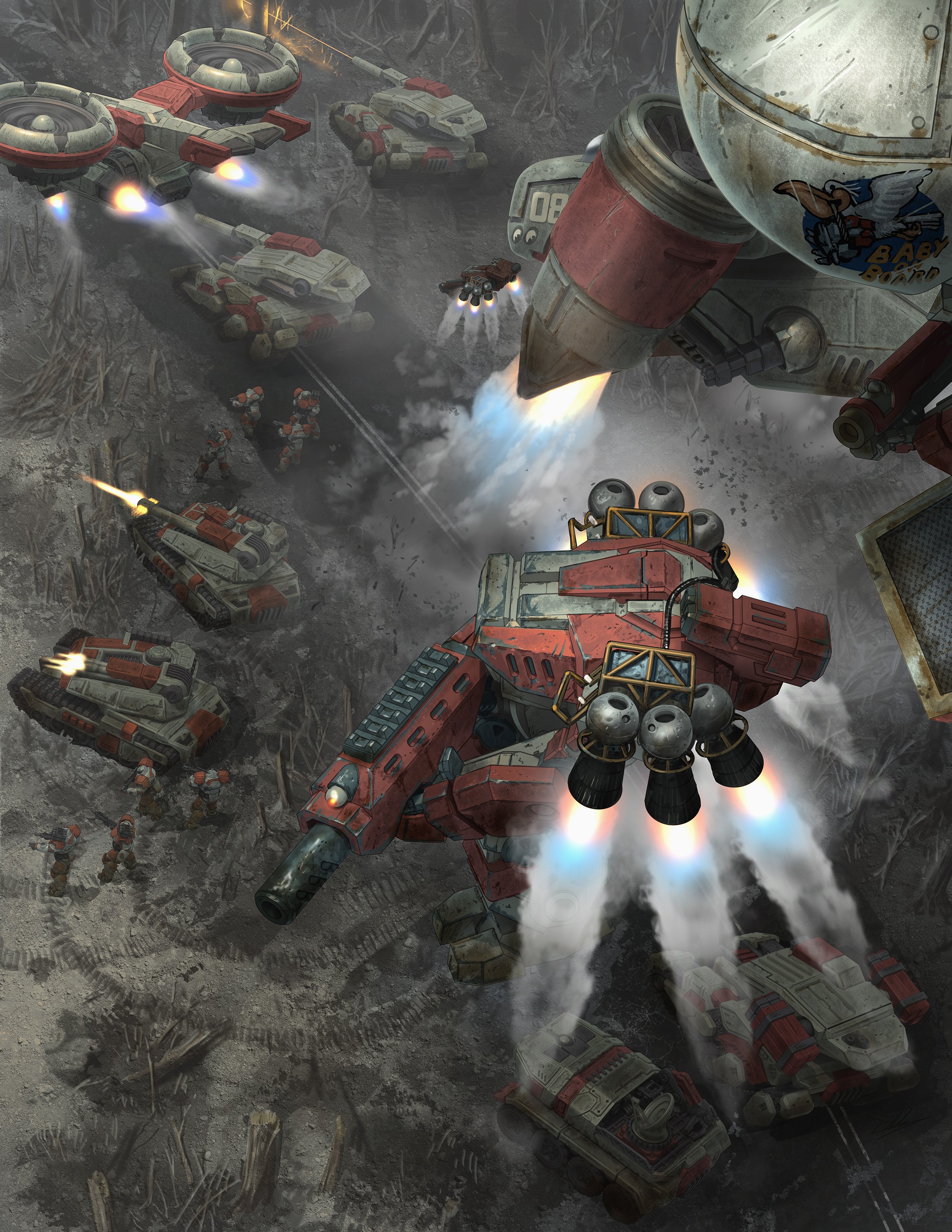
Illustration by Eldon Cowgur