
No Exit
July 8th, 2386
Vicinity of Great Falls, Montana
The bar setup in the old garage had no name. No quirky adjective, no novel animal. It was too cheerless for all that. The bar’s roof gave shade from the blistering sun, and it didn’t leak, and that was enough to make a sanctuary for those who entered with coin in hand.
Inside, men and women in dirty clothes slouched, bent from cruel labor, on chairs arranged around scattered crates, cable spools, and one immense steel cog, provenance unknown. They whispered to one another or sat in silence, and resembled the newly resurrected or else those given a short refrain from purgatory. A bartender stood behind a U-shaped wood and metal hightop, doling out local brew and bathtub spirits.
A man named Cook had ended up here after three days riding south in quest of men that could help him, and help his rural village. Great Falls was the closest and best place to look. The town itself was little more than a remnant or a fragment of the once-populous city’s carcass. Just across the river to the east, was a sprawling, desolate expanse of shattered rubble and scavenged ruins; some old military base flattened in a war long ago. The town served as a waystation, a hub of sorts, for haphazard commerce in the region. A natural confluence of humanity situated at a bend in the river. It was one of many such pitiful echoes of civilization scattered across North America and the northern hemisphere.
When Cook had arrived with his companion, Jewel, the town was flush with a typical assortment of travelers and transients. That was a good thing considering his predicament. He’d received no warm welcome, asking around as he was for men-at-arms: banditry and predation were near-constants on the continent. But in time, and with a good word from two locals that knew him, he was told that he might inquire of two traveling guns-for-hire. Pilots. They were at the bar right then. Their HE-Vs squatted, shutdown, in an overgrown lot not far from the bar. One of the machines was wide, low and heavy; the other somewhat taller, thin and spindly. Though not unseen in these parts, a clot of townsfolk had nonetheless gathered to gawk at them; two men with rifles kept the onlookers at a respectful distance.
The men Cook sought were seated at a corner table with the remains of drinks and meals between them. Cook approached and introduced himself, and the men did likewise: Ballard and Snyder. Jewel was not inclined to palaver with characters such as they, and she waited alone at a nearby table, watching.
Ballard was a middle-aged man that looked older than his years. His deeply tanned and lined face was preternaturally still, save his eyes and brows that betrayed his inner sentiments as he spoke and thought. Snyder was a decade younger, or a little less, lean, and outwardly friendly. He made no attempt to hide the bellicose tattoos proclaiming loyalty to Empyrean Reach on the back of his left forearm.
Cook inquired of the men’s profession directly, and Ballard answered. Snyder clarified: they were both freelance purveyors of violence, the third oldest and most-honorable profession. Cook told them that he, and his neighbors, had need of their services, specifically the kind armed HE-Vs could provide.
Ballard had nodded almost sleepily at that. "What can you pay?"
Cook listed off commodities: Grain; meat, preserved or on the hoof; fuel alcohol; various sundries. He died a little inside as he spoke but maintained his outward composure. His village was the furthest thing from materially wealthy. He watched Ballard closely for his reaction but the man’s stony expression revealed nothing.
Snyder had no such reserve. He leaned back in his chair until it was on two legs, creaking, and his expression mildly insulted. "Dear friend. HE-Vs are expensive to operate. And we cannot haul your cows for exchange elsewhere. We aren’t in the business of livestock," He said.
"It's everything we can offer. We farm to live, and try to trade for what else we need. But we’re in danger. The whole town is," Cook said with earnest dignity.
“Sir, do you lack guns or balls? Cannot the men of, eh, nowhere drive off a few rustlers and thieves?” Snyder settled in his chair and reached for his glass, tone needling.
"If only. We have guns and men but we aren’t facing flesh and blood. They have machines. HE-Vs, I reckon, and armed. Like yours, but smaller.”
That changed the temperature of the conversation. Ballard’s eyebrows went up. "Is that so? Yet here you stand, alive. Could be you are trying to lure us someplace.”
“It is, sir. I couldn’t guess as to why, but so far they haven’t turned their guns on us. And I tell you true. I have plenty of witnesses.” He gestured to Jewel.
“How many? How many, we’ll say, attackers?” Snyder inquired.
“Many. I counted almost two dozen, once. At least that many.”
Snyder whistled long and sharp, drawing looks from the dour patrons of the bar. “Well! I am sorry! You do indeed have cause to bone up the old homestead’s security. But cause alone, Mr. Cook, does not pay-”
Ballard waved two callused fingers toward his companion, cutting him off. “We may be able to help you. You and your friend, there, should tell us what all has happened.”
Cook looked back at Jewel and gave her a nod toward the table where the men were seated. She rose and walked over to join them.
“Sirs, we could perhaps discuss this somewhere with fewer eavesdroppers?” Cook asked, unsure of what and how much to reveal in mixed company.
"We should discuss it now." Ballard said flatly, and that was that.
Snyder picked up his drink. “Go on, go on. Tell us everything." He smiled at Jewel over the rim of his glass like a Cheshire cat.
—
Cook’s tale followed the beats of a bad dream. The first sign of trouble was downed fences around the western pastures. New post-and-rail they'd spent the better part of six months setting, smashed flat or knocked loose. This was not unprecedented: agitated animals and the blistering storm winds that pushed through year-round had caused plenty of headaches before.
Their herds of long-haired cattle had seized the opportunity to flee from whatever did the damage, scattering across a vast range. The folks sent out to round them up the next day reported odd, large depressions in the soil by the broken sections and within the pasture: Four-toed, smooth, and very regular footprints measuring several feet long, and wide. Deep, too; made by something heavy. Some of the men figured whatever it was had four legs, but was obviously not any animal anyone had ever heard of.
Then the sounds started. Echoing through the night. A low, bassy pulse, like a truck horn blasting through a busted speaker. Another that was a high, rhythmic, electronic ticking. Jewel described it almost like Morse code, but with no discernible pattern. Both sounds carried for miles in the darkness of the moonless prairie night. Most of the villagers woken by them had a hard time getting back to sleep after, and none felt bold enough to investigate the noise despite the distant lowing of the cattle.
The following day, two men were sent out on horseback to the wooded hills west of the village. They failed to return. The brother of one went out after them days later, but returned early the very next day. No trace, he said. The look of fear on his face made Cook doubt how thoroughly he had searched.
The first actual sighting was one night at the end of June. Cook himself had been on watch, up on the walkway crowning the settlement's grain silo. A cloudless night, and the moon waxed nearly full. The eerie light of the aurora, too, painted the swaying grass like an alien sea. Almost as good as daylight. He saw them out the prairie, a mile out. Black, darting shapes, stopping, starting, moving gradually closer as if unsure or very cautious. Arrayed in a rough line. Cook had rubbed his eyes furiously, fearing they were playing tricks, as adrenaline jolted him to full alertness.
Quadruped, compact, ultralight HE-Vs. No arms, but paired weapon mounts at the shoulders. A group of glowing red sensor lenses in the middle of each hull. Cook had been frozen with fear and fascination. One had come within a stone’s throw of the outermost buildings before it sounded that awful chittering. Cook had snapped out of it, then, and rang the simple bell he had carried up with him.
Lights came on in homes across the village, including the cottage nearest the machine. Shouted questions, screams; the germ of panic spreading fast. A man named Jeremiah had burst through the back door of the cottage in nightclothes, flashlight in hand. The thing saw him and aimed, pivoting with feline agility. It sounded its awful horn and advanced on the poor man, a tarantula from the pit. Jeremiah fell back with a yelp of terror, scrabbled, and regained his feet, sprinting away. Jewel had taken him in and later told others that the man was unhinged from fright.
Curiously to Cook, the operator of the machine seemed to lose interest, stopping and watching him go. After a moment, the bastard turned and marched through his erstwhile victim’s home, splintering wood and pre-fab panels like crackers. Something inside sparked and caught, and the wreckage quickly went up in a bonfire, a total loss. Clear of the blaze, the machine stood motionless and waited for some twenty minutes before turning and heading back the way it came.
Nobody else in the village had been hurt, mercifully. Not yet. But all were certain it was only a matter of time until things escalated, and no one had any illusions about their chances of stopping one, much less multiple, of the damned things.
—
When Cook finished, Snyder looked pointedly at Ballard, who sat quietly for a minute, thinking.
"Centaurs. Has to be. Only kind fits the description," Snyder said after an interval of silence, somehow aware of Ballard mentally surfacing for discussion. Snyder referred to the relatively rare VisalCorp-manufactured quad ultralight design. They were well-regarded for swiftness and stability, but disliked by many operators for their unintuitive gait.
“Mm hm. Sounds like it. But where did anyone down here come by them?”
"And what would they be doing out there? Has to be one corporatipon or another," Snyder finished the dregs of his drink and glared mirthfully at Cook and Jewel. “I hear they sometimes send probbies down here to Earth for live-fire final exercises. You know. Blood them in, if you will.” He seemed to enjoy the look of disgust and horror on Jewel’s face. Cook glanced at the tattoo on Snyder’s arm and started to reconsider his plea for help.
"Table that for now," Ballard set down his own glass. He studied Cook for a moment. “Mister Cook. Miss Jewel. We can offer our assistance with the condition that we have full rights and consideration to salvage anything brought down or left behind in the defense of your homes. Do you object?”
“No, of course. We don’t need it,” Cook said. Jewel shook her head in agreement.
“I’d beg to differ, but thanks all the same for your understanding,” Snyder quipped.
"Y’all have done this sort of thing before. Just who are these people? Why would they attack us? Surely you’ve got some idea?" Jewel blurted.
Ballard rose. "That, miss, is a good question. We'll take on the job,” He looked at Snyder, and back at the villagers. “Excuse us for a time. We have to discuss particulars and make preparations. Meet me back here in three hours, and I will accompany you."
—
The two freelance pilots speculated and talked through contingencies, timetables, betrayal, ambush, backup plans and other possibilities privately. Even if the number of attackers was exaggerated by a factor of two, Ballard and Snyder agreed there was no way they alone could handle the onslaught: Snyder’s Buckler had been repaired, refitted and modified so often it was no longer top-of-the-line, and Ballard’s mighty Shepherd wasn’t invincible. With the promise of substantial, tantalizing, high-tech salvage as payment, it was decided to recruit allies to the job. Ballard had remarked that it was pigs that got fat, while hogs got slaughtered.
Snyder, well-travelled and connected, left at once heading south. He spent two days pitching the job to reliable men in the region that he knew from prior experience or reputation. In that time, he signed on two other pilots, their HE-Vs armed and ready to walk, plus secured a handshake deal with a man of dubious reputation named Haywood, he of Haywood’s Boys, an alleged private security provider for hire. The trio operated shabby Kobold ultralights, rusty little gremlins packing handheld canister rifles and an assortment of other weapons. Snyder had seen rigs like them in worse shape, he was sure, but he could not remember when. Haywood could not depart with Snyder’s ad-hoc team, but promised timely arrival hot on their heels; he owned a heavy transporter truck that could carry their Kobolds cross country.
Ballard left Great Falls heading north with Cook and Jewel. The village was about sixty miles north, a little more than two hard days' ride along the remains of a highway buckled and overgrown from decades of neglect. Ballard kept way back from his companions’ horses, and occasionally called Snyder over the radio, hoping for a break in the disruptive solar weather. Twice he caught garbled and broken snatches of his business partner’s voice between the endless, squealing static. At night, Cook and Jewel camped in the open beneath the dome of the iridescent sky overhead. Ballard camped in the cockpit, dozing, while the Shepherd’s sensors remained alert to any approaching threat.
On the morning of the third day, the village was visible on the horizon. It sat in a gentle depression in the prairie, some thirty miles east of where the hills started their slow ascent to the Rocky Mountains. Solar arrays glinted on shingled and earthen roofs, and two windmills turned slowly between threads of chimney smoke. The burnt wreckage of the ruined cottage lay on the western edge, surrounded by blackened grass.
The appearance of Ballard’s Shepherd on the southern road drew a crowd first in alarm, and then in greeting once Cook and Jewel were spotted in attendance. Nothing on his sensors suggested a threat, and Ballard judged the risk of disembarking minimal. He set the Shepherd’s minifusion reactor to idle, locked its joints and dismounted, heaving himself up and through the roof hatch in the rear of the cockpit before descending a cord-and-peg ladder over the back to the ground.
He was introduced to and shook hands with the village eldermen, and he said the same polite things to each of them. The crowd marveled at the Shepherd, its long autocannons and railguns, and already murmurs of certain salvation ran through the multitude.
Ballard endured a cursory tour of the village, finding little of note that would aid its defense, and then walked the perimeter while Cook talked. Ballard mentally catalogued background fields of fire should the attackers get in among them. All around, clear to the horizon save a few stands of trees, it was wide open, and flat. The unobstructed expanse would work in favor of the larger HE-Vs and their titanic firepower.
The structures in the village were split between aboveground and partially belowground; he was told the latter could hold most of the population in a pinch, around a hundred and twenty people, if they had to seek shelter. Ballard told Cook to start planning exactly that, and rehearsing, at once.
Ballard was shown the tracks. He crouched by one clean impression and lowered his hand in it to judge the depth. A few moments figuring over ground pressure and weight distribution cemented his opinion. Ultralights, very likely Centaurs, indeed, or something similar.
Snyder arrived at a jog with the other hires late afternoon of the same day, his many-times refurbished Buckler in the lead. Behind him came Stokes, in a camouflaged Daiko bearing scars and dents on nearly every surface of its hull. Its left arm ended in the oversized fist the prolific design was known for. An autocannon occupied the right shoulder mount, while an anti-air cannon and howitzer were fitted to the torso bays.
Beside Stokes was Lahtinen in a tan Scarab. Stripped of most of its armor packages it resembled an overgrown bird, and moved with the same jerky quickness. The light HE-V carried a rotary cannon, shot cannon and a searchlight, nothing else. Another round of introductions followed, and later with Ballard on watch the night passed without incident, though the Shepherd’s sensors picked up ten small, distant signatures.
The next morning, the growl of a heavy diesel engine was heard long before the huge truck carrying three Kobolds in its bed appeared. Slathered in mud it pulled in, and two of the Kobolds, manned, stepped heavily off the bed, rocking it. Haywood hopped out of the cab to greet Snyder, the villagers and the rest of his new companions. One of the Kobolds - Agli or Ringer - kept its canister rifle muzzle-high and waved with the free hand.
Ballard stood back and watched the colorful assortment of characters Snyder had assembled. He had misgivings about Haywood and company, but trusted Snyder’s judgment on such things, as ever; the man had superb instincts.
They ran constant watches in pairs from then on. The day after Haywood and his boys arrived Ballard sent Snyder and Lahtinen west to scout, into the foothills and along the forest’s edge. Tracks from the mystery attackers were everywhere, but seemed to be roughly converging somewhere beyond the forest. Snyder noted several distant sensor contacts, and was certain that he and Lahtinen were undetected. Curiously, those contacts made no moves to close with or withdraw from their encroaching HE-Vs. Both pilots’ hails went unanswered.
The people of the village gave the band of gunslingers a house to share and stayed mostly clear of them. For two nights, the sentries posted in their HE-Vs reported distant contacts, closer each time, moving along irregular routes to the west. Ballard could not make sense of the situation: the raiders had ample opportunity to flatten the village and plunder it in the time Cook and Jewel were away. Now with the appearance of substantial defenses, they still followed some logic known only to themselves. That made him uneasy. A discussion with the others offered no insights.
It was the bellicose Stokes that suggested what ultimately became plan of action: move to contact with the unknowns on the prairie when they neared, force the interaction, and deal with them accordingly. The following evening Stokes, Haywood, Agli and Ringer were on watch, about a kilometer from the hills, and six contacts were on scopes, closing, in a wandering way, toward them. The call went out.
Ballard was already waiting in the cockpit of his Shepherd.
"They're coming. Count five, make that six, right now," Stokes said.
"Copy that." Ballard keyed the common channel. "All gunhands, it’s time to earn it. Snyder, Lahtinen, mount up. Cook, and anyone else that can hear me, get everybody else underground, right now."
Ballard buckled his harness, armed his weapons, set the radar to active and LIDAR imager overlay to constant. He unlocked the Shepherd’s joints and directed his ugly machine gracelessly west across the open prairie to join his fellows. Snyder and Lahtinen passed him in short order. Ballard’s sensors picked up the approaching hostiles, and he reviewed the previously discussed order of battle one last time.
“Stokes, Snyder, on-line with me. Wait until I give the okay to open up.”
“I’ve got your back, brother,” Snyder replied with earnestness.
“Party time. Let’s get to it,” Stokes, eager for action.
“Lahtinen, I want you far left, pick up any flankers. Be ready to push out and turn theirs. Don’t overextend.” Ballard had rehearsed some finer points with Lahtinen earlier. He was green yet, jumpy and anxious.
“Will do, Ballard.”
“Haywood, you and yours on a second line behind us. Take out any that get between us or go for the village. Don’t let them get past, but let us draw most of the fire.”
“We can handle these fellas, don’t you worry, boss man! We’ve been in worse scrapes than this, ain’t that right, boys?” Haywood sounded positively nonchalant. Brave or foolish, Ballard could not tell.
The defenders were set, and on came the quads, descending out of the wooded hills. Ballard could see them, now, with his display’s magnification. What the machines carried was most troubling: small autocannons, rocket racks, and the tuning fork shape of an arc gun on each. Very heavily armed. Six contacts, and six visually tallied. Ballard hailed them one last time.
“Unknown force, unknown force, you are trespassing. State your intentions, or be fired on.” No response, only the hiss and warble of interference. He waited thirty seconds. They kept coming. No answer, no challenge, no hesitation, and no change of course. Ballard switched to the team circuit.
“Pick your targets, push them to the network and deconflict. One last try.”
“Unknown force, this is your final warning. Halt and respond or we will fire on you.” Still nothing.
“Take ‘em. Weapons free.” Ballard said over the radio, and the night flashed with heavy ordnance as the HE-Vs opened up. A barrage of rockets, howitzer shells, lines of tracers and more all plowed into the oncoming hostiles. Ballard had his reticles on one as he spoke the order, and he waited but a moment longer for the combat AI to finalize a lethal firing solution. Ballard fired one railgun, its boom splitting the air, and the hypersonic dart turned one ultralight inside out, a glowing fountain of slag trailing it as soil erupted from the earth where it impacted.
Two contacts winked out on Ballard’s display. The remaining hostiles reacted with impressive speed and coordination. Immediately their posture changed, increasing speed and juking, all while returning focused autocannon and rocket fire into each of the HE-Vs in turn. They bobbed and weaved, or hunkered to shield themselves. The accuracy of the defenders outgoing fire dipped as they took evasive maneuvers of their own. Lahtinen took a serious hit when he dared a bit too close, but his Scarab was still mobile and he darted away.
Two more hostile contacts dimmed on Ballard’s tac map, but his sensors now relayed many more, approaching fast. The remaining two turned to six, then nine. Eleven, then fifteen. Finally twenty.
“Wrap this up and regroup, we’ve got a lot more coming!” Snyder, urgent.
Too late. There was nothing artful about the melee that followed. The attackers moved in precise formations, spread just enough to avoid being an easy target. Rushing in, they concentrated their continuous fire to deadly effect. Ballard fired both of his autocannons at one group, mangling two of the small machines before another group raked him with their own guns. The small bore shells sparked off the Shepherd's glacis plates, biting hunks from its armor where they hit square, doing little damage overall.
Ballard had to lift fire and step sideways to clear Stokes as he kicked one Centaur aside. To his right, the Kobolds were working from the edge of the fight, shoulder to shoulder. They weren't built for this kind of slugfest, but Haywood and his men fought efficiently, picking off damaged attackers with coordinated salvoes of explosives from their handhelds and prioritizing any Centaur that got into an HE-V’s rear arc. Snyder’s laser pulsed in a killing rhythm, each discharge turning the night to day for a quarter of a second. Speed was life for Lahtinen, and he circled the fray, strafing any he passed when he had opportunity.
But there were just too many. Cohesion vanished as the fight turned into a wild scrum, every man for himself. The defenders’ HE-Vs started taking fire from all sides. The Kobolds ended up fighting one-to-one while badly outgunned. Haywood was knocked flat from a rocket strike, and the quad moved to finish him with its gun before Agli, his canister rifle missing, leapt for it with both arms raised to smash it. The two ultralights collided and went down in a heap, limbs thrashing.
Ringer ran up to aid Agli, but his rig was blown apart by autocannon fire. Stokes was beset on all sides. His Daiko, aflame, turning and blazing away with both cannons as his attackers dodged and riddled him with fire at point blank. A bolt of lightning cracked from one, and the Daiko slowed and staggered like a palsy victim, systems overloaded.
Stokes bellowed curses over the radio, damning the Centaurs’ builders and the very ship that first carried their kin from Earth. Helpless as he was, the swarming machines laid into him and the Daiko’s armored magazine was finally breached. Ballard saw it happen. There was a momentary flash of blinding blue-white as the damaged reactor vented and the Daiko came apart in a colossal, fiery blast. One arm whirled away and fatally crunched one Centaur, and only the Daiko’s toppled legs remained as debris rained from the sky.
The surviving defenders fought on, destroying more of the quads with every shot and every blow. When only a handful remained, they turned and retreated in unison. Lahtinen moved to pursue and Ballard called him back. Many acres of the prairie had been churned into smoldering, blasted ruin. Wreckage was scattered everywhere. In the aftermath, Agli did not check in. His Kobold was found prone, one leg sheared away below the hip. No response on the radio.
Haywood rolled his squadmate’s rig over and discovered it had been hit by a burst through the right side. Agli had died messily.
Haywood was distraught. “Damn. He went fast, at least. Just me now, isn’t it? Adios, boys...”
“I’m real sorry about your friends, Haywood.” Lahtinen said.
“Yeah. Yeah.”
“They fought bravely, Haywood. We owe them a debt.” Ballard offered solemnly.
“They knew the risks. Mourn them later, this isn’t over.” Snyder said.
Haywood offered no reply to that. In an unforgiving mood, he began picking over several of the wrecked Centaurs looking for enemy operators to vent his wrath upon. Ballard thought for a moment he’d have to stop the man personally before Haywood revealed there were no pilots, and no remains. A more thorough investigation proved it true: each of the Centaurs was a drone, operated remotely or else it functioned completely autonomously.
Ballard was floored. “Snyder, did Empyrean ever-”
“No sir, never. Never even heard the idea seriously floated, in my time. Couldn’t speak for the other corps, though.”
A piece of the bigger picture started to resolve in Ballard’s mind. “That explains their reactions, and their seemingly nonsensical behavior. They’re following programming.”
“Are they old? Breaking down and glitchy, maybe?” Lahtinen asked.
“Not that old, kid. But, I dunno. Maybe. Rift emissions are real hard on sensitive electronics. It’s possible,” Snyder concluded.
Ballard reviewed his ammunition count and damage reports. He’d made it through the fight with only a few minor, penetrating hits, and more than half his warload remaining. Rotating one stick, he noticed the left arm pod lagged behind the right, now, but was otherwise functional. He turned and looked west, to the hills.
"Form on me, we’re following them." Ballard said.
He informed the village of their intentions, and the defenders pursued the fleeing Centaurs.
—
They found the origin of the Centaurs at the edge of a wide, bowl-shaped clearing some miles into the forested hills. A complex of low structures with evidence of subterranean construction, all consumed by many years of vegetative growth. A double chainlink fence around the perimeter was toppled, flattened in sections, and so overgrown in others it resembled a hedge. Snyder said the construction was post-Rift, and the whole arrangement smacked of a corporate black site. Whatever company had built it, in the middle of nowhere, had intended to remain far beyond ethics and accountability boards. It was not meant to be found.
The thing was on the far side of the site.
Ballard saw it on sensors as they approached, a much larger contact that the AI could not classify, and held the team back in the forest. Moving in, they saw it on optics. It was another quadruped design, like the smaller Centaur bots they had fought, but where they were still recognizable and obviously mechanical, this was something else entirely. Something unknown.
It was as big as the largest ultraheavy HE-Vs. Bigger, even. But the proportions were odd: a lumpy torso hanging between limbs like those of a crab, or a cellar spider. The mottled black and gray hull had an organic texture like melted plastic that looked like nothing any of the men had ever seen on a fighting machine. Obvious weapons protruded from the top of the hull, and from a pair of shorter, articulated arms on either side. It prowled around the facility slowly, curiously, stopping occasionally to scan items of interest with sensors clustered at the front of the hull. Four Centaurs orbited it at a cautious distance, weapons aimed at the thing they were seemingly guarding.
No exterior running lights. No transponder signal. No answer on any channel that Ballard and Snyder tried.
Watching the thing from within the metal confines of their own machines, all of the men were shocked and speechless.
“Snyder-” Ballard started to ask.
"No idea. I’ve got no idea." Snyder replied, tense and careful.
“It’s always you corpo dogs messing with stuff, unleashing unspeakable shit on the rest of humanity. I never woulda signed up with you had I known-” Haywood was furious, itching for violence.
“Haywood.” Ballard warned, and the confrontation was averted. Nobody else said anything.
“Here’s our payday. The real one. We bring it down, check the facility. Job’s done.” Ballard said, matter of fact.
“Yeah, yeah and maybe we can gain control over the rest of the Centaurs, the bots. Oh, I bet there is a boatload of good stuff in there. Try to be positive, Haywood. You’ve got a much bigger share, now.”
“Snyder, enough,” Ballard was sure mutiny and probable fratricide was right around the corner. “Okay, let’s get them. On my mark…”
Ballard maneuvered to get a clean shot through the trees and the thing sensed them, flinching like a startled animal. It happened fast.
The thing broke into a sprint that no HE-V of its apparent mass should have been capable of, firing at Ballard as it came with guns and lasers. The guard bots trailed in an attack pattern and opened up, suddenly defensive of it. Ballard got two railgun shots off; one slug missed the sinuous mass, and the other blew through a front leg, doing surprisingly little damage. Such a hit should have buckled anything smaller than an ultraheavy. The thing kept coming, firing with deadly accuracy. An explosion shook the Shepherd, and the status display lit with many warnings, tones of amber, yellow and red.
Snyder moved in from its right, snapshooting one Centaur with his laser before opening up with the Buckler's rockets, scoring hits across the thing’s flank and legs. It reacted on instinct, shooting back, before turning again to the ailing Shepherd, the greatest threat.
Haywood was trading fire with the remaining bots from behind an ancient tree, keeping them engaged and away from the main fight. He launched his last missile, blowing one Centaur apart before charging the last and finishing it with a contact shot from his canister rifle that destroyed the gun. Lahtinen circled and came in from behind the thing as it bore down on Ballard, the lean Scarab moving fast.
Ballard tried to backpedal and keep the rushing monster in his sights. He pulled the trigger for both autocannons. One malfunctioned, indicator light lost in the red sea on the instrument panel. The other banged away, blowing off one of the weapon mounts as the thing reared up and struck. The Shepherd, massive though it was, was knocked backward and off its feet. Ballard’s vision swam and he felt a molar crack as he crashed down against a stand of trees, not quite flat on his back.
The thing loomed over the fallen HE-V and fired a final fusilade of shells and lasers into the Shepherd, cutting through already damaged armor. Lahtinen and Snyder poured everything they had into it, desperate to break the attack. The black shape jerked away from the incoming damage, and its movements became erratic as it retreated quickly, galloping. It smashed through smaller trees, headed north.
Dangerously low on ammo, they let it go. Snyder confirmed Haywood and Lahtinen were okay and raced to Ballard’s fallen HE-V. The Shepherd was half sitting, one leg dislocated at the hip and the left pod gone. The same side was ripped open, hydraulics gushing fluid. Sparking, jumping cables hung dangerously. The barrels jutting from the other pod were badly bent, both guns now useless.
Snyder repeatedly tried to raise Ballard with no response. He moved to disembark. It was a risk, but he had to get to his friend and mentor if he was still alive. He called for Haywood, telling him to pry open the Shepherd’s hatch. Snyder knelt, settling the Buckler into a three-point stance, and unbuckled as he keyed open the top panel above the pilot’s nest. It slid back and he scrambled out of the cockpit, jumping to the top deck of the Buckler’s torso, then to its arm and then down to the ground. He sprinted through the dark and past sizzling hot shards of armor belonging to the wrecked Shepherd.
Haywood’s Kobold gained purchase and pried the Shepherd’s hatch open. Heedless of the danger, Snyder climbed on the wreck, burning his hands, and dropped into the pilot’s compartment. Red warning lamps blinked, slow on, slow off. With the HE-V’s torso sitting at an angle, the deck sloped upward toward the pilot’s seat. Ballard’s helmet had rolled to the back, beneath the ladder and for one awful moment Snyder thought he had been decapitated.
Much of the cockpit enclosure was shattered, perforated by spalling and shrapnel. Jagged edges were everywhere. Snyder found his friend still strapped in his seat, one arm hanging limp over the armrest. His stomach dropped.
"Bal? You there, pal?"
"I hear you." His voice was weak, sleepy. Thin.
"Oh, man. How bad?" He half-climbed, half-crawled up the deck toward the front.
A long silence. "Bad. It’s all up with me."
"Nah, no way, you quitter. Let me get a look at you,” Snyder saw Ballard was bleeding heavily from multiple hits across his chest and thighs. Arterial blood seeped. Too much lost already. “We can cut all this away and get you out the front-"
"No. Forget it, Snyder. Get the salvage. Make sure the job’s a good one. Those folks have been through it." Ballard’s last command.
Snyder was quiet for a moment. He laid his hand on the crown of Ballard’s head, clammy with perspiration. "Ballard. Man, I’m sorry."
"It's fine," Ballard said. “I had a good run. We had a good run."
"You never did have a plan for getting out of the business."
"No, guess I didn’t," Ballard made a single sound like a hiccup, all that passed for a laugh. His gaze was wandering and far away. He winced, gulped for air.
Snyder gently set Ballard’s hands in his lap, in repose.
"It was worth it. All of it," A long pause. “It hurts…” Ballard went slack, let out a rattling sigh and was gone.
Snyder stayed for a little longer, the whispering of the leaves in the dark forest outside and the creak of the cooling hull the only sounds reaching him in the Shepherd.
—
The three survivors walked back into the village just as the sun rose.
The people came out again and were aghast at the state of the defenders’ machines. Cook was at the fore, face ashen.
Snyder dismounted and spoke with Cook. "They shouldn’t be back. They were robots, automated. In any case, we destroyed a lot of them."
Cook nodded slowly. He didn't ask about Ballard or the others. Snyder’s face said it all.
Everyone ate in the settlement that night, a proper meal. The whole community was present, with Snyder, Lahtinen and Haywood as the guests of honor. While warm and well-intentioned, only Snyder was able to lock away the horror and the loss to interact civilly. Lahtinen was too amped, repeating anecdotes from the battle over and over. Haywood vacillated between numbness and irritation.
The next day, the three of them took Haywood’s heavy transporter west and collected as much salvage as they could load, caching the rest. The facility itself was an enigma: it had obviously been built to contain whatever the terrible thing was, and held little else of value or import aside from automated deployment and repair bays for the Centaurs, and their spare parts. Snyder had been able to figure out that when the facility power failed the thing was released, and the Centaurs had deployed as a kind of containment system: keeping outsiders away while attempting to usher the “project” back to the site as it wandered. That was all.
On the way out, Snyder stopped by Ballard’s HE-V, now his tomb, one last time and paid his respects before shutting the hatch over him for good. They all returned to the village before nightfall.
The following morning, Cook, Jewel and many others came out to see them off. Cook had prepared what modest goods the settlement could provide. They sat in wooden crates. "If any of you want, please stay," Cook said. "We've got room, and we’d love to have you."
"I’m sure. Thank you, but no." Snyder said. He extended his hand and the men shook. Snyder looked at Jewel for a moment and some flicker passed between them. In another life, maybe. “That’s it, then.”
Haywood had already climbed his Kobold onto the truck’s bed. Lahtinen was busily checking over his Scarab's feet methodically, obviously uncomfortable with the goodbyes and the gratitude.
As Snyder turned to walk away Cook spoke up again. "I know he died for us."
"That he did, but he fought for the salvage.” Snyder gave in to the sudden, nasty urge to gig the man, and just as quickly regretted it. All the defenders had chosen their lives, had signed on the dotted line. His tone and expression softened before he spoke next. “He's buried out there, in his rig. Can’t miss it. Follow the tracks into the woods."
Cook nodded.
The transporter started up, diesel sputtering. Lahtinen had mounted up, and Snyder did likewise. The truck pulled away, laden with salvaged parts and one particularly interesting gun, and the two HE-V’s followed it away from the village, down a long and broken highway. Haywood, driving the truck, looked once in the mirror and saw the settlement's people standing in the road behind them, watching them, as the windmills turned slowly and the sun climbed higher into the sky.
Truly alone, at last, with his thoughts in his Buckler’s cockpit, Snyder wondered about the thing they’d faced. Despite its appearance, the recovered gun was entirely mechanical, but the connective material surrounding it was like nothing he’d seen or heard of. Metallic, and utterly tough, but flexible like fabric. And whatever the thing was, it was still out there somewhere. Still moving north, perhaps, its diminished bot contingent pacing behind it.
Lahtinen, on the radio, interrupted his train of thought and seemingly read Snyder’s mind. His voice was distorted by the atmospherics. "What do you think that thing was?"
Snyder watched the truck negotiate a bad patch of road ahead of him. "Something that someone built," he said prosaically.
"What for?"
"Nothing good. Why else build a black site in the sticks?"
Lahtinen was quiet for a while. "Did I do okay?"
"Mostly," Snyder replied.
The convoy rumbled south. The morning was clear, and their destination was a long way off. Far behind them, in a forested clearing to the west of a village with no name, a gunslinger and his Shepherd sat in the shade, still and cold.
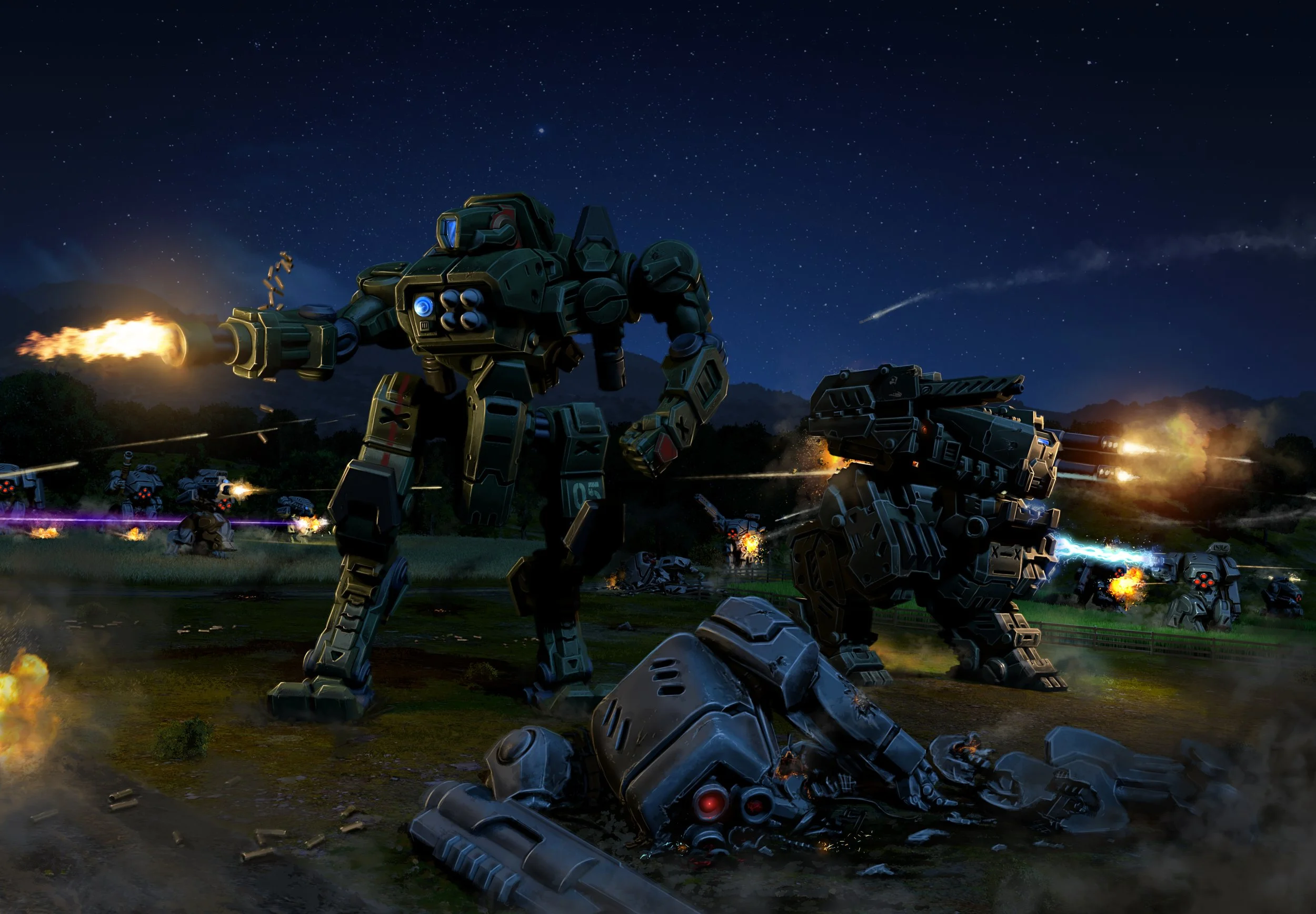
Illustration by Florian Mellies