
Plasma Blade
Echelon Group Headquarters
Military Products Division Administrative Complex
Mars
Overheard in Conference Hall B.
Good morning, everyone. Colleagues, associates, shareholders. I am Doctor Juurou Ryouichi, Echelon’s program manager for advanced warfare products. In light of recent contention, the board has bid me articulate why continued investment in our next-generation close-quarters HE-V weaponry is necessary to achieve our fiscal goals, and so here we are. If you could please take your seats...
Let us begin with the two most fundamental questions: why does this project exist, and why is the company, why are we, spending so much to see it brought to fruition.
The answer to the first question is, simply, that armored combat today is not what it once was. And I do not refer to the ancient age of sluggish ground vehicles as compared to the modern era of the nimble HE-V. Not 40 years ago, many direct conflicts were predominantly standoff engagements. Rail guns were the weapons of choice, and to a lesser extent lasers. But belligerents’ casus belli has changed, and so has the choosing of battlefields. The same belligerents of yesterday routinely fight in built-up urban and industrial areas, or else in terrain where such long sight lines don't exist.
Accordingly, among HE-V pilots, specifically those professionals skilled in the application of violence, tactical doctrine now emphasizes close range prowess. The expectation is that combat now primarily takes place inside three-hundred meters, and often much closer. Thus, the proliferation and adoption of purpose-designed and improvised melee implements should be no surprise to anyone with an IQ above room temperature.
In answer to the second question, the initial investment of billions of credits and the necessity of investing billions more is, purely, good business sense. Reducing the economic waste attendant with waging war has been determined a smart investment at the highest levels of the company.
Presently, HE-V armor and other defensive measures are closing the performance gap with ranged weapons. In the endless arms race, the defender is now gaining. All manner of direct and indirect ranged weapons face specialized armor types that greatly degrade their performance or defeat them outright. Even the smartest missile systems must now negotiate engagement spaces teeming with electronic countermeasures and point defense systems. By our metrics, the failure of guided weapon engagements, across all domains, approaches 45%. Those numbers are derived from our own capabilities measured against near peers as the benchmark, of course.
So. Despite their wondrous capabilities, the most advanced ranged weapons of today no longer guarantee overmatch, and no longer enjoy near-total reliability. But, as one of our veteran security personnel stated so succinctly, you cannot jam a knife. It is melee weapons, more than any other, that prove the great Dr. Martin Marcus’ wisdom: The more advanced the system, the more vulnerable it is to comparatively primitive attack.
Our plasma blade project surpasses every efficiency milestone that the logistics department has set, and overcomes tactical problems in a way that no other close-quarters weapon can. It does not require ammunition and the energy required to operate it is, practically, free, part of the attendant costs of operating the HE-V for any other purpose. Some in the audience should consider that chemical- and kinetic energy munitions budgets run in the millions to billions of credits annually. That is by type, mind you…
Just as important for high-risk operations in areas containing sensitive infrastructure or other valuable material, the collateral damage potential of a plasma blade is greatly lowered, but with no commensurate loss of lethality. This advantage assumes, though, that the engagement can be brought to a quick and profitable end. Fortunately, one strike, perhaps two, from a plasma blade has so far proven more than sufficient to disable or totally destroy any opposing HE-V or combat vehicle.
Now, for those of you who are not read-in on the project or were cleared for this dissertation only, I should explain what a plasma blade is. It is not a close range energy projector, or an oversized cutting torch. The plasma blade system is exactly what its name suggests, despite the complexity of its component groups. The heart of the system is the kinetic element, a physical blade, one made from our own proprietary alloy capable of withstanding the heat and physical stresses of its intended use.
The other element, the thermal element of the system, is the plasma field generator, an assemblage of subsystems that create, magnetically confine, and ultimately augment the physical cutting edge of the blade with plasma. Some of my colleagues have taken to calling this element the plasma jacket after consultations with Stabilization Team personnel issued prototypes for field trials, despite my efforts to correct the catchy misnomer.
Our success was only attained after years of repeated, demoralizing failures. In operation the physics of the weapon’s interaction with a target are easily explained. When energized, the plasma blade is forcefully applied to the enemy, be it an opposing HE-V, vehicle, or anything else, where the thermal component, upon contact, causes severe molecular degradation of all known armor and structural material through extreme heat and thermal shock. So weakened, the immediately trailing impact of the kinetic component will cleave through the affected material with great efficacy. Believe me, it was quite the engineering feat to make the system a reality.
A clean strike will effortlessly dismember the target or destroy its weapons. The practical and psychological impact on competitors’ assets and personnel cannot be overstated, as proven by measurably significant improvements in engagement success rates during recent field trials. Use of a plasma blade offers some certainty in close combat, a commodity most valuable to the company.
That said, the technical and operational hurdles yet to be overcome are momentous, and are the factors requiring additional investment of company resources. Power requirements are what some of you would expect, with startup loads on the order of 600 to 800 megawatts. This is necessary to ionize the hydrogen fuel and simultaneously establish magnetic containment for the resulting field. However, sustained operational needs are a far more manageable 300 to 400 megawatts. Enough energy to power a large settlement or small orbital platform continuously, yes, but fortunately modern and many legacy HE-V powerplants are more than capable of meeting these energy demands.
Maintenance regimens are similarly demanding, with various components of the magnetic containment system requiring servicing, recalibration or even total replacement after only a few hours of operation. Tactically, this deficiency can be overcome by activating the plasma jacket - ah, they’ve got me saying it - activating the field generator only when combat is imminent. Ruggedizing the weapon system is another obstacle, a design and manufacturing challenge that our engineers and scientists are eager to conquer.
The final obstacle is one that must be surmounted by experts of another craft. The use of a plasma blade in close combat should only be undertaken by skilled pilots, those with a proven track record of success. Despite their value proposition for the company, these weapons are too expensive to risk losing in the hands of careless brawlers. And even when carried by elite pilots, physical combat between two HE-Vs, I have been assured, is most unforgiving.
In closing, the plasma blade project is a data-driven response to an economic reality the company faces now, today. In this reality, pivotal battles that will determine our market share will be won by machines fighting at point-blank range. Thank you all for your time and attention. I will take your questions. Yes..?
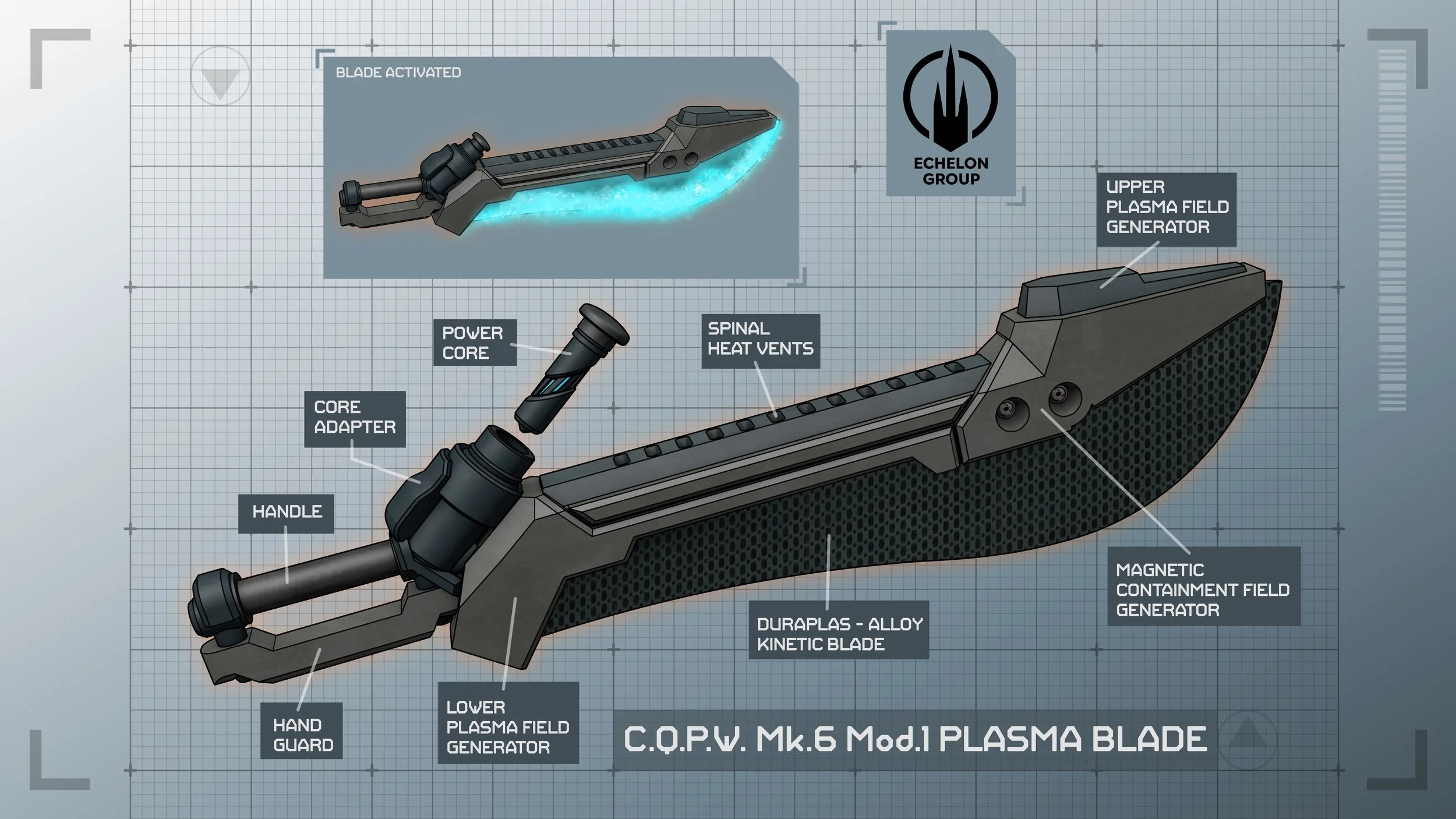
Illustration by Florian Mellies
