
TECHNICAL BRIEFING
For Stakeholder Distribution Only!
Subject: Testing Results - Battlefield Electromagnetic Accelerator System, Proprietary, Mk.1 Mod.0
Facility: Echelon Group Proving Grounds, Mars
Date of Test: <REDACTED>
Prepared By: Echelon Group Military Products Division, Technical Section
EXECUTIVE SUMMARY
This document summarizes the attached video documentation and empirical data collected from comprehensive testing of the Battlefield Electromagnetic Accelerator System, Proprietary, Mk.1 Mod.0; colloquially "rail gun." This summary includes three phases: static fixture performance testing, installation trials mounted to an Aegis-class HE-V, and live-fire scenario-based validation.
Testing has demonstrated excellent accuracy, exceptional armor penetration, and performance scaling potential across all domains.
Phase One: Static Fixture Performance Testing
Initial testing employed a reinforced test stand rated for weapon recoil forces. The video documentation begins with anti-static-suited Echelon Group technicians conducting final pre-fire checks of the weapon's accelerator rail assemblies and capacitor banks. The weapon system, including all component groups, measures approximately 3.65 meters (12 feet) in length removed from HE-V or vehicular mounting. The "bore" measures 51 mm. The subcaliber projectile is 28 mm.
Technicians verify alignment tolerances, inspect all installation packages, and retreat to the nearby hardened observation position. Thirteen cameras monitor the test range, covering all angles of operation and flightpath to the target. One high-speed camera is set to track the projectile in flight.
A synchronized timer appears on all feeds at T-minus 30 seconds to test fire. The capacitor charge sequence initiates. The rising hum of the weapon's power supply becomes audible. At T-minus 10 seconds muzzle flash baffles extend and set automatically. At T-0 seconds, the rail gun discharges. A brief, violet flash is visible at the muzzle.
The high-speed camera (recording at 30 million frames-per-second) captures the hypersonic shot package departing the barrel. The two halves of the sabot peel away, revealing the 8 kg hyperalloy projectile. At 20 meters from the muzzle, the projectile's velocity is 3,084 meters/second. The tracking camera follows the projectile downrange.
The test article set at 2,850 meters from the muzzle is a composite armor slab representative of current-generation HE-V plating supplemented with reactive armor packages. Thickness is <REDACTED>. Supplementary reactive armor is installed across the entire test article. The projectile impacts the test article within 3.1 centimeters of point of aim.
The strike causes catastrophic damage. Footage reveals the reactive armor detonating uselessly, unable to meaningfully deflect or degrade the projectile. The projectile punches cleanly through the test article, the entry hole neat and circular. It exits trailing a supersonic jet of molten armor material that ignites surrounding test fixture equipment.
The exit hole is a ragged crater measuring 84 centimeters in diameter. The backface of the test article shows significant spalling. Analysis shows complete integrity failure in test article extending an average of 1.91 meters in all directions from the point of impact. Terminal performance is subsequently assessed as lethal to any organic pilot and highly damaging to HE-V internal structure and systems.
The destroyed test article material displaced by the impact creates a debris field extending a considerable distance beyond the target. The recovered projectile shows minimal deformation after post-test assessment.
Phase Two: HE-V Installation Trials
The rail gun is now installed on its intended combat platform, an Aegis-class HE-V. The weapon occupies the right side torso hardpoint. Note: The weapon's custom fabricated mounting interfaces necessitate torso installation for the test. Production versions will be fully compatible with all existing arm and articulated hardpoints rated for recoil forces.
For this test, the rail gun has been fully integrated with the Aegis' standard OEM fire control, millimeter-wave radar, rangefinding suite, and ballistic forecast computation system. The HE-V's stabilization and recoil dampening systems are active.
The Aegis assumes a standing firing position at 3,400 meters from a test article identical to the one utilized in Phase One testing. The Aegis' pilot will fire the weapon when ready after the test commenced.
The first test fire of Phase Two begins. Telemetry records the capacitors completing charging in 4.2 seconds, fully four seconds faster than the Phase One test. This performance gain is achieved through optimized power delivery from the HE-V's onboard reactor.
Discharge occurs. The Aegis’ stabilizers easily compensate for the recoil. The projectile impacts at 6 centimeters from the designated point of aim, within acceptable deviation. Effect on target is functionally identical to the Phase One test.
Following inspection and manual reloading, a second test fire is conducted against a new test article: a decommissioned Fennec HE-V also positioned at 3,400 meters and facing the Aegis. The projectile impacts the torso at centerline, just above the lower glacis. The projectile penetrates the entire vehicle, including the reactor housing, before exiting the rear torso armor. Note: target's installed reactor assembly was not fueled for the test.
Terminal performance inspection reveals the entire pilot compartment, including internal armor enclosure, was perforated by secondary projectiles (spalling) and completely destroyed.
Phase Three: Live-Fire Scenario Validation
Phase Three testing employed autonomous combat drones and decommissioned HE-V hulls configured as hard targets to simulate a dynamic battlefield environment. The rail gun is now fitted to the right arm hardpoint for the test. The Aegis' pilot is instructed to engage 12 targets across varied terrain. The test was conducted at Test Site 04. See addendum 02-C for scenario terrain details.
Compiled footage shows the Aegis maneuvering, defending, and systematically destroying drone tanks at ranges from 500 to 3,000 meters. Engagements follow an identical pattern: the target is acquired, firing solution computed, a single shot is fired, and the target is neutralized. Engagements against HE-V targets show similar see and shoot efficacy.
An on-the-move, 1,300-meter engagement against two light HE-Vs performing evasive maneuvers is conducted with no misses. Results of Phase Three testing are 12 targets neutralized with 12 shots.
CONCLUSIONS
The Battlefield Electromagnetic Accelerator System, Proprietary, Mk.1 Mod.0 is emblematic of Echelon Group's dominance in the HE-V direct-fire weaponry category. The product exceeds all performance benchmarks by considerable margins when integrated with advanced HE-V fire control systems. Baseline capability renders current-generation defensive systems obsolete at all tested ranges.
Stakeholders are advised that full-scale production and deployment of this weapon will fundamentally alter outcomes in any conflict where it appears.
END
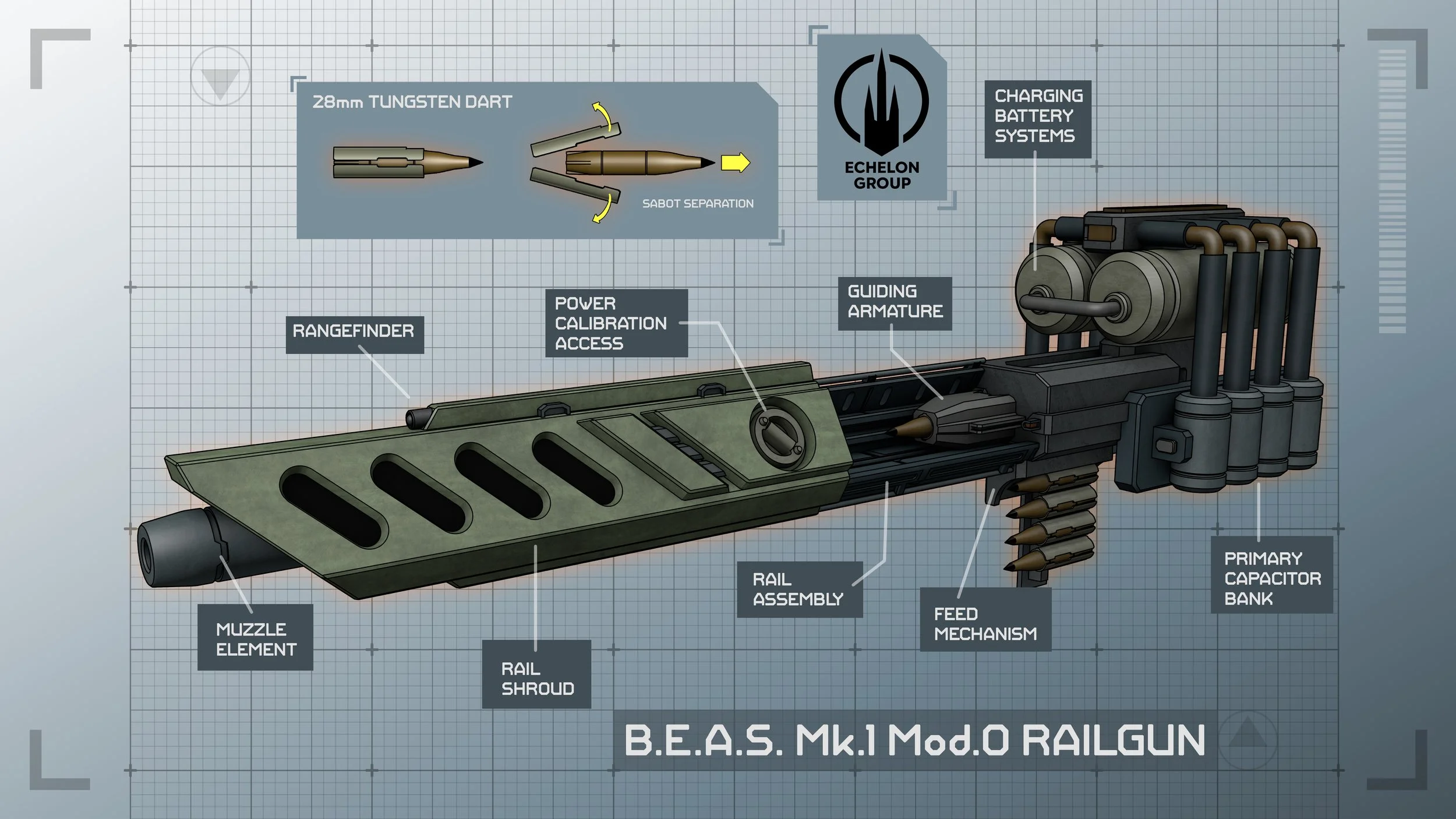
Illustration by Florian Mellies
