
HE-V Combat Blade
Load Transcript
Archive: Firepower Through the Ages - A WegMaCo Historical Series
Episode: 8 - "CLOSE QUARTERS: Combat Blades in the Mechanized Age"
Since the advent of gunpowder, mankind has strived to create weapons offering ever greater range. After the musket came the rifle, then the cannon. Missiles followed, then KKVs and lasers. The ability to destroy your enemies from a distance and prevent them from striking back has always been a fundamental tenet of warfare. And so the HE-Vs of today bristle with guns, missiles, and directed energy weapons more than capable of destroying any target at extreme range.
Why, then, would so many armored combatants revert to carrying giant blades? Why go close quarters, at arm’s length, with a similarly deadly foe? The answer may surprise you, and it is found in the ever-widening gap between the theory and the practice of modern combat.
Throughout the history of HE-V combat, battles have raged through the ruins of Earth's cities and cramped industrial installations, and descended into teeming jungles or maze-like tunnel networks. In these places, engagement distances between opposing HE-Vs may, incredibly, be measured in single-digit meters, even when armed with weapons that can reach out for kilometers.
Naturally, once warfare settled into these tight confines, it was only a matter of time until the fighting turned hand-to-mechanical hand. The decisive results of these early physical clashes made an immediate impression on pilots and generals: a few quick strikes from a sturdy implement wielded by a powerful war machine could disable opponents just as quickly as ranged weaponry. The idea spread quickly throughout military war colleges and corporate thinktanks, and what was originally desperate improvisation soon turned into established doctrine.
The genesis of combat blades as go-to weapons for HE-V pilots first began as a purely mundane tool and not, as is often asserted, any misplaced notion of martial honor or chivalry. Early adopters of military-grade HE-Vs quickly found that the powerful, versatile machines still needed more than their own manipulators to handle the full spectrum of field operations. A simple but strong cutting tool would serve to sever tangled power lines and cables, clear battlefield obstacles, hastily construct fortifications, and perform light demolition work. A correspondingly huge, reinforced blade was the obvious solution, and they proved far more intuitive, affordable and practical than any kind of specialized attachment.
The combat blades of today, though, look very different compared to their utilitarian predecessors. Most are manufactured as composite assemblies of molecularly-reinforced carbide alloys and other materials, optimized for incredible durability. Gone are the basic, almost crude rectangular and notched shapes of the historic utility tools; modern models are singularly designed for the rapid disassembly of tough, armored targets. Categorically they take many forms, from point-driven, tanto-style blades to stout, thick swords and broad wedges more akin to a cleaver or axe head. No matter their shape, all are heavy and sharp enough to cause significant damage with repeated blows, and durable enough to withstand deformation from the terrible stresses of the same.
Despite the brute simplicity of these HE-V weapons, proper design remains a critical consideration. Weight distribution is especially important, as poor balance impacts ease of handling, speed and power in a brawl. Similarly the configuration of the cutting edge will determine the method of employment and may better serve an individual pilot’s preferences or the physical configuration of their machine.
Beyond their obvious situational advantages, combat blades have always conferred other benefits to combatants and their host forces. They require no ammunition, a major boon in times of scarcity when every munition, every bullet and bomb, must be used judiciously. They also have simple maintenance requirements compared to the intricate machinery of all ranged weapons. Consider, too, that sophisticated countermeasures, effective point-defense systems, and specialized armor types have also rendered many ranged weapons less effective or even unreliable. And, most importantly to those right behind the sharp end, they work every time. There is no mechanism to jam, magazine to deplete or power cell to drain.
For insurgents, freedom fighters, militias, and cash-strapped contractors, combat blades have remained relevant by easing logistics concerns, a wise investment of often limited resources. For national militaries and corporate security forces, blades are still the best tool in the toolbox for specific close-quarters problems, and enabling effective asymmetric warfare tactics.
From the most desperate to the best equipped, combat blades have proven themselves a fundamental necessity for fighters through the ages, and in either case they are as useful today in the hands of HE-Vs as they were in the hands of our ancestors millennia ago.
This historical presentation has been brought to you by WegMaCo Media Studios; a division of WegMaCo, a family company.
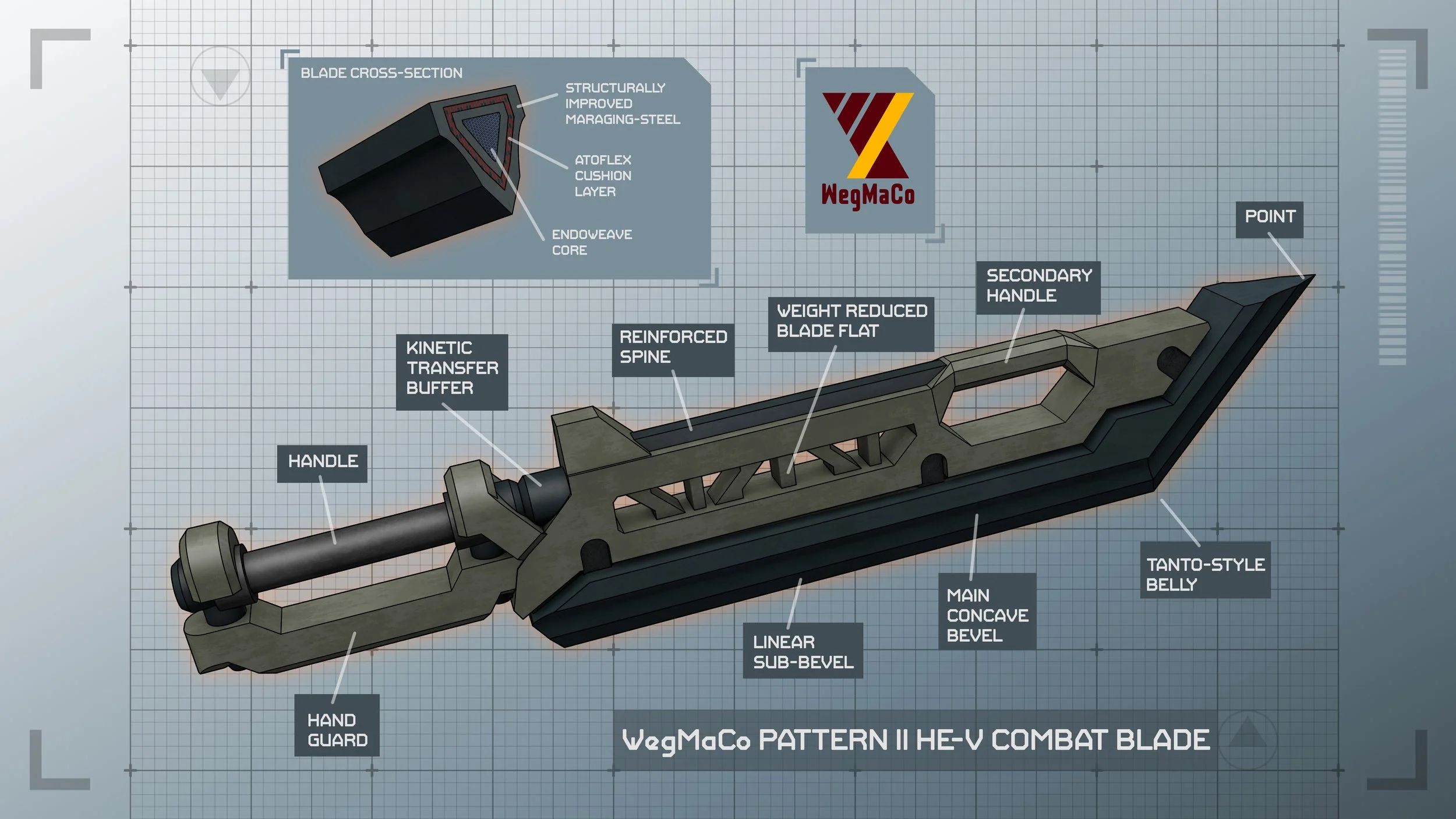
Illustration by Florian Mellies
