
Dedication
May 24th, 2383
Solar Republic Armed Forces Base “Honor”
Lima, Peru
The amphitheater-style briefing room, originally designed to seat hundreds, was currently occupied by only fourteen in the front rows. Thomas “Nacht” Johnson, listened to the struggling air handlers while his compatriots chatted quietly. One unit rattled quietly somewhere above, the stale air it pushed a bit too humid.
Even the little things were subject to corner cutting. Johnson sipped at his foul instant coffee, winced, and tried to project calm patience. His immediate superior was eleven minutes late to the briefing. Johnson was thirty-eight, a Solar Republic captain and HE-V pilot in the armor corps. He was a believer in the Republic’s ideals, in their long-standing vision of a united, prosperous mankind spreading in an orderly fashion throughout the solar system. He had enlisted at twenty-three and served with distinction ever since.
Next to him sat First Sergeant Justin Keller, callsign Relic. He had come by his handle honestly: at fifty-eight, he was the oldest member of the team, by far, and one of the oldest still serving fighting men in the Solar Republic Armed Forces. By rights, he should have been drummed out to non-combat duty, or even retired, but the state of things on Earth along with Johnson's constant lobbying kept him behind the sticks. Johnson increasingly questioned himself over allowing, much less encouraging, the old timer to keep plugging away.
Keller was something of a unit mascot, now, but still sharp and a living link to the before times. Not before the Rift, of course, but rather the time when the Solar Republic still waxed powerful and potent. Back then more organizations, especially the corporations, respected their singular authority. Privately Johnson regarded Keller as a mentor and something of a father figure. His actual father had been dead for more than a decade.
Keller was talking softly but animatedly, gesturing with his hands, explaining some intricacy of maneuver to Dixon and LaPlace, the two junior HEV pilots in the team. Junior was a relative term; both men were seasoned veterans but had been transferred to Johnson's command as replacements. One for a resignation, the other a death in combat. The pair listened to Keller with rapt attention, but Dixon's cocked eyebrow made him out as less sure of the lesson.
Johnson finished the dregs of the cheap, nasty coffee, immediately regretted it and heard the rapid clicking of boot heels in the long hallway outside the briefing room. They reached the door and it swung open forcefully. Major Eder entered and snapped as you were before half the butts in the room lifted from their seats. The formerly crisp and composed military man was a sorry sight in Johnson's estimation. He wore a near-permanent five o’clock shadow to complement the heavy, dark circles under his eyes. As bad as Johnson's schedule and duty tempo had been for the past twelve months, apparently the Major’s was far worse.
“Good morning, men.” The room responded with a chorus, likewise, echoing through the nearly vacant space. “I apologize for the delay. To business. We've got another interdiction op on deck.” He approached the podium with its built-in workstation, and the clicking of keys also echoed. A theater sized wall display lit up as the lights dimmed sympathetically. High resolution satellite and aerial photography appeared, a familiar tableau to the men in the room.
“As of 0430 Zulu yesterday, an independent, unregistered ship evaded the Republic picket measures, made planetfall and landed here. In Panama.” The Major’s voice was dog tired. Worse than tired, Johnson thought. Ragged. Worn out. A new picture appeared along with a topographical map, a red bullet glowing a little ways inland from the Pacific coast. The recon image showed a rough but functional light-duty spaceflight complex and accompanying airstrip. A modest blue and yellow civilian cargo lander sat in the middle of the tarmac’s expanse.
Eder continued. “Usual suspects, usual activity: Free traders from the outer system, and intel shows the outbound cargo is the typical black market buffet. Arms, medical supplies, a smattering of luxury goods and materials. We aren't sure right now what the ship delivered, but satellite imagery and flyovers indicate heavy cargo being unloaded.”
He continued, leaning on the podium as if delivering a eulogy. “You all know the drill. Go in, bust ‘em up, shut it down. Impound the ship and cargo, and detain everybody. If they resist, lethal force is authorized. Questions?”
Johnson led here, like always. “Enemy forces, and any fixed defenses, sir?”
Eder appeared exasperated even at this. He clicked over to another set of photographs with an accompanying chart. “Three HE-Vs. Two old tracked warhorses, one armed workrig, all variously equipped. There may be four, total. A second work rig that is as of now unaccounted for. Plenty of footsloggers, too, with small arms and light anti armor weapons. No visible anti-air, no emplacements. The local strongman has been doing well for himself, but we’ve tackled his sort before.”
The hell they hadn’t. Not this lean, Johnson thought to himself. He turned to glance at Keller who was already giving him a sharp, knowing look from beneath his snowy eyebrows. This was way too close to an even fight already, far from the three-to-one odds the Republic favored for gaining compliance with a minimum of loss or bloodshed. That didn’t even account for handling detainees.
“What's our force allocation for this op, sir?” Keller asked with false optimism.
“Just what you see, Top.” Murmuring from the men at that. Someone let out a low whistle. “One armor team, three infantry squads for the roundup and to secure the ship. Two Makos running escort for the transports.” A few rows back, by themselves, were Rob Lee and Eliar Hernandez, flyboys jockeying the swift attack craft. The other flight officers who were present flew the Orca infantry transport or the massive HE-V lander. Also present were a few senior technical personnel, and an infantry officer and noncoms.
Johnson and Keller shared another pointed look. This was, without question, the thinnest interdiction mission that either man had run. An infantry lieutenant asked, “Sir, what are the atmospherics looking like for the projected duration of the mission?”
“Emissions forecast is severe. Expect long range sensor interference, and short range comms may even be affected. Suits mandatory for dismounted operations. The good news is we can use this to our advantage, it will mask our approach to the AO.”
“Bring your sunblock, girls,” the infantryman quipped.
“This is going to be some kinda party,” Keller whispered, ruefully.
“Tactical plan, strategic considerations and maps should be on your pads now. I want departure no later than 1100 local. Element leaders, brief your subordinates accordingly. Prep your rigs, check your gear. If there are no other questions, you are dismissed. Good luck and godspeed, gentlemen.”
Major Eder wasn't waiting for questions regardless. He closed the briefing on the terminal, returning the wall screen to a giant Solar Republic Armed Forces emblem before turning, grabbing his briefcase and leaving in a rush.
—
The tall, cavernous hangar space was also mostly empty, like the rest of Honor Base, and its interior was half in shadows. The base complex once supported five task force elements of fifteen HE-Vs each; each element was three teams of four, one team of three, plus attached supporting forces, ground and air, per standard doctrine. Johnson presently commanded just five HE-Vs total, and his air assets were shared between his unit and another understrength element. The arc lights above the empty gantries were shut off.
Johnson took the noisy, metal stairs two at a time up the scaffolding surrounding his Mars, musing on the sorry state of the Solar Republic. The twilight years had already begun when he joined up, but he didn't know it at the time. Keller had said as much back then, but Johnson had brushed it off with the bravado and certainty inherent to youth.
Despite the shabby pageantry of permanence and dominance they still vainly projected, the Republic launched fewer and fewer interdictions in space or the skies over Earth. When they did, the results of such missions were no longer beyond question. More ships snuck through, more escaped, and more went unchallenged after runners increasingly pushed back. And no wonder: the warchest was empty. Personnel were jumping ship to private or national concerns. Signatories, friends and foes alike no longer respected Republic decrees.
The Solar Republic yet lived only because of tremendous inertia. A mountain inverted, and poised to fall.
Johnson reached the mid-deck, level with the machine’s cockpit and low-slug arm-mounted weapons pods. A technician was there carefully wiping down the domed transparent cover over the target designator in the top socket, situated just above the long barrel of the 90mm Rockwell autocannon that served as his primary weapon.
Johnson slipped past the man to complete his own visual pre-mission inspection, and quickly walked around the backside looking for leaks, signs of sabotage and the like. The same way he had hundreds of times before. He moved to the left arm and its railgun, leaning out to take hold of the ventilated shroud around the rails. He tugged several times forcefully; not even a wobble, all secure.
Another technician approached with a large, padded helmet bag in hand. The bulky helmet, its interior studded with non-invasive EEG sensors, would together with the physical controls help Johnson control and orient his HE-V. The visor would project a reactive HUD and other data, also. Johnson gave him an encouraging word, and he followed down the narrow catwalk stretching to the Mars’ cockpit, the transparent armored canopy already yawning open.
Captain Johnson stepped out onto the rim of the cockpit, gingerly avoiding the hazard-striped flat marked no step; a warning against the procession of explosive bolts. He gripped the overhead handhold on the canopy frame and stepped down and into the recessed space. He turned and took his helmet from the tech’s outstretched arms. Thomas settled into the heavy, padded seat behind the layered, raised instrument panels. He removed the helmet, socketed in the leads, and stowed the bag. The tech finished checking the seals lining the cockpit, stepped back and gave a crisp salute that Johnson returned. With that the tech turned and walked away.
Compared to other, more modern HE-Vs, the Mars was not top of the line. The 80-ton behemoth was comparatively simple and slow, but it boasted ruggedness and reliability in spades. He missed his Shepherd, but Johnson had grown to appreciate how secure the cockpit environment was while still affording a wide field of view. It was deeply set and low on the torso, near the machine’s chest, and recessed under a monumental cowl that afforded tremendous protection from overhead threats. Together with the chunky digitigrade legs, it lent the deadly heavy a stooped, awkward appearance, but it more than lived up to its god-of-war namesake.
Johnson donned his helmet, and ran through the remaining elements of his stand-up sequence. The techs had already lit the Mars' reactor. He clicked one switch and then held a short lever down to lower and secure the canopy, the servos a baritone whine. Before it could close, a klaxon in the hangar sounded three times, followed by loud, reverberating clangs. Dixon was stepping out slowly and carefully in his Scarab, heading for the staging area. The Mars' canopy shut with a clunk and a hiss of pressurization and the noise outside turned dull and thin, muted.
Sealed against the hot outside air, the cockpit smelled of metal, lubricant, ozone and old sweat. It was distinctly unpleasant and to Johnson strangely comforting; the aroma of familiarity. Johnson went on with the sequence. Hydraulic master standby light on, fluid level check okay. Backup battery and auxiliary power unit, okay. Boot fire control system, weapon system diagnostics - autocannon, railgun, submunition launcher, rocket rack - all in the green, rocket fusing system okay. Optics and sensor test done, good to go.
He reached forward with his left hand and flipped a succession of switches: spin up gyroscope, balancer activation, actuator tensioning system, reactor demand synchro and PTO. A succession of clangs, whirrs and a deep, rumbly hum sounded deep within the Mars; a titan, wakeful, one dreadful eye opening. Johnson buckled his five point harness and cinched the straps down tightly.
Another bank of switches and buttons: load compensation, surface interpretation, locomotion master controller, locomotion assistance - the last two would rouse the HE-Vs computer brain and subbrains that handled keeping the monstrous machine upright and going where Johnson intended. Four more; radar to standby, combat AI to standby, friendly datastream acceptance and protection.
Several displays lit up and blinked through a torrent of information as the Mars networked and completed handshaking with the other HE-Vs and assets in the unit, ready to share and respond to vital targeting data and telemetry in combat, and do so far faster than any human being could relay and act upon.
The last step. Johnson settled his feet on the pedals, took a firm grip on the left control stick and flipped a cover up to throw one more switch with his right hand, releasing the mechanical interlocks that allowed the HE-V to settle into a stable posture. There was a loud clang, a brief sensation of falling as the Mars sagged momentarily under its own immense weight before catching and standing up to its full height.
He thumbed a knob on the right stick and spoke into the helmet mic. “Gauntlet Team, this is Gauntlet Leader. Comms check and confirm datastream crosslink, over.” Keller was striding out of the hanger now in his Daiko.
“Reading you, Geist. Gauntlet-Two copies, datastream is okay,” Keller replied.
“Gauntlet-Four copies you, loud and clear, Lead. Crosslink is good to go, warheads ready for requests.” LaPlace in the missile-laden Corso, not out of his bay yet.
“Gauntlet-Three copies, data integrity is green, all systems okay. No problems.” Dixon.
“This is Archer, Gator-1, reading you five by five. Network looks good here, we’ll double-check underway before we put cleats on the ground.” That was Lee, the Mako’s LAS engines audible as a tinny howl over the airwaves.
“Comms check and crosslink confirmed. Let’s head ‘em out, Gauntlet,” Johnson replied. He pushed the left stick forward and nosed the Mars out into the hangar lane, watching his main display’s “chin” camera to follow the instructions of the spotter crew. In a few steps he was under the radiant Peruvian sun, and striding toward the waiting lander that would carry him and his unit on their mission.
—
Things had gone dicey fast. The flight to the area of operations was uneventful, but that ended when the colossal lander touched down in a pasture by the town, disgorging Gauntlet as the Makos circled overhead, ready to pounce on any threat. People fled from their work, others watched from rooftops beneath shady pergolas, radios in hand. Several pickup trucks had already sped away, dust flying, toward the illicit shipping terminal.
The Republic HE-Vs were only covered by a single Mako on station, Lee, Gator-One. Gator-Two had tailed the larger craft up protectively as it withdrew to join the Orca carrying their infantry in a holding pattern. Hostile HE-V signatures soon appeared on scopes, and the aircraft quickly confirmed four moving around the grounded runner ship and heading to block their approach. Dense vapor rolled from the belly of the ship; a sure sign of intention to take off and boost for orbit. Repeated hails announcing the Solar Republic’s presence, and demanding immediate compliance and surrender had been ignored.
A low earth-container wall surrounded the complex, but was no obstacle at all even to the lightest HE-V in Gauntlet. Johnson’s Mars, paced by Keller’s Daiko, plowed straight through it and the flimsy tilt-gate guardhouses barring the road, LaPlace and Dixon just behind. The runway stretched across the northern edge of a wide, reinforced landing grid. The southern and western edges of the landing grid were flanked by irregular stacks of deep space shipping containers, conex boxes and other cargo-moving paraphernalia. To the east a clutch of long, low warehouses, taller hangers and other structures. Surrounding the cleared space, verdant jungle greenery; trees, shrubs, tall grasses.
“Watch those stacks, Relic. Movement, watch it..!” Johnson snapped into the mic as his combat computer buzzed urgently about a possible threat.
“I’ve got it, Tom. Something, trying to lock it up,” Keller replied hastily, proper protocol slipping into familiarity.
“Gator-One, do you have visual on possible bully in the crate stacks to the west?” Johnson asked. Bully was code for a hostile contact on the ground.
“Negative, Lead. No vis.”
Across the runway, a tracked Falke dashed into Johnson’s view from behind an intervening building, stopping on a dime between the oncoming Mars and the grounded ship. It opened fire with paired rocket salvos and a long burst from a rotary cannon before he could react. Johnson winced as his view, and his HE-V, disappeared in a fireball. He pressed forward, emerging charred but mostly unscathed; the Mars’ reactive armor packages had triggered and blunted the worst of the rocket salvo, and the smaller gun’s armor piercing rounds had little hope against the thick hide of the heavy.
“Gauntlet Leader is engaged! Return fire, weapons free!” Insolent bastard, Johnson thought, blood running hot and payback on his mind. The sound of heavy ordnance erupted across the complex, friendly and otherwise, as Johnson twitched the right stick to drop his twin aiming reticles on the glowing target indicator bracketing the Falke’s center of mass. The compact machine surged forward toward cover a split-second too late, just as the automatic smoothbore gun on the Mars’ right arm fired.
Rockwell’s infamous auto-ninety enjoyed its reputation for a reason: A stream of armor-piercing high-explosive 90mm shells, three per second, bit great hunks from the Falke, mangling it beyond repair. They smashed through and blew away the left weapon pod, then split the left track bogey into a ruined mess. The pilot desperately tried to rotate in place and bring intact armor into the line of fire, but only managed a jerking start and stop that spat what remained of the left-side track sections through the building behind it.
Johnson leaned on the trigger, a stream of case heads like giant tacks tumbling from the gun to the pavement behind him, and the deadly autocannon gnawed all the way through the Falke’s torso section, which collapsed in flames and thick, black smoke. A few of his rounds went wide and punched through the flank of the grounded ship behind it. He advanced, toward the wreck, and saw, worryingly, smoke starting to pour from the fresh holes in the ship.
BREEP-BREEP. Missile alarm. Too late to react or evade. Johnson barely caught the missile as it swooped down, then felt the terrible, shuddering impact through his HE-V. Too close: it struck just above the cockpit, under the cowl. Damage indicators popped up on the panels. A bad hit; his cockpit seal was damaged.
The radio was alive with chatter now, the Solar Republic pilots calling out targets and instructions. “Ultralight! UL, UL, Husky in the containers, west side, Gator-One setting up for a strike!”
Undeterred, Johnson kicked the flaming ruins of the Falke aside to make way and halted. He turned, watching the nimble Mako up high bank hard, nose over and dive. A barrage of rockets, tight lances of fire, streaked down followed by a bright, jagged stream of tracers before he heard the ripping report of either.
“Kill is negative, might have splashed him. Evading!” Lee flew past overhead and sideslipped before banking away north, fast and low.
Johnson knew they had to get a handle on the situation and finish the fight. He assessed his tactical map and traversed left to the other side of the complex. “LaPlace, hold position. Dixon, you need to peel off east, come up and get a lock-”
Just then, Johnson saw a wide stack of cargo containers open. Unfolded, rather, on the long side. Not fall, they didn’t tumble; one whole side of a stack fell flat, like sheet metal. He didn’t quite understand what he was seeing at first. Inside the cleverly camouflaged position, standing two abreast, a pair of squat, chunky Huskies. Both hoisted and leveled dangerous handheld autocannons like oversized rifles, easily powerful enough to threaten larger HE-Vs. And the Mars was halted, flat-footed, an easy target.
Elephant guns! Terror seized Johnson, liquid nitrogen freezing his blood. A heartbeat later the Huskies opened up on full auto, advancing, launching two short range missiles each from shoulder racks. Rounds impacted all over and around the cockpit, the fat warheads accelerating on columns of smoke-
An explosion. Captain Thomas Johnson’s world shrank, compressed into a nucleus of incandescent agony. The searing heat of boiling oil and savage cold, the pain that erased language and thought and self. The kind that etched its name into the marrow of DNA. He bellowed, eyes bulging wide. Stinging, acrid smoke filled the cockpit. Blood was splashed everywhere, his blood. Over broken screens and rows of switches. Up his nose, the taste on his tongue. Instinctively he reacted, trying also to turn away from the danger. Left turn left stick left stick turn turn turn no - but his HE-V wouldn’t respond.
Through the shock, some horrified fragment of his lucid mind whispered a secret: His left arm was gone, reduced to so much pulped meat and bone. The hot, hot, shard of metal, steaming, still pinned him to the seat. Going quiet now, and lighter, somehow. Had to do something. Voices buzzed in his ear. Flies, shouting at him. The ugliness in front of him mercifully dropped away. Beyond the tarmac green treetops receded into pure, blue skies. Leaning back now, his weight lessening. Better. A rest.
The Mars lurched, off-balance, before it fell backwards out of control. It slammed into the pavement with sickening force, the impact sending cracks radiating out in all directions. Darkness rushed up to envelop Johnson, sweeping him away into oblivion.
Keller raced to protect his fallen commander and friend, urgently sending up a call for immediate reinforcements as the Huskies retreated, bounding away from their kill to join their companion in the maze of container stacks. Blood dripped and ran, pooling on the rear bulkhead of the cockpit. As Johnson’s life ebbed, the sun blazed mosaic patterns across his fluttering eyelids through the shattered canopy.
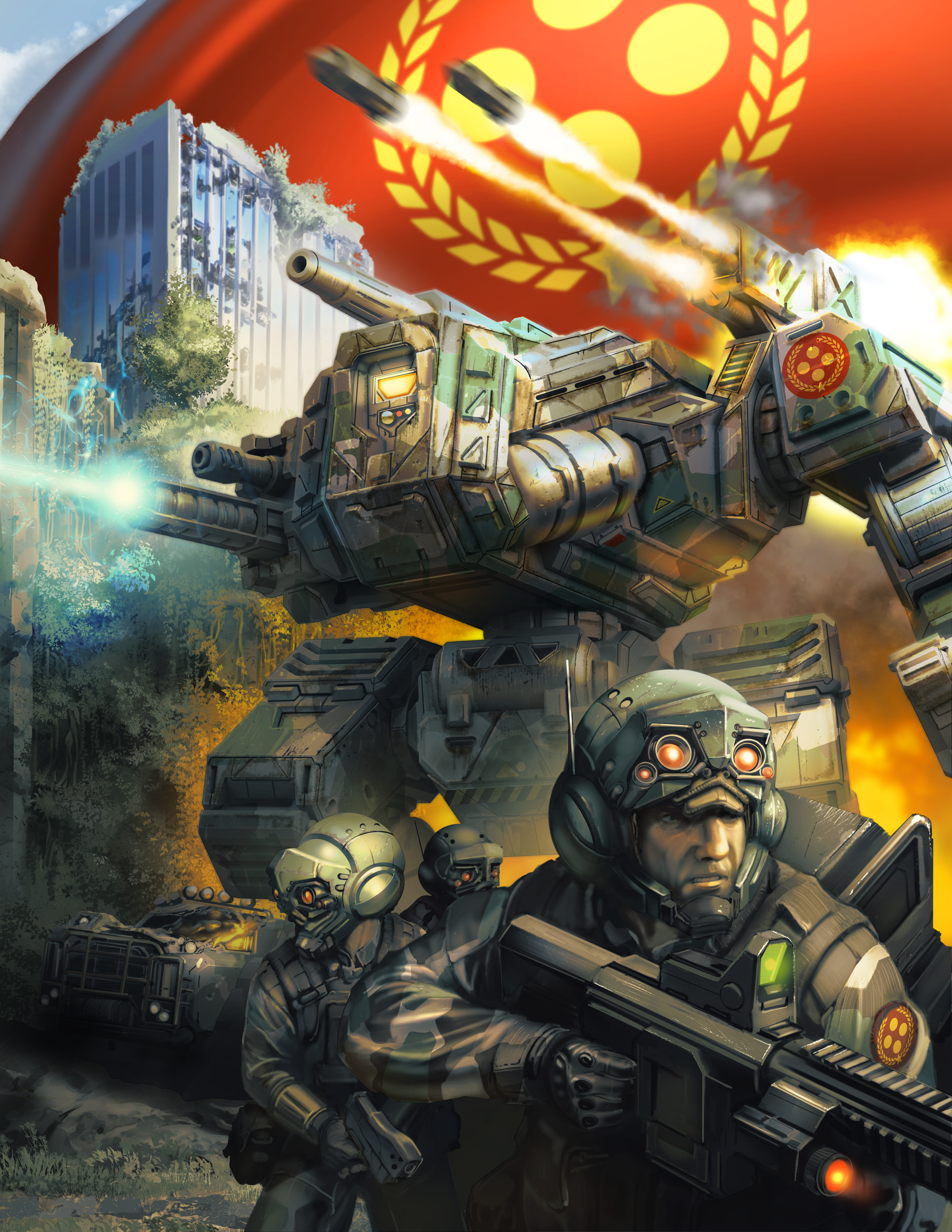
Illustration by Eldon Cowgur
