
MAGLM Missile
Solar Republic Armed Forces Archives
Armor Corps Training and Testing Center - ACTTEC
Munster, Germany
Lecture Segment: Advanced HE-V Weapon Systems - Missile Employment
Instructor: Commander Mike “Kicker” Hoxie
Date: <REDACTED>
Good afternoon, pilots. Resuming where we left off from yesterday. Decisioning. In the field, you’ll have aboard your HE-V you’ll have every resource needed to accomplish the mission at your disposal. Expending these resources wisely will win you the day. Squandering them will put the mission, and the Republic, in jeopardy. Choosing when and how to employ your weapons is chief among your responsibilities, and among all the weapon systems you can carry, the most versatile, powerful and expensive are your missiles.
You’re on the hook for every launch authorization. So pay attention. Let’s begin with a historical overview of guided missiles. They’ve been a staple of warfare for three centuries now, with the first combat-effective models emerging in the mid-20th century. Damned crude by our standards. Simple rocket motors, basic radar or infrared seekers, uni-charge warheads. Real fire-and-forget capability was the goal in the early years. For decades, high accuracy demanded constant input and correction from the launching platform; fighters, ships, so on.
Nearing the end of the 21st century, guidance and maneuverability was much improved. Hybridized navigation systems. AEG-fueled motors, fulltime datalinks. High resolution seekers that could differentiate subtle nuances in target profiles. We see here, too, the first multi-mode attack profiles. In the mid 22nd century, the state of play changed again. Composite fire control systems paved the way to superior pre-launch routing, and most state-of-the-art missiles around here first employed multiple coprocessors for true onboard intelligence.
Still pretty dim compared to the ones you’ve got, but they were the first decision-maker missiles that would proactively counter evasive maneuvers or other target defenses. This capability was enhanced further by the use of improved bi-pro fuels and pulse-detonation motors; throttlable, restartable, and programmed to burn or conserve as needed to ensure a kill. These birds were sophisticated enough to select their own attack vectors and coordinate with other, compatible missiles in flight.
The end of that era marked the beginning of the brilliant missile age, our time. Modern missiles, the ones you'll be launching and defending against, are vastly superior by an order of magnitude to anything any army has deployed prior. The current model MAGLM you’ll field uses a seeker package combining radar, laser imaging, infrared, and visual profile recognition, with all modes capable of crosscheck across a friendly battlenet. That means that if one, or even all, scan and track modes are nullified, the missile will still figure out how to reacquire the target as long as it can communicate with another node on its network, be that a friendly missile, the launch vehicle, a forward observer… You get the idea.
The MAGLM’s warhead is optimized for armored vehicles and structures, but will auto-select for soft targets or limited area saturation as needed. No man-in-the-loop needed, but you can override as required. Direct, top, offset or loitering attack decisions are likewise made by the missile’s brain. When you receive the launch auth request, all you have to do is pull the trigger and so long. Right? Isn’t that nice..?
Wrong! Big time. These munitions are, without question, the most sophisticated guided weapon system ever devised but they pale next to the ultimate weapon: you. Working together, your HE-V, the missile, and the battlenet will solve for all aspects of the tactical equation: where is the missile going, what is it targeting, when does it need to get there and how to deconflict or coordinate. But it is up to you to assess whether the launch is prudent. Only you can factor in the intangibles: the tempo of the fight, the strategic situation, the cost-benefit.
Oh yeah, you heard me. Listen very carefully. Missiles are expensive. Every single missile matters, and you are accountable for every one. War is, has always been, about logistics. Remind yourself of that. Your commanding officer isn't going to pin a medal on you when you waste three brilliant missiles on a convoy of trucks you could've smoked with your guns for a fraction of the cost. Your company quartermaster may well strangle you.
Your HE-V’s AI combat controller will always look for ways to do the most damage as quickly and as surely as possible. You’ll get lots of launch requests, just like a needy girlfriend. Can we go here? Here? How about here? Here sounds good! Rookie pilots will always try to make her happy, authorizing every launch request the second it pops up on the HUD. Launch, launch, launch, treating missiles like common bullets. Tsk. Don’t laugh, I know who you are; I’ve seen your simulator logs. You won’t last if you don’t break that habit. You’ll be relieved for negligence or wind up dead.
Your missiles must be shepherded, saved for when precision, standoff, or overwhelming firepower is required to crack a hard or dangerous target. Usually that’s another HE-V. From a tonnage-to-versatility perspective, missiles are unmatched. Use them to do the things your other weapons cannot achieve. Use them as personal fire support. Or team fire support. By all means, loose a bird to save a friend in need. It’s far simpler to launch on an immediate request and maintain focus on your own engagement, rather than attempt a breakaway to reach a teammate.
Now, they are not foolproof. We, and the few militaries that can rival the Solar Republic’s, fit HE-Vs and many vehicles with defenses designed to defeat them. You must endeavor to understand these systems to both employ missiles effectively and protect yourself from them.
First and most common: submunitions. Typically shoulder- or turret-mounted, they fire airbursting bomblets that make clouds of fragments or flechettes. You ever hunted birds, or shot clays? Same thing. Think of it as a shotgun blast in three dimensions. Targeted missiles are damaged, or more rarely, destroyed. Usually seekers get blinded, or propulsion or steering ends up compromised. The missile then goes off-track or is forced to detonate prematurely.
The other major countermeasure is proper anti-missile systems. Point defenses, PDWS, CIWS. These are automated turrets, usually superposed volley guns or small pulsed lasers, that engage incoming ordnance when it reaches the terminal phase. Invariably they are set to full automatic operation and are commanded by an HE-Vs combat controller. That’s the only way they can engage quickly enough. Acquisition and tracking happens in fractions of a second, and a good PD suite can intercept multiple threats, but only high-angle ones.
You must factor all of this and more when deciding to engage. Here’s the takeaway, gentlemen: Out there, in the field, you won't have me and your other instructors watching when the request pops up. You'll have to make the call, launch or abstain, and there’s always more to consider than just destroying any given target. Think carefully, but quickly.
That’s enough for today. You are dismissed.
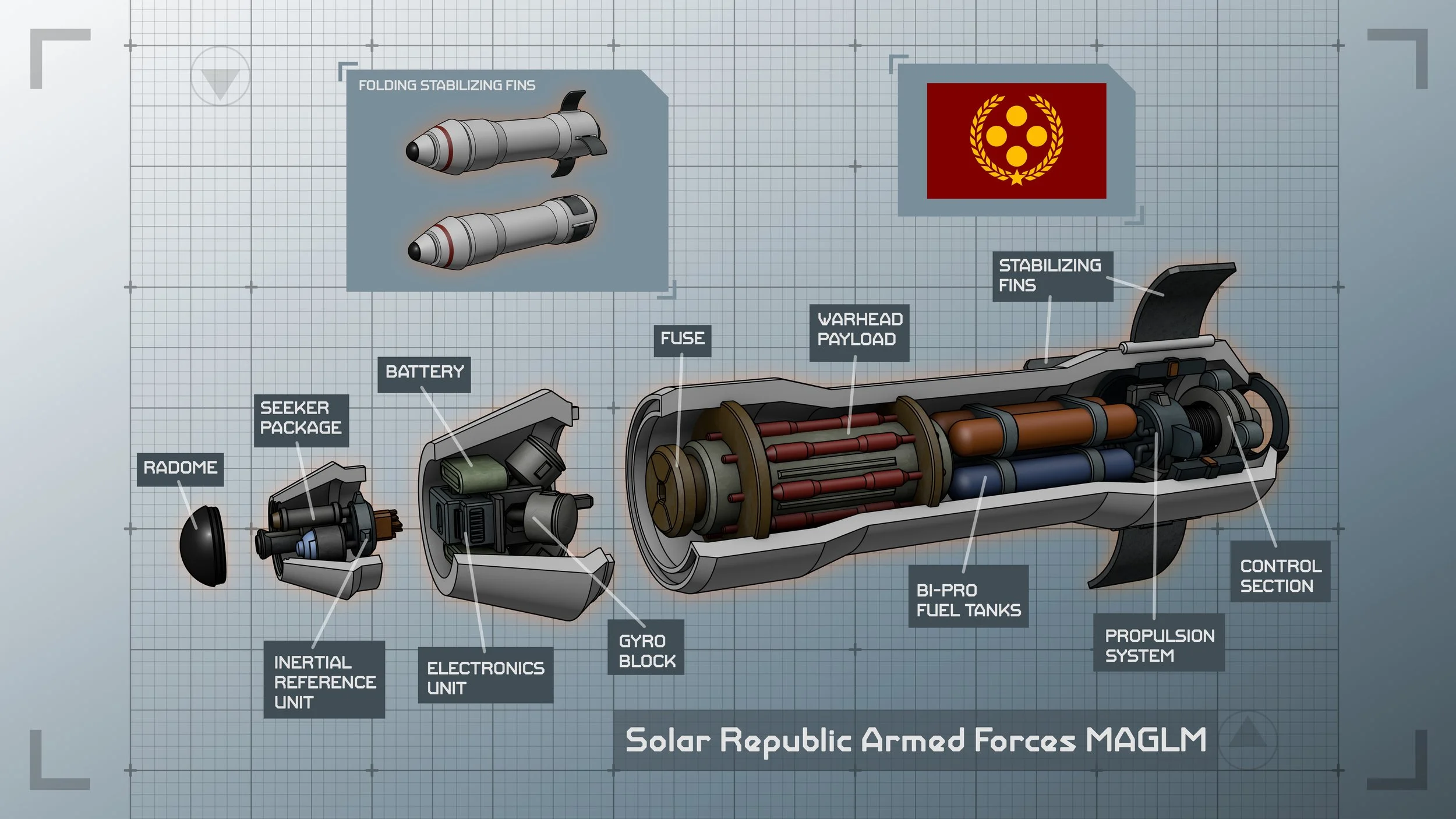
Illustration by Florian Mellies
