
Laser: WegMaCo Model 34-2020
Load Transcript
Archive: Firepower Through the Ages - A WegMaCo Historical Series
Episode: 19 - "CUTTING EDGE: The Rise of Laser Weaponry"
In the pantheon of humanity's directed energy weapons, none have captured the imagination like the laser. For generations, truly powerful lasers were relegated to the realm of science fiction, or else industrial curiosities. The notion of bringing lasers to the battlefield, always so tantalizing, proved frustratingly impractical for actual, head-to-head combat. However, the status quo changed in a millisecond upon the perfection of portable fusion power systems circa <REDACTED>. In a flash, offensive lasers became a deadly reality.
Far from an enthusiastic milestone, initial testing proved the allure of laser weaponry as nothing short of intoxicating to generals and soldiers alike: unrivaled precision, impressive range, and functionally instantaneous time-of-flight to target. If the target could be seen, it could be struck and often before they could even register a threat was present. A laser beam, unlike missiles and even shells, left zero time to react.
Engagement was now achievable at, quite literally, the speed of light. Early laser adopters enjoyed a period of near-total battlespace domination across all spectrums. This paradigm shift, and the resulting arms race, consumed the defense and R&D budgets of every major Earth military and corporate power for decades. Lasers were used in every role, from direct engagement of ground, sea, air and space targets, to employment as persistent and efficient counter-missile arrays.
The focused beam of a laser instantly melts then vaporizes metallic armor in microseconds, with the resulting thermal shockfront creating a jet of superheated material that bores into and through the target, causing further damage. Traditional reactive armor systems offer no protection whatsoever against a laser attack. Lasers are also especially effective against optical sensors and other sophisticated electronic equipment. Delicate optics and electronics can be rendered blind or hopelessly ruined by even the most passing contact.
These effects are impressive enough, but the worst is still in store for the unlucky target. Once the beam breaches the target’s hull, unarmored structural members and other components are rapidly degraded or destroyed: Hydraulic systems rupture and fluids ignite, ammunition cooks off, and delicate electronic components slag under intense heat. For crew members, the consequences of a laser strike are brutal. Should the beam pierce an occupied space, or penetrate a non-compartmented vehicle, the typical result is near-instant death as superheated metal vapor floods the interior. It goes without saying that should a laser directly hit a human being, such as a foot soldier, the outcome is nightmarish.
The effectiveness of lasers was, and is, undeniable but the early, frenzied adoption and proliferation of the technology soon revealed intractable operational hurdles. Potent lasers capable of defeating armor had always demanded extraordinary amounts of power; that problem was handily solved by sophisticated microfusion powerplants, but they were still strained to their limits, effectively imposing a governor on maximum beam duration and rate of fire. Furthermore, the waste heat generated by even the most efficient battlefield lasers was and remains immense. The necessity of intricate thermal management systems increased weight and complexity, and greatly increased fragility.
Ultimately, the sum of these drawbacks meant that sustained fire proved impossible for all laser classes intended for HE-V, tank or aerial installation. To sidestep the issues, engineers configured “portable” class laser weapons to fire in short, intense activations or strobe their beams via rapidly charged and discharged capacitors. This solution allowed a modest rate of fire, but the end result was that, for all their penetrating power, lasers simply could not match the raw destructive force of more traditional options like autocannons and missiles.
The great Golden Age laser arms race chilled substantially once all interested parties determined that these limitations were simply part and parcel of the weapon system, categorically. Further drawdown on lasers occurred as countermeasures evolved: Ablative armor coatings, specialty ceramic plating, and foamed carbon-titanium internal baffling all proved effective at degrading laser performance and improving survivability.
Lasers still remained a primary HE-V weapon for over a century, but eventually the technology settled into a particular role, just one battlefield tool among many. It wasn’t until the aftermath of the Rift that lasers faced an existential crisis. The expertise needed to craft such weapons along with their intricate construction, demanding maintenance regimes, and overall fragility made them too difficult a proposition for many belligerents. Many vintage lasers, each a marvel of artifice, were abandoned outright or else cannibalized for parts.
Lately, the sudden resurgence of laser weaponry comes from an altogether likely source: corporations! Considering that ammunition shortages and logistical concerns are just as likely to sway conflict outcomes as any tactical failure, weapons that can ease such burdens once more command a premium. Some corporations, like Tri-Tac SpA, quickly leveraged their intact manufacturing infrastructure and institutional expertise to craft new laser weapons optimized for modern combined arms warfare, like their acclaimed and deadly Sapphire Series.
Other companies took an innovative approach with their laser products; WegMaCo’s Energetic Products Division broke new ground with their two-time award-winning Model 34-2020 by exchanging raw power for dramatically improved ease of maintenance, user-friendliness and reliability. WegMaCo’s very own employee, Security Guard David Thomlin, has voluntarily equipped the 34-2020 on his HE-V for years:
Oh, yeah, the Tri-Tac one? I've run one of those beamers. Heh. It’s an absolute monster- uh, when it works! But let me tell ya, this WegMaCo model, it’s reliable. You fire, you hit, you just keep on firing. It won’t core out an ultraheavy at a klick in one shot, sure, but you won’t spend half a week in the bay waiting on a tune-up, either. That's a good trade, I'll take that deal! WegMaCo allll the way for me.
What an endorsement! But despite how advanced the lasers of today are, their true value is largely unchanged: their ability to effortlessly engage targets at extreme range with pinpoint accuracy and zero time to impact. Lasers are still the weapon of choice for surgical strikes against high-value targets or against foes that lack access to specialized laser defenses even if they are not, and likely never will be, the universal battlefield solution that the early dreamers imagined.
Nonetheless, the king of directed energy weapons endures as the exemplar of human ingenuity in mankind’s endless quest for the perfect implement of war.
This historical presentation has been brought to you by WegMaCo Media Studios; a division of WegMaCo, a family company.
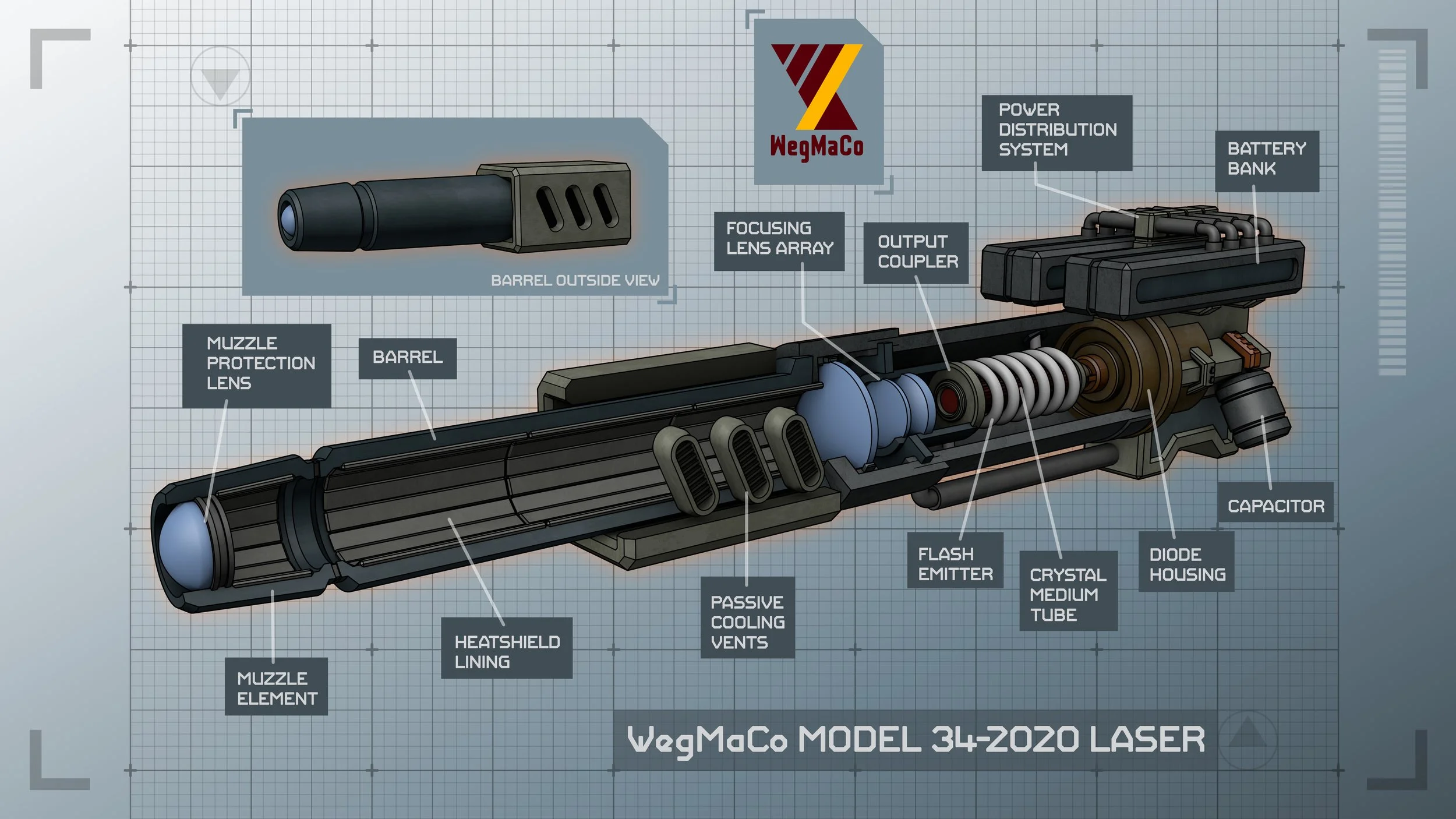
Illustration by Florian Mellies
